A documentary about the great mass of contradictions that is Eurovision was always going to be a winner. But lob in an Icelandic grenade in the form of the BDSM-wearing anti-capitalist band Hatari who sing of hate, debauchery and the purposelessness of life, and you’ve got gold dust. A Song Called Hate director Anna Hildur talks to Business Doc Europe.
“It was a journey into the unknown, even if you have some very known facts in front of you,” says UK-based director Anna Hildur of the Eurovision odyssey to Tel Aviv that she undertook with Icelandic band Hatari in 2018.
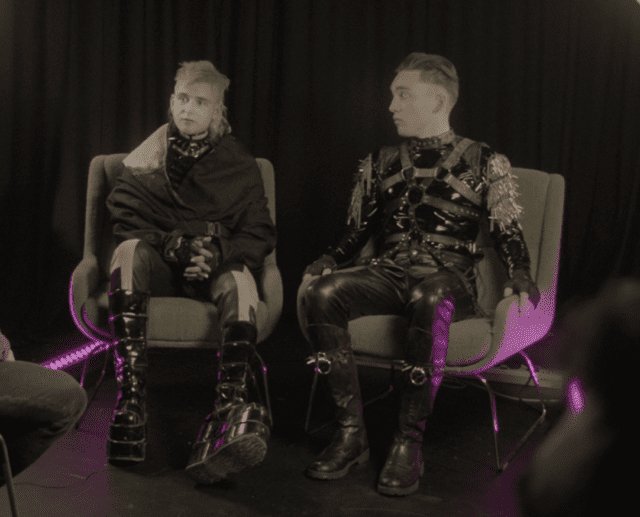
Cousins Matthías and Klemens are exotic, intellectual, hermaphrodite, thoughtful and articulate in equal measure. They are also highly politicised and wield irony like a sword.
In 2018 they entered the Icelandic preliminaries for Eurovision with a song called ‘Hate Will Prevail’, performed with bile and anger, and in costumes of leather and spikes. Few people thought it would stand a chance, but it won. At which the point both a challenge and a dilemma presented itself.
As fellow band member Einar comments in the film: “As an anti-capitalistic band that participates in a capitalistic environment…we felt Eurovision was a very interesting path.”
But there were many who objected to the band’s participation, such as the pro-Palestinian BDS (Boycott, Divestment, Sanctions) organisation, as well as many at home in Iceland. We are told that Iceland is one of a mere handful of international countries that officially recognises the state of Palestine within the 1967 Israeli borders.
Nevertheless the band set off, but when they arrive in Israel they don’t take the proscribed path of press junkets, canapés and high life. Instead they drive to the likes of Hebron and Ramallah to witness at first hand the settlement areas and the shocking division within the country, which forces Matthías to use the outlawed A-word: apartheid. And they begin to collaborate with local Palestinian artists and activists.
At which point, their presence in Israel begins to make serious waves, which the powers that be at Eurovision don’t like one little bit, threatening them with expulsion from the contest. But the band presses on and begin to make plans for a final outrage during the live global event…
“What captured my attention was the bold move from a little known grassroot band in Iceland wanting to take on the big mainstream TV show that Eurovision is,” comments director Hildur (shortened from the full-length 17-letter Hildibrandsdóttir). “It was a joke, like a lot of their stunts in Iceland had been, but this was a joke that went too far and became a reality. After that it became an interesting and exciting journey to see their determination to get their message heard in mainstream media. And to see the art of making a stand and getting it known to the world.”
“But they are clever and intellectual, but also emotionally intellectual, which I found fascinating as well,’ she adds.
There is one point in the film when Matthías answers a press question at great length, in English, with mind-bogglingly enviable levels of articulacy, clarity and complexity. “They were very aware of what they were doing, how they could manipulate the press and at the same time they were aware of how their friends and fellow artists were in difficult situations, making decisions on where the collaboration could lead to, and how it could be executed. They are those kind of characters with whom you can’t go wrong. They are both gems in the way they articulate themselves and also how super creative they are.”
There’s something about Iceland as well in all of this. In most other European countries, the oddball antics of their Eurovision contestants would be ignored, met with derision or would simply go unreported. But the economy of scale in a country like Iceland, which has a population of a mere 356,000 and who are fiercely passionate about their Eurovision, determined that they made a huge and indelible mark.
First the kids got it, and then their parents, and then their grandparents, with the result that on the big day, leathers and spikes and heavy make-up were de rigeur across the island. Hatari fever even reached the office of Icelandic Prime Minister Katrín Jakobsdóttir, who makes a telling contribution to the film. No stranger to pop, Jakobsdóttir starred in the video of Icelandic band Bang Gang’s ‘Listen Baby’ in 1996.
“And she is a huge fan of Eurovision as well, which is why we had the idea of getting her to speak in the film. It was a good point that she made, that when Iceland takes something on, they tackle it all the way,” says Hildur.
“She is in that group of well-respected female leaders who lead with insight and who listen, and they are not too forceful and they represent something that is generally perceived to be good for the maturity of people. She has a good sense of humour and doesn’t take herself too seriously. And she can dance too,” Hildur concludes.
Copenhagen-based LevelK is handling sales on the film.