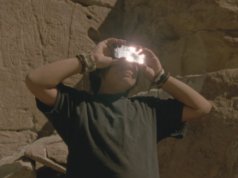
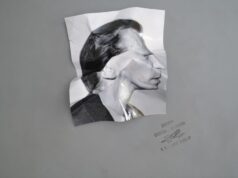
“Mika Myllylä was a national icon and Olympic hero whose fall from grace shook Finland,” Finnish producer producer Pasi Hakkio (Wacky Tie Films) tells BDE of his Nordisk Panorama/Finnish Film Affair WIP. “Through all of this Mika filmed his family with his home video camera. Through Mika’s personal point of view, a deeply personal story of a public hero behind headlines unfolds — a story of love, pressure, shame, and the cost of greatness.”
Directed by Sean Ricks, Jussi Sandhu and Ville Hakonen, the majority of the feature doc Myllylä is filmed by Mika himself during the years in which he became one of Finland’s greatest sporting heroes, and one the greatest skiers of his era. But when he was caught in a 2001 doping scandal, he began to lose control of his life.
“He films his children, his wife, bath time, Christmas mornings, jokes, illness, exhaustion, ordinary afternoons,” says Hakkio of his complex subject. “The public archive shows the national icon. Mika’s own camera shows the man inside the family who tries to be, at the same time, the world´s best father and best skier.”
“[Mika’s camera] is unstable, intimate and imperfect. The autofocus searches. Someone walks too close to the lens. A child takes the camera. Nothing important happens for thirty seconds – and those thirty seconds may become more important to us than an Olympic medal,” the producer describes what we see in the documentary. “We want to preserve that quality rather than polish it away. The home-video camera becomes almost another character in the film. Mika is usually behind it, so we experience the family through his attention: what he chooses to look at, what he finds funny, what he wants to preserve. Later, those same images become memories for his children.”
“For audiences who know Mika, this offers a perspective they have never had before,” the Finnish producer further stresses. “For audiences who have never heard of him, the film does not require an interest in skiing. At its core it is about ambition, shame, addiction, parenthood, self-worth and the things families pass from one generation to the next.”
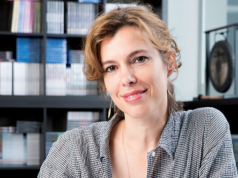
The main director of the film is Sean Ricks, whose debut film this is. Ricks has worked for almost two decades in journalism, for many years hosting one of Finland’s major, award-winning, current-affairs programmes, while also working on multiple short-form documentaries.
“Sean spent a long time building a relationship with Mika’s family before they opened their archive,” says Hakkio. “The film would not exist without that trust. His approach is not investigative in the conventional sense of trying to expose Mika; it is investigative in a more human sense – staying with contradictions long enough for something more complicated than a verdict to emerge.”
Co-directors Jussi Sandhu and Ville Hakonen both have a background as editors and Ville also as a cinematographer. “More than about co-directing, the co-operation of these three people is to create this film together,” Hakkio underlines to BDE. “Sean protects the human and thematic spine of the film; Jussi and Ville are particularly strong at finding cinematic form, rhythm and associations inside a huge amount of archive.”
The producer points out the strengths both of the story and the production, as well as his company’s ability to deliver it.
“The strength of the story is the contradiction at its centre. Mika’s greatest gift was his ability to endure. In elite skiing nobody can ski fifty kilometres for you. He built himself into a world champion by pushing further than almost anyone else,” he says. “But life outside the tracks demands something different. The film gradually asks what happens when the strategy that makes you a champion becomes the only way you know how to survive pain.”
“By the end, Mika’s children offer another definition of strength: stop, speak, ask for help, break the chain. This makes the film much larger than a Finnish skiing story. It’s a deeply personal but universal story,” he adds.
“Wacky Tie Films also has established international experience, and the project has been developed from the beginning with the international audience [in mind],” Hakkio continues. “From the beginning it has been clear that the film has huge potential in cinemas in Finland, Norway, Sweden and other winter Olympic countries, but the human story will travel further. After all Mika wanted that he ‘will remembered as a little boy, who skies, falls and wins.’”
Director Ricks articulates his reasons for making a film that is personal on many levels.
“I grew up with Mika Myllylä as one of my heroes, although I have never really cared about skiing. What I recognised in him was something else: an outsider trying very hard to prove that he belonged. Just like myself,” he says. “When the doping scandal happened, I did what much of Finland did. I turned away from him.”
“Years later, after becoming a father myself, I started thinking about that reaction differently. We had loved Mika for being almost superhuman, and when he failed in a very human way, many of us no longer wanted him,” Ricks continues. “When his family eventually trusted us with the tapes Mika had filmed himself, the film changed completely for me. I began to see a man who was almost desperately trying to preserve ordinary life around him. His children growing. His wife laughing. His family simply being together.”
“The film is not an attempt to excuse Mika or absolve him. I am interested in something harder: whether we can look at a person completely – at the love, the damage, the choices and the contradictions – without reducing him to either hero or disgrace. And increasingly, the film belongs to his children as much as it belongs to him.’”
“Mika spent much of his life responding to pain by pushing harder. His children have had to learn something different: to speak, to ask for help and to face what happened,” Ricks signs off. “Perhaps that is ultimately what the film is about.”