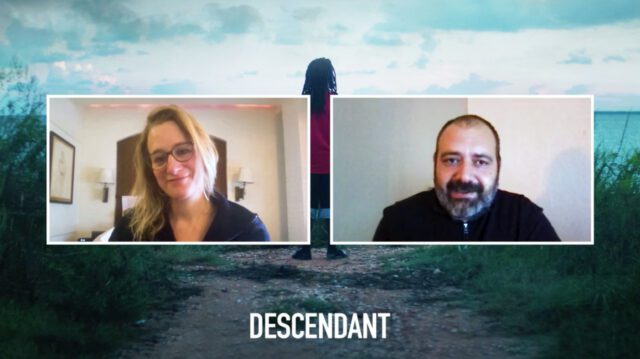
IDFA Creative Director Orwa Nyrabia sat down to discuss the Oscar short-listed Descendant with director Margaret Brown. The film tells the story of Africatown in Alabama, and the descendants of the last known enslaved Africans who were brought to the United States aboard the ship The Clotilda.
Descendant picks up on Brown’s earlier documentary, The Order Of Myths (2008), about two Mardi Gras Queens from Mobile, one Black and one white who both had connections to The Clotilda. Mobile has two Mardi Gras associations, separated racially. The white Queen was Helen Meaher, a direct descendant of Timothy Meaher, the man who had brought The Clotida to the US. The Black Queen, Stephanie Lucas, was descended from one of the slaves on the ship.
Early in the Descendant discussion Nyrabia expressed his admiration for the film and for Brown’s persistence in making films about her hometown and the legacy of racism that remains. “There’s something here that is a paradox that I really respect a lot, or appreciate a lot, in your work because, at the same time, you are not a descendant. You are looking from outside at the experience of the descendants and their struggle and their dream of first finding the ship. So what can you tell me about your motivation? I think this is not about guilt, but is it?”
“Growing up, I came from this really complicated place and I sort of hated it and loved it and I was always curious about it,” she responded, adding of her sense of curiosity, “how can there be people in my family that I love but who are also racist? And that’s a paradox to me. Like, how can these two things exist at the same time? How do I reckon with that? How do I make art about that? How do I explore that? And I think there’s something there at the root of all my work. I’m not sure it’s guilt either, but it is like a deep obsession with the paradox of really being from America, if you want. I mean, slavery is in America, it’s not just the South.”
“The Clotilda was in my hometown,” Brown continues. “The story was there to be discovered because I had connections there. And again, I thought I had a connection to the Meaher family when it came to a question around justice or reparations. They weren’t willing to speak. They were willing to speak when it was about Mardi Gras, but they were not willing to speak when it was about what happened 160 years ago, the results of which we’re still dealing with today and we still see so alive in this community I’m from.”
“So yeah, I’ve always thought you can’t throw a rock in Mobile without hitting a story,” she adds. “It’s just so rich. I was always taking photographs growing up. I was just obsessed with it. But I also, you know, wanted to get as far away as I could when I was younger. Cause I felt very stifled by it. But as I’ve gotten older, I’ve just kept coming back and back to explore the paradoxes of where I’m from.
Click here for the whole conversation between Orwa Nyrabia and Margaret Brown.