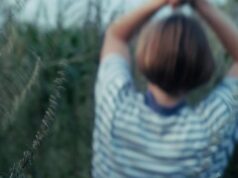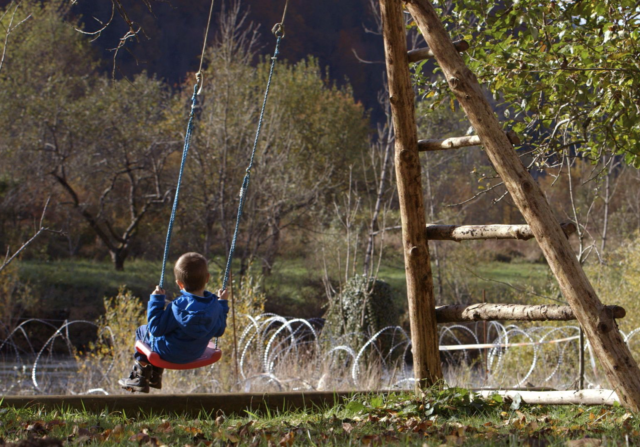
The troubled coming together of borders and migrants is brought into sharp and fascinating focus in Tiha Gudac’s engrossing and at times gently provocative documentary The Wire which heads to the edge of Eastern Europe to detail the impact a steel fence with razor wire has had on the beautiful Kupa region and the River Kupa itself which acts as a border between Slovenia and Croatia.
Part of Off World’s Borderline series, the opening credits also act as both geography and history lessons as the graphics detail the relationship between the countries, their position in EU trading dynamics and how the River Kupa – which belongs to both countries – has an imaginary border in the middle of its flowing waters.
Slovenia is dubbed the gateway to free Europe, but it has also become an entry point for migrants travelling via Bosnia to try and enter this halcyon notion of ‘free Europe’, which has led to Slovenian authorities placing a fence of steel along the riverside. Whether it has a major impact on migrant travel is debated in the film, but certainly the fact that it has divided the communities on both sides of the river provokes heated debate by locals.
Because of the fence, tourism has essentially collapsed and many new dynamics have been generated. The region has now become a focus for extreme right nationalists, human rights activists, politicians, police and border forces, as well as migrants and refugees trying to reach Europe.
From the enthusiastic sports organisers who for 15 years have been staging a race to bring to bring Slovenians and Croats together (they want to show the world that “friendship rules”) through to a man who runs a company that lets tourists kayak along the lovely river (and whose business has been ruined), there is a great deal of residual anger. They state that there was no consultation and that the fences were put up on private land without any agreement. For the police and officials it is all about the bigger picture of preventing migrants crossing the border, but for locals it is “the new Berlin wall”.
As one person says: “The wire legitimises hate speech and sends a message that nobody is welcome here.”
The film also delves into “The Jungle,” a dense and inaccessible forest region that stretches between Bosnia, Croatia and Slovenia and also a place when migrants try and hide from authorities. But as one unidentified migrant says, it is also a place with no water, where police search and where it is easy to get lost.
The final third of the film focusses very specifically on those migrants, who tell their often harrowing stories about trying to reach Europe through Kupa and The Jungle. Their stories are of violence, loneliness and poverty, and while they do receive some assistance from agencies and individuals their journey is a harsh one. But as many locals point out, the fence and the wire do not really put people off.
The film, while quite straightforward, manages to balance beautiful vistas with tough stories and angry rhetoric with governmental platitudes. The key elements of The Wire are nicely pulled together, and despite never taking a clear stance or adopting a campaigning posture it is clear that this wall of steel is an ugly and violent imposition on a once tranquil community.
The Wire is part of the Borderline series of films which make intriguing journeys to the edges of communities and reflect on the impact a border can have on people and landscapes.
Belgium, Croatia, Slovenia, Lithuania, Norway, 2021, 75mins
Director Tiha K Gudac
Production Off World, Kinoteka, Relation04 Media, InScript, Umedia,
International sales 3BoxMedia
Producer Frederik Nicolai, Eric Goossens
Co-producers Ljubo Zdjelarević, Karl Emil Rikardsen, Lukas Trimonis, Viva Videnovic
Screenplay Tiha K Gudac, Igor Bašin, Frederik Nicolai
Editor Thijs Van Nuffel
Music Frederic Vercheval