Philippe Niclaes’ new documentary is both about the process of ageing and the disappearance of the corner shop or convenience store, just like the one he grew up in as a kid, and to which he returns to film his mother as she eyes up her future years. As the logline says, the film is both about social isolation and the disappearance of a generation of shops. But as the director explains to Business Doc Europe, it also a story of hope and deep affection.
Niclaes’ mum Marie-Rose isn’t the only shopkeeper (actually a drugstore owner) featured in the long doc, made for non-fiction powerhouse Diplodokus and screening at RE>CONNEXT. When he knew that the disappearance of small retailers and their establishments would be the subject of his next film, the director embarked upon an odyssey through the villages and small towns of Flanders to check out similar small stores, and to find his other stars.
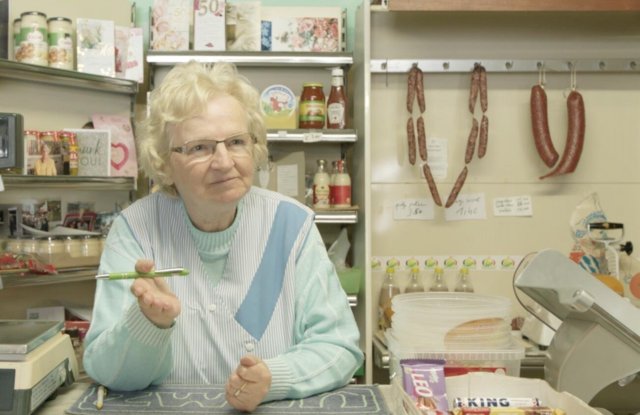
When he met Maria he discovered she had been having a difficult time since a superstore opened up nearby, and now her shelves are nowhere near as full as they might be. So she is looking at selling up, but is lachrymose at the thought of life after retail, or whether she will be able to even afford a roof over her head after the spoils are shared among her remaining family.
Henriette is a born optimist who dispenses kindness and homespun wisdom in equal measure. She lives both for her customers and for her beloved “hubby” Raf who is happy to stand in her shadow, but who is suffering from prostate cancer.
The director’s mother has lost her zest for life since the passing of her own husband, director Niclaes’ father, and therefore embraces even more the routine of shop life. Even when her daughter takes over the shop, Marie-Rose can’t quite let go of the tiller, but little by little she eases into semi-retirement, undertaking classes and preparing to fully pass over the baton.
As the son of a shopkeeper, Niclaes lends an authority to proceedings, and we hear that while he had to be on best behaviour in the drugstore as a kid, it was nevertheless a wonderful playground for him and his sister.
That said, it was never his intention to get quite as involved with his subjects in the film as he did. He wanted to examine from the sidelines, to be aloof, to act like a fly on the wall. Fat chance. He could never hide from Henriette and Maria the fact that he was cut from the same cloth and he is therefore continually consulted, chatted to, asked for his opinion by them as he stands behind his camera. “They invited me like one of them,” he says, to the extent that he became the link between the three women who now regularly meet for coffees, despite having not known each other before. His decision to immerse himself as a character made for a better film, he points out.
Of course the film that Niclaes thought he was going to make differs radically from the work he is showing at RE>CONNEXT, especially concerning Maria and her escalating worries over her future and the mooted sale by auction of her shop. What’s more she now misses the gathering of people in her shop that in the past would drive her to distraction. These days, she doesn’t like to go to bed at night and doesn’t want to get out of it in the morning, she says.
Yes, in the past the shops really were gathering places for friends – to some extent Henriette and Raf’s still is – and we see a party of folk singing ‘Que sera sera’ in Niclaes’ shop in old family archive. Everybody now misses the doorbell that would ring incessantly, except on a Sunday, and the inherent sweet melancholy of the film is further enhanced by a delicious accordion soundtrack, also by the increasingly deserted streets within the villages and towns that the shops serve. The film was shot before Covid, but the villages still resemble the pandemic at its peak. All this serves to underline a sense of timelessness. Such are the characters he has chosen, and such is the environment they inhabit, this could be “from the 60s, or the 70s, or the 80s,” Niclaes stresses.
During RE>CONNEXT, the director and his colleagues at Diplodokus will be drumming up sales, distribution and big screen festival interest before the film’s broadcast on VRT Canvas. Niclaes would also be keen to go on the road with his film to screen it throughout Flanders, he says, “because people recognize very well this subject.”
Towards the end of As Long As We Can Henriette describes beautifully her love for what she does and her very raison d’etre. “For me, life is being with the customers. And that’s good. And for my husband too. We’re with the people, until we no longer can.”