Courtroom 3H is Spanish director Antonio Mendez Esparza’s first documentary and follows on, in tone and essence, from his fictional Life and Nothing More (2017) which depicted the inherent lyricism within the lives of a black teenager and his minimum-wage mother in one of the US’s poorest neighbourhoods.
Esparza returns to the Florida capital of Tallahassee to record proceedings in the Dependency Court of Leon County, which specializes in judicial matters relating to children and parents. He did so, he underlines, to chronicle better the activities of the US court system, which he was unable do in sufficient depth in his fiction film.
“The documentary is a response to, or a continuation of, Life and Nothing More,” confirms the director. “In that film, I spent a considerable amount of time in the courtroom, but I thought it was more like a plot device. I didn’t quite explore the court that I saw.”
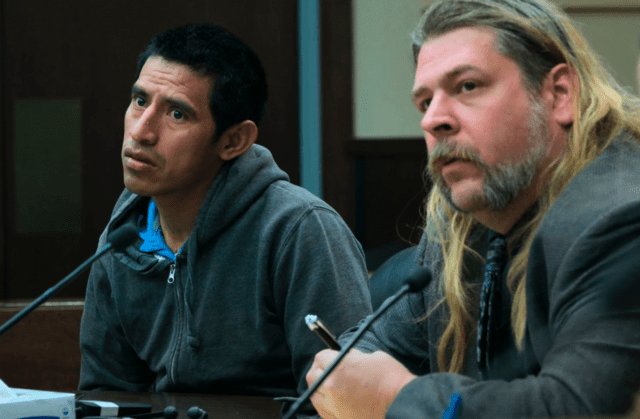
In Courtroom 3H Esparza redresses this imbalance. It is a documentary in which lawyers prosecute and defend, and where a judge continually presides over matters. Procedure is explained and parents bear witness, whether in measured or emotional terms, to their relationships with the children whose care is being considered by the court. It is the very opposite of fiction but ten times more riveting. “I was compelled… to test myself in documentary,” Esparza confides.
It is also a film of two halves, the first half packed with hearings where we are introduced both to court personnel and to folk whose claims are being assessed or grievances heard. Sometimes the kids themselves are running around the court, playing with building blocks or hilariously repeating what the judge says. Parents are generally articulate, sometimes lachrymose, sometimes devastated, but at all times they respect the authority of the court. And the judge is accordingly courteous, thanking one parent for “sticking this out… It’s a privilege to be in your presence.”
The other half of the film presents two trials, the first in which a Venezuelan man wishes to claim shared custody of his US-located child, the other a petition for termination of parental rights. Both cases are wordy and intense (in the case of Ela, tears are shed by parent and attorney alike) and captivating, not least because the ultimate verdict will have real world implications.
“I wanted to depict these families in the midst of this legal system,” Esparza comments. “The other thing which was extremely compelling was the fact that in this court, what is being discussed is not a criminal act but your own responsibility, your role as a father or a mother. That can be severe. It can be removed. And that of course is, one could say, anti-natural.”
He further underlines the project’s raison d’etre. “With this film, we pursue the idea of the citizen before the judicial system. We focus on the accused, the anonymous characters. Courtroom 3H represents people in between institutions. People are, in a way, parts of the machinery. This is not to objectify them, but rather to give a face, a soul to the machine, to represent an institution that can sometimes succeed or may fail them.”
Shot in November and December 2019, the film may have a seamless linear structure, but but the correct line didn’t always seem obvious, the director notes.
“After three or four weeks of shooting I didn’t even know if there was a movie. What was the film? I was overwhelmed,” Esparza says. “This was a strange discovery. In a fiction film, because it is very clear in your head, you have a very clear story, you think that you are the best teller of that story. The way you shoot. The scenes you have, the scenes you take out. In a way it is very controlled.”
“So it was very hard for us to find the balance…Should we be more procedural, looking at the judicial process? Should it be more about the emotions? Should we have to explain more, as the process itself is quite specific? Or what is the difference between an arraignment and a hearing? Should we identify who is who from the state? Is it a psychiatrist? A psychologist? Social services? Does it matter? There were many decisions that we made which seem straightforward but it took a long time.”
“I think when we started to understand the direction we were going to go, it was when we decided to focus on the emotion,” Esparza stresses.
Unlike the UK and many European countries, cameras are allowed in US courts. “There were objections at the beginning,” the director comments. “The courts are a public space and there is also freedom of the press and the freedom of expression, and I think that is what protected us… One of the main things that the judge believed in was transparency as a way to make the system accountable. And I think that is why we [were] able to make the film.”
Directed by Antonio Méndez Esparza
Producers: Pedro Hernández Santos, Álvaro Portanet Hernández, Amadeo Hernández Bueno
Director of Photography: Barbu Balasoiu, Santiago Oviedo
Production Company: Aquí y Allí Films
Coproduction Company: 9AM MediaLab
Country: Spain, United States