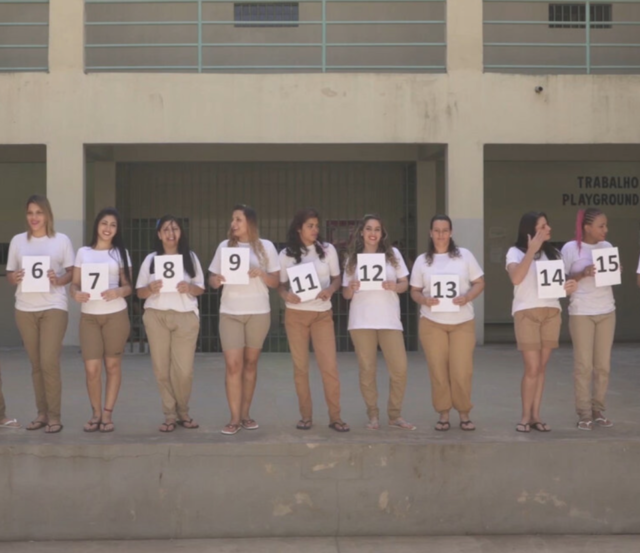
Graziella Fernanda Costa, the director of one of Pirajui’s three prisons, knew that the female inmates in her charge would be happier and less prone to recidivism (re-offending) if the monotony of their lives could be alleviated.
She therefore decided to organize a series of beauty contests, held over the course of four weeks, during which drab prison uniform could be ditched in favour of the gladdest of rags, and levels of pride and self-esteem behind bars could be subsequently allowed to soar.
The Brazilian city of Pirajui may only have a population 25,000 people but its three prisons house a total of 4500 prisoners. Most of the female inmates are doing time for drug offences, he underlines. Some of them did it for money but the others did it for love, helping their boyfriends or husbands.
In his feature doc project Prison Beauty Contest, which will be ready by the end of 2021, director Srđan Šarenac follows three characters of the prison characters; Joyce competing for Miss Spring, Angel in the Mister (transgender) category and Sueli, who is eyeing up the top prize in the Miss Plus size category.
The project is budgeted at €210,000, of which €150,000 in place. All territories are available, except Bosnia and Herzegovina, Serbia and Croatia) and during CineLink Šarenac is looking to secure a sales company.
“The prison contest helps prisoners to regain their self-esteem, not to feel defeated, to feel that there is an exit at the end of their prison sentence, and not to feel depressed,” says the director. “So it’s an uplifting journey that they go through. They’re able to compete. They’re able to practise a cat walk, they’re able put fabulous clothes on, they’re able to put normal shoes on. All the things that are not allowed in the prison. During the prison beauty context, they are feeling that their lives are at a premium.”
“It’s a creative documentary,” he adds. “And I definitely see also an impact campaign and advocacy for changing the situation in European prisons and elsewhere…This is a way to somehow help prisoners to change, perhaps never to go back to prison again.”
Šarenac will therefore be “joining forces” with NGOs, government agencies and charities in the field of human rights and prison reform “to show that the life of a prisoner can be something other than just serving a prison sentence.”
In making the project, the thing that “astounded” the filmmaker most was also, perhaps, the thing that gave him his biggest headache. “When we arrived there [at the prison] and it was announced that there is a film director, who has won awards for the movies he made before, that wants to make a movie about the prison beauty contest, all the female prisoners responded. That was quite shocking because all of them, all 1,500 of the women, wanted to be in the movie.”
“Of course we couldn’t shoot 1,500 female prisoners so we had to make research and narrow it down, but that feeling that they wanted to be in the movie, just to show that they’re different, it was amazing. It was an amazing feeling that they wanted to participate. They wanted to grab, tooth and nail, every chance that will help them not to have to undergo the everyday prison routine,” Šarenac concludes.