

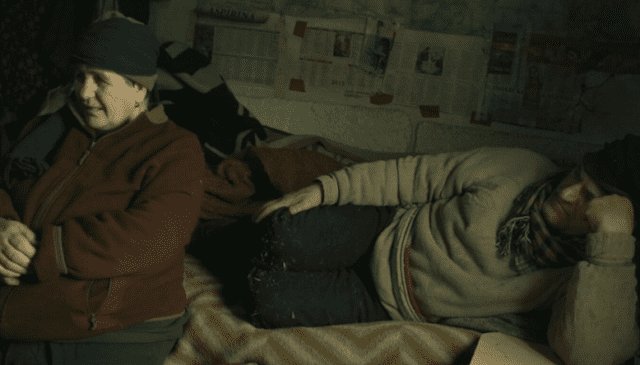
The Kosovan village of Vërnakollë that the elderly couple Fran and Verka inhabit bears little resemblance to the same one in which they got married, and settled down in, many years ago. Back then the place was full of children and vitality, and the weddings seemed to go on forever. But then the war came, and everything changed. Little by little the youth left, folk died, and now husband Fran and wife Verka are the village’s sole inhabitants.
The lives of Fran and Verka are very simple in their ramshackle residence. Outside is winter with a resplendent blue sky and snow on the ground, and therefore the pair are well wrapped up. Fran forks hay while Verka builds a fire. He tunes in to a transistor radio while she leads their donkey to water, but [alas] she cannot make it drink. We see the local church and we hear the organ play and, as it is Christmas Day, the couple sit down to a festive lunch of chicken and bread, giggling towards a camera that is recording events. The film is moving and elegiac is equal measure.
Director Sovran Nrecaj has set himself the task of record the forgotten live, telling the untold tales from Kosovo’s villages, both as a photographer and filmmaker, before the residents are no longer around to give their testimonies.
“I’m a young filmmaker from Kosovo, and we had this last war that removed many of these micro histories from the public discourse, just leaving society and especially the younger generation in complete confusion and with a very sterile picture of our own country and people,” Nrecaj tells Business Doc Europe.
“So it’s kind of a personal mission to document as many of these kind of micro histories as possible, to bring these stories back from under the radar and diversify the already existing narratives. I was not looking to tell like a story of poverty or something, but just a story of belonging, kind of subversively [telling] a story of what it takes for a society to abandon its own people in such a way.”
He heard about Fran and Verka and their sole inhabitant status when he visited the local church. His curiosity was immediately piqued about what seemed an absolute “state of solitude.” The film offers no suggestion that Fran and Verka are lonely or unhappy. Instead they seem like equal and necessary twin cogs within a day-to-day process whose sole purpose is to sustain their bucolic existence.
“Fran and Verka belong to that community,” Nrecaj adds of their Croatian heritage within Kosovo. “They were born in that village, were raised there and lived their whole life there. It was for me, even interesting, to know that they were never even in Croatia.”
When Nrecaj and his crew approached the couple to record their lives, they were welcomed with open arms even if, in winter, the filmmakers needed off-road vehicles to get to the dwelling. “The trust came very quickly. Fran and Verka were very hosting [hospitable]. Maybe it was the solitude and the need to have someone to talk to for them [but] the first time that we met, we were drinking rakia and just talking things over.”
That said, there were language barriers to overcome. “Fran spoke Albanian, but his main language is Croatian. Verka didn’t speak any Albanian, and I speak only a little Croatian. So, I got to know Verka mostly from her gestures, and what Fran was translating. So that was not very practical, but we got to understand each other most of the time.”
The short format seems perfect for these micro-histories although Nrecaj acknowledges that audiences are generally more interested in the feature doc format. But he is working on more such stories, as well as a fiction feature that will address issues along the same lines as those raised in Fran and Verka. “It’s something similar, but also different, in some sense,” says enigmatically.
He is also delighted by the selection of Fran and Verka for Sarajevo Documentary Competition. “It’s a city that is very close to my heart as I got my education there. Also, it [Sarajevo] is very important for us as this is a story of our society. When I say our society, I mean the Balkans in general. Bosnia has also this very complicated history with its diverse Bosnian, Serb and Croat communities. So this our story, everybody’s story.”





