

Ivo Dimchev is happy to admit he was wrong.
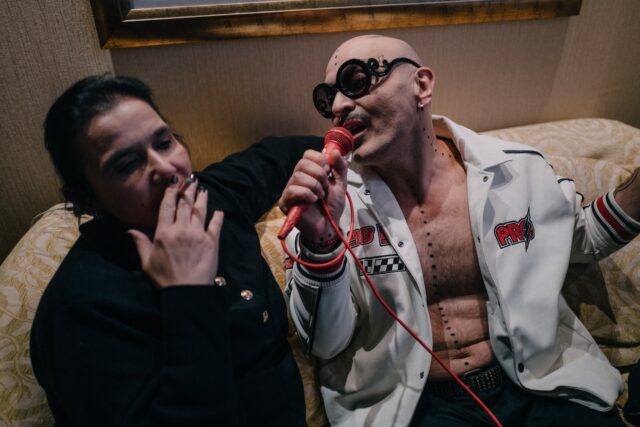
The subject of Kristina Nikolova’s eponymously titled In Hell with Ivo, which competes in Sarajevo 2025 Documentary Competition, Ivo is a force of nature, radical and exuberant, promiscuous and bitchy, but highly lovable, and with a voice like Elvis.
But he harbours a profound bitterness towards parents who never supported him when he needed them most. His mother never protected him from a violent father, and neither supported him when he came out in his late teens.
So there was a profound difference in opinion as to which direction the documentary profile should take. While Nikolova wanted to talk about his parents and his upbringing, he wanted to focus on his artistic output.
“Every time I was barely holding myself still. I wanted the film to be about my work, not about my banal childhood,” he tells Business Doc Europe. “I was considering myself someone who is out of many boxes, and I felt that she is trying to push me into this mega banal and clichéd childhood trauma box and I had a lot of resistance, cos I believed that it will only lower the value of the story.”
“But I was wrong. My relationship with my family were those chunks of ‘normality’ that we needed in-between all my weirdness and artistry, in which I feel a bit too safe.”
That said, we still see a lot of Ivo the artist in the feature doc. His response to the pandemic was to arrange more than 400 private concerts in people’s homes in his home country of Bulgaria, as well as in Istanbul, New York, and Los Angeles. Did he compromise on his outrageous tendencies in folks’ homes? Not a bit of it. He continued to sing filthy songs about cocks and clits, prompting one elderly woman to exclaim afterwards, ‘wow, I just had a great orgasm.’
“I like the one-to-one concerts mostly because the audience is such an important part of it,” Ivo reflects to BDE. “And also, because it’s happening in their very personal space it gives an opportunity for my music, which is very personal, to collide with a space which is also very personal. Concert halls, theatres, clubs are communal spaces, but a kitchen is not. So when your kitchen becomes my theatre we start talking about cinema. One of the reasons I started the home concerts is because I believed they will have a very organic cinematic value, which I needed for my music.”
In all his concerts, whether in people’s homes and onstage, he offers his audiences a binary choice. In Hell with Jesus? Or in Heaven with Trump? It’s provocative stuff, but it’s not without doctrinal foundation as Ivo is also a devout Christian, even if he lapses regularly. He has known the hell of HIV, but Jesus accompanied him through his ordeal, he explains to an abrasive radio jock.
All of which justifies the adjectives of ‘brave’ and ‘uncompromising’ that are often used to describe his approach to his craft. Does he agree? Or are there other, better adjectives that spring to mind?
“I’m curious,” he responds. “Everything that scares me very much attracts me. When I was a kid I was very much into dark spaces. I would spend hours in dark basements with no light investigating them. Same with the stage. I find the stage frightening and probably that’s why I’m so addicted to it. Does that make me brave? I don’t know.”
One of the final scenes of Nikolova’s film comprises a showdown in which Ivo demands answers from his parents about their aloofness and lack of compassion when he was young. Wasn’t this a brave gesture on his part?
“I don’t think so. The scene just makes very clear the resistance they have towards my gayness. I knew I will make them feel very uncomfortable, but I believed that’s [why] we need this scene, cos for me it was crucially important to approach them through my art and not in a normal conversation,” he says.
“The private concerts and the Q&A are part of my art, so that was the only way to really encounter my parents in the context of the movie. Of course the presence of the camera and Kristina made me bolder and less shy. The camera also made them [his parents] stay in the room no matter the discomfort they felt. I felt a bit guilty for using them in that way, but I also know that they were ready and also even happy to suffer a bit and show me their support.”
Does cinema figure in his artistic future? If Ivo were to film a documentary of his own life, would it be similar or radically different to In Hell with Ivo?
“If I direct a movie about myself I will focus on my creative process. In music, in theatre, in visual art. Because I believe it can be inspiring for other artists. I will focus also on the moments I’m alone. Maybe lots of lovers,” he says. “Or another approach would be very, very artsy, very fragmented, no story, something you can watch only in a museum of contemporary art,” he answers.
Ivo has a phenomenal skill for writing heart-breaking and beautiful songs, sometimes seemingly out of nowhere, (as he does together with his beloved nephew Alexander, a relationship that is presented in stark relief to the bitter one he has with his parents). Which artistic direction will his life be taking next?
“I’m in a period in which I want to focus mostly on my music. But I have done so much theatre in the last 30 years that it’s very, very hard to get out of that,” he answers.
“Festivals and art institutions are often commissioning me to do new works and I can’t say no, cos they pay me and with this money I can pay my musicians and my music productions, so it’s really hard for me to get out of the art world. But maybe that’s good. The mess is getting bigger and bigger, the eclecticism of my work is getting wilder and wilder. I have no idea where all this is going to. All I know is that I want to become a better artist and a better person.”





