

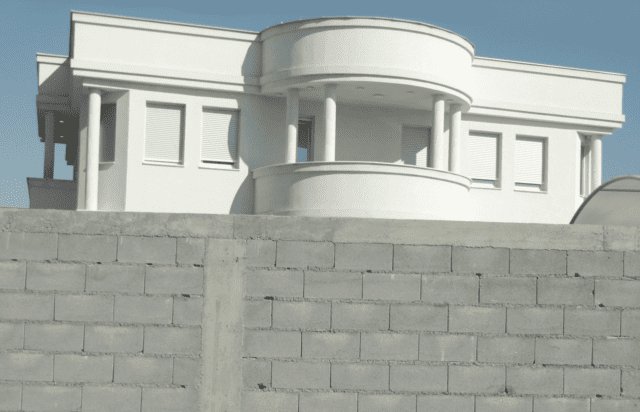
Anabela Angelovska’s Retreat, screening in Sarajevo Documentary Competition, tells a fascinating if somewhat sobering tale of modern warfare. As the US continues to prosecute its “war on terror” thousands of miles from home, it has outsourced the recruitment of ancillary staff, such as kitchen and laundry, to poor countries like North Macedonia. In the case of North Macedonia, these personnel number in the tens of thousands.
The pay is good, more than 30 times the salary they can expect at home, and the local purchasing power is therefore considerable, as evidenced by the commission of Southfork-like new builds and the acquisition of top of the range cars, such as Porsches and BMWs.
All this comes at a price, however. Figures quoted in the film (albeit without official confirmation) suggest that of the 12-14,000 people from the city of Kumanovo who served in Afghanistan and Iraq over this period, 70% are suffering from PTSD. They brought home the big bucks, but also a raft of traumatic memories.
But the lure of a better life is a constant, the film shows. War zones like Afghanistan may no longer be an option since the US withdrawal, but there are always other theatres of conflict, such as Somalia, where ancillary staff are needed.
And so a decision must be made, with migrant workers having to weigh up the lure of financial security against the threat of (statistically likely) trauma-related mental illness. That said, as the film further indicates, the second wave of migrant workers went back because they “liked being able to afford anything.” They are therefore prepared to risk their lives to maintain the status they have assumed.
“I was so astonished to see this huge building boom here in the city,” says Anabela Angelovska who, although born in Germany, has close links to North Macedonia. Her father originally hails from the featured city of Kumanovo. “They tore down old houses and built up these huge palaces…I was astonished to see that in the biggest economic crisis they are building like this.”
“In my father ́s hometown…almost everybody has a family member who worked in the Middle East. I knew that when I started shooting the film, but I was not aware how deep the experience from the war zones affected the social life in Kumanovo on all levels,” she adds in her notes for the film.
“Also our shooting was influenced by the traumas from the war zones and had to be paused several times as protagonists disappeared from one day to another,” she continues. “Our sound operator suffered a flashback and had to stop shooting, others changed their minds and…cancelled the appointments etc. But it was obvious that all of them who we met and who worked in the war zones struggled with their experiences from the war. This made the work on the film extremely exhausting, but at the same time all difficulties even strengthen the project as we all felt the importance of telling the story.”
Most of the film’s protagonists contribute via audio, as PTSD is considered a stigma in North Macedonia, says Angelovska. “They didn’t want to speak so openly and I had to find a way how to bring the feeling to the audience,…to find a solution in the montage,” she says of her editing which emphasizes the poignancy and enormity of the rich/poor disparity in the housing visuals. “I think montage is a key thing for the film because we don’t show everything. It’s a balance [between] what we show, what we don’t show, what is said and what is not said. We also work with secrets and so on. So it was important not to show everything.”
Another construction site we see in the film is that of a new sanatorium for PTSD sufferers, built by leading trauma specialist Dr Med Mice Dudučki, whom Angelovska describes as a “really impressive man,” who has also been at the forefront of compensation claims for trauma-related sufferers.
The film world-premiered at in Short Film Competition at Berlinale 2022 and after Sarajevo is set for EBS International Documentary Festival (EIDF) in South Korea, where it will also be broadcast on the educational broadcaster EBS.
Angelovska reflects on a story that is, to her, both personal and remote. “The stories are both strange and familiar to me, since I was born and grew up in Germany. It is this balance of closeness and distance that keeps the tension and which helps me to find the stories and to reflect them from different perspectives.”





