Simple on one level, but in fact deeply complex, Kristof Bilsen’s The Apologist, world-premiering at Sheffield DocFest, examines the ritual of saying “sorry,” and uses that well-known and much utilised phrase as a starting point on a journey to explore how apologies redefine history and what happens to us as witnesses to the act of atonement.
As Bilsen says at the start of the film, he “started the film to understand what makes a good apology,” but realised that the more he looked the more he felt the question was the wrong one. In essence, the film asks how we live with the scars of shared violence.
The threads of the discussion see The Apologist veer between continents, blending voices and events that are seemingly unrelated. A Belgian actor works with a Belgian-Congolese collaborator to confront their country’s colonial past; a political commission wrestles with reconciliation, and In El Salvador, we witness a ritual that movingly and powerfully honours those lost to a massacre.
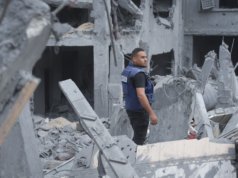
It is a tough watch at times as it leaps between talking heads and archival footage of the impact of brutal violence, but this helps keep the intellectual debate grounded in harsh reality.
As Bilsen said about the film when it was being pitched: “Many peoples and communities today are waiting for apologies, sometimes for events that occurred decades or even centuries ago. Public apologies have a significant impact on how history is told and by whom. This project is vital because it examines the powerful role of apology in shaping both personal and collective histories.”
A key component of the film is sequences of Flemish actor Valentijn Dhaenens and Congolese actress Musia Mwankumi as they deal with Belgian’s colonial past in the Congo. They are working a new play called ‘Shame Bone,’ an adaptation of Jef Geeraerts’ controversial (because of its sexual and racist content) book Black Venus. At one point Mwankumi is in tears as she worries about the project’s violence and racism, adding “I’m feeling that I don’t want to give this violence any more space.”
Intriguingly, the film tries to find the most accomplished apology, with help from Professor Juliette Schaafsma and her colleagues at Tilburg School of Humanities, where they have compiled every political apology made since the walk to Canossa – the German expression that involves humbling oneself and asking a foe for forgiveness. The idiom’s roots can be found in an 11th century power struggle between the pope and King Henry IV of Germany.
Bilsen says of Professor Schaafsma’s works: “They spent years trying to make sense of them, and have coded them neatly by country, year of delivery, whether they succeeded or not, written or spoken and victims present or not,” all of which amounts to a “spreadsheet of guilt”.
He adds: “The exploration of public apologies not only influences how history is remembered but also shapes our cultural memory. By delving into the origins of these apologies and questioning their place in our collective history, we can gain a deeper understanding of the world we live in today.”
The film searches for reparation in different ways: through theatre, political process, song, or the careful work of stitching memory so it is not lost. Bilsen is a gentle narrator who shepherds the film through moments of brutal violence alongside calm analysis, aiming to find the balance between memory, pain and reconciliation, and asking what it means not only to seek forgiveness, but to receive it.
Belgium-Netherlands-France, 2026, 82mins
Dir: Kristof Bilsen
Production: Limerick Films, Warboys Films, Tangerine Tree, Wrong Men
International sales: Film Harbour
Producers: Kristof Bilsen, Sara Skrodzka, Rémi Grellety, Nienke Korthof, Benoît Roland, Willem Baptist
Cinematography: Joachim Philippe, Kristof Bilsen, Diren Agbaba
Editors: Luca Mattei, Aaron Minnebo
With: Musia Mwankumi, Valentijn Dhaenens