

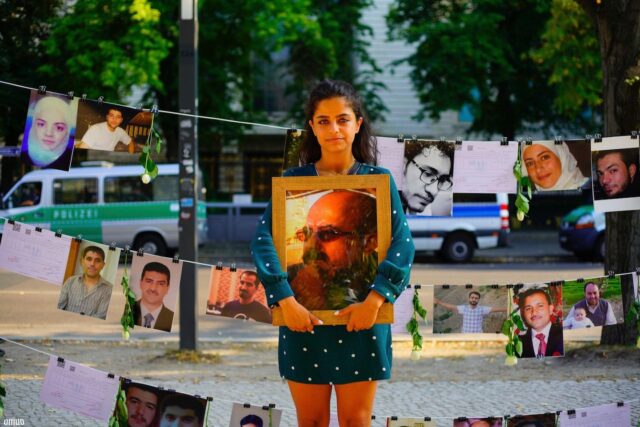
Oscar-nominated Syrian filmmaker Waad Al-Kateab (For Sama) is childhood friends with Wafa Mustafa, the subject and the co-director of the heart-wrenching new documentary, Maybe Tomorrow. The film, produced by Joanna Natasegara and Nevine Mabro, follows Wafa in the years after her father Ali Mustafa, a human rights activist, was arrested by Bashar Al-Assad’s murderous regime in 2013.
Ali vanishes into the Syrian penal system and she doesn’t know if he is alive or dead. She herself is forced into exile and many years pass before she discovers what happened to him.
“After my father’s disappearance, I and my family had to flee the country for our own safety,” Mustafa recalls.
Al Kateab and Mustafa had the idea for the project a decade ago, in 2016. By then, Mustafa was living in exile, studying at a university in Berlin. She had to make a short video for one of her classes. “I just made a video about my farther and my relationship to his disappearance. I showed that to Waad because she is one of my closest friends.”
By then, Al-Kateab was already working on her much-lauded feature documentary For Sama. Impressed with her friend’s video, she suggested that they should make a film about her and her father.
“For me, to be honest, I thought she was just being nice. I said let’s talk in four years when I graduate,” Mustafa remembers. Four years on, though, in 2020, they picked up the threads.
This is a deeply personal family story about love and loss which many viewers will find devastating to watch. However, as Mustafa (a journalist and activist) explains, her predicament wasn’t unusual. Thousands of others were left in limbo in the same way.
“The authorities use it to break the will of a whole community,” she says of how Assad’s government set about snatching dissidents and political opponents off the streets and then refusing to divulge what it had done with them.
“One of the main messages [of the film] is that this crime is not in the past.”
Mustafa admits that every time she watched a new trailer of the film, her “heart was broken again.” In advance of the Sheffield premiere, she is wary about how she might react.
“I don’t have the luxury to collapse and come back to the hotel and cry. I have to speak to people. I have to advocate for this film,” she says. “It’s not just doing justice to my father’s story but doing justice to the stories of millions of people in Syria and beyond because this crime is a universal one.”
Al-Kateab adds that when they embarked on the project, they knew there was “no way this pain can disappear. She [Mustafa] is living through this every moment.” The point of the film is “to keep the fight going – to try to push for her dad, for all the disappeared people in Syria but also for the world because this has become a technique everyone is using to silence people.”
In the documentary, we see Mustafa returning to Syria in 2024 after the sudden end of the Assad regime. It was a turbulent experience. At a time when others were on the streets joyously celebrating the dictator’s fall, she was still trying to find out just what had become of her father. She was spending her time at hospitals and detention centres, looking for clues about his fate.
She talks of returning to the family home for the first time in many years and seeing her father’s chair empty. At that point, the weight of his absence was almost impossible to bear.
“It was both a dream, and a nightmare at the same time for me,” she says. “Even when I went back to Germany after my first visit [back to Syria] I was looking at the photos and I was not sure I was really there.”
“This whole painful experience makes you a philosopher at some point. You have to become one otherwise you cannot survive mentally. I have given up on hope a long time ago, since Assad was there and all governments started normalising relationships with him. I thought that hope was a toxic feeling, and that I will just give up on that,” Mustafa continues.
She was driven to make the documentary by her love for her father, a sense of responsibility and also by feelings of guilt. She can’t hide her dismay that even now, forced detentions and enforced disappearances are continuing in Syria.
“Of course, the fall of the regime is a new beginning for humanity, not just for Syria, but the fight continues…the only thing that will give me hope is fighting every day for other young women not to lose their fathers because they dared to speak politics, or dreamed of a better reality.”
Al-Kateab lost friends and relatives during the Assad years. “For me, every visit to Syria comes with much more heaviness and grief,” she says. For the country to heal, the director argues, there now needs to be “accountability, transitional justice and freedom and democracy…”
She worries that people are too exhausted by what they’ve endured even to have conversations about the values that were behind the Syrian revolution in the first place.
Maybe Tomorrow is 40 minutes long. One reason for the length is that the “industry was shifting to true crime, celebrity and stuff.”
“I’ve been told many, many times to my face that you’ve done For Sama, that’s Syria, just move on to something else,” Al-Kateab notes. “That’s the reality unfortunately. The only reason this film was made was that we did not give up.”
For Sama won awards and rave reviews wherever it was shown, but that didn’t seem to make things easier when it came to the impact campaign or trying to engage politicians. “No-one had one hour and a half to sit down and watch a film. They always wanted a shorter version.”
Maybe Tomorrow will be shown on the UK’s Channel 4 by the end of the year – so it will be seen widely. Al-Kateab acknowledges that “it is a hard film to watch.” There isn’t any of the leavening humour found in For Sama. This is a story about “the violence of waiting. There is not blood, but there is a lot of grief and difficult moments…” That’s why 40 minutes seemed a sensible length.
The film ends in heart-breaking but also cathartic fashion.
“That’s why I love documentary. Documentary is not something you structure. It’s not something you enforce or try to create. The process of making a film is a process of mirroring, translating what is going on,” Al-Kateab says. “The film has no closure. There is an ending for the film, but there is no closure…no one film, not a hundred films, can really give the true experience of something that painful and that big.”
Al-Kateab and Mustafa were born in the same year (1991) and have known each other all their lives. They got through the documentary without ever falling out. “To survive making such a sensitive and complicated film together and stay friends, that for me is a big achievement,” Mustafa concludes.





