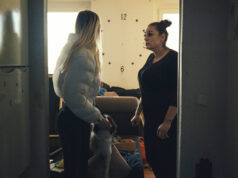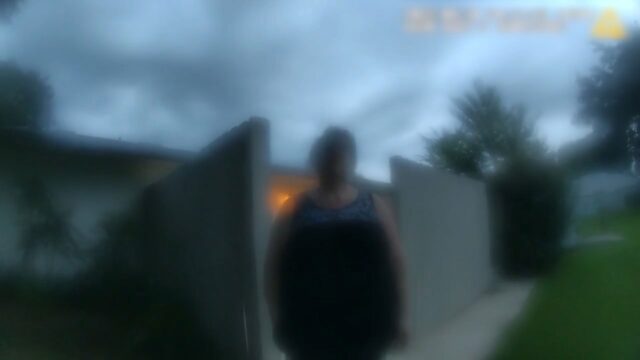
It all started off as a minor dispute after Ajike Owens’ kids were playing close to neighbour Susan Lorincz’s yard. But the matter escalated, and two years later Owens was dead, shot by Lorincz through the front door of her house. In her defence, Lorincz cited Florida’s “stand your ground” legislation that allows for justifiable homicide.
But the murder could easily have been avoided, as evidenced by the mass of police bodycam footage that Geeta Gandbhir, director of the Netflix film The Perfect Neighbor and a friend of Ajike, was able to access after a successful FOIA (Freedom of Information Act) application by lawyer Benjamin Crump.
At that point she wasn’t thinking of a feature documentary. She was simply collating the footage to see what could be of use to the wider media who were covering the story.
“I realized that the footage went back two years and that [Lorincz] had been calling the police for about two years [about] children playing nearby, and was not seen by the police as a possible problem, even though there were many, many flags,” says Gandbhir. “It’s interesting, we have spoken to people who were in the police department at one point who told us that the third time she called, she should have been flagged as an issue. Because when you call frequently about the same thing, and after the police have repeatedly told you that ‘there’s really nothing to be done here’…[then] someone should have been sent out, perhaps a social worker to mediate the situation.”
“And there were signs that Susan [Lorincz] should not have had access to a gun,” the director adds.
What the plethora of bodycam footage (which Gandbhir estimates makes up 90% of the film) also shows is that this was a happy, leafy neighbourhood, not the depressed, underprivileged view we are often presented in crime dramas and docs. It is light years away from “the footage that is usually used to surveil vulnerable communities of colour,” says the director. She therefore wanted to subvert the cinematic norm, to “flip it on its head.”
“What the footage does unintentionally paint is this portrait of this beautiful community, living together harmoniously raising children together, and how this one outlier, how one person’s access to a gun ultimately changes all that in the most tragic way.”
That said, the aftermath of the night-time murder makes for a difficult watch as we see the heart-breaking reactions of Ajike’s children to her murder, sourced via the numerous police bodycams worn that evening.
“It was really grief work,” Gandbhir says of her work on The Perfect Neighbor. “I think we felt – myself, my partner and my team – because of the connection to the family, we felt compelled to make the film. I think we wanted to understand what happened because it seems it is almost unthinkable. Again, gun violence in the US happens far too often, but how someone goes from being your next-door neighbour that you have a trivial dispute with, to being someone that you target and murder, it seems unthinkable.”
At the heart of it all is the vigilante-style ‘stand your ground’ legislation in operation in the US today. “The right to defend yourself…has been weaponised against black and brown people as a licence to kill,” director Geeta Gandbhir tells BDE. “People often use it as defence, even when it doesn’t apply, or when they perhaps have looked into it and decided to use it to commit a crime. So it becomes a dangerous law, particularly in a country where there is already a bias within the justice system, really the fabric of our society against black people.”
The film quotes a statistic that indicates that ‘stand your ground’ laws have led to an 8-11% increase in homicide deaths within states where the legislation was passed.
Even as the production team was assessing the footage, they could sense the impending sense of doom, a feeling they seemed to share with the young people within the community on camera. “There was just organically this feeling that there was this looming threat that only the children could see, and that the adults didn’t,” says Gandbhir. “They [the adults] dismissed [it] because I think there’s a certain privilege that Susan had as an older white woman and her neighbours being mostly multiracial or black or brown. I think that she weaponised her privilege in a way that did great damage to the community.”
The director heaps praise on Ajike’s mother Pam who gave her blessing for the film to be made. “I think one of the last conversations they had, Ajike said to her mother she had some scheme coming up, and they were laughing about it. And Ajike said, ‘just wait, mom, just wait. One day the whole world is going to know my name,” Gandbhir recalls.
“So I think that’s what we’re left with. For Pam, she really felt she wanted Ajike’s story to make a change in the world,” Gandbhir continues. “She takes a lot of strength from Emmett Till’s mother who chose to have an open casket funeral when Emmett [was murdered by racists in Mississippi in 1955]. She wanted the world to know what happened to her baby.”
“And I think that’s been really the defining mission for us. How do we make something more out of her loss and how, even though she’s no longer with us, can Ajike leave a mark in the world?” she asks. “And how do we make the film a tool for sparking conversation? The gun laws here are so challenging to overturn, but I believe hearts and minds can be swayed.”