When they made their 2022 film When Spring Came to Bucha, Mila Teshaieva and Marcus Lenz were not expecting that the war the raging in Ukraine would still be going on more than three years later. They had arrived in Bucha not long after the Russian occupying force had left and they had witnessed at first hand the death and destruction in the city.
“Probably it was quite naive but then, among those first months of the war, among all the pain and suffering, we felt an incredible solidarity. It was a very powerful moment when the nation’s people, military and civilians, were standing together and supporting each other,” Teshaieva remembers a period when, again the odds, there was some optimism.
But months passed and the war continued. “The darkness began to be a little bit overwhelming,” she says. This was both in a literal and a human sense. The Russian forces were bombing power plants and the mood of the community was low. “There started to come this feeling of desperation. The traumas started to pop up. Resilience weakened. Questions appeared – and the pain, anger and sense of injustice about everything that was going on started to rise enormously inside society.”
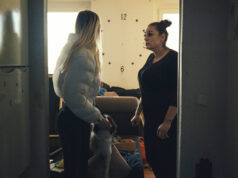
By late 2022, Teshaieva and Lenz felt the urge to make a second film. Shards of Light, a world premiere in International competition at Sheffield DocFest, focuses on what the protagonists from the first documentary have endured in the many painful months since the full-scale invasion, “the often unspoken side of what war brings to normal people,” as Teshaieva puts it.
“Our protagonists are ordinary but also extraordinary in a way because they survived the occupation in Bucha,” she adds.
Teshaieva describes Shards of Light as being about “those fragmented realities, that complex world which exists at time of war…it’s like their personal lives are broken in pieces.”
One of the main characters is Olga, a kindly woman who looks after all the neighbours in her block – but has unaccountably been accused of treason. Then there is Ludmyla, whose house was destroyed but who still patiently tends her garden there.
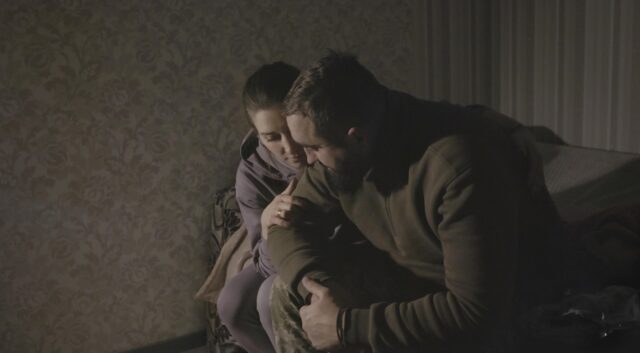
Also featured are Alla and Yuri, a mother and son. Her husband, his father, was murdered in cold blood, in what was a clear war crime, by a Russian soldier. Now, they are locked in a Kafkaesque struggle for justice. Another character, Taras, stayed behind in Bucha while sending his family away to safety and hasn’t seen his children for three years.
Ask Teshaieva about the accusations against Olga and she suggests that this is typical human behaviour during wartime. Neighbours denounce one another in a way that would be considered absurd in normal times. “Olga definitely did not collaborate…but as she is saying in the film, she had to negotiate with Russians. This point, that you have to negotiate to survive…war also gives a place for absurd accusations.”
Once you are accused, the director observes, it is almost impossible to clear your name. “It stays with you forever.”
The documentary touches on grim subjects: homelessness, false accusations, family separations, guilt and death. Even so, Teshaieva believes it also shows “lights in the darkness.”
“I was trying as much as I could [to make] a film that would not only speak about the dark side,” she says. “[But] at the same time, I think our film is strikingly, strikingly honest about those very normal lives touched by war and broken into pieces.”
The filmmakers tried to establish a “great intimacy” with their subjects. “This is not coming easy. I have built enormously close relationships with our protagonists. We can spend two to three hours on the phone, talking about life, talking about things. These are very, very close and trustful relationships. I’m completely open with them. They feel it, they trust me – and the film very much reflects this closeness.”
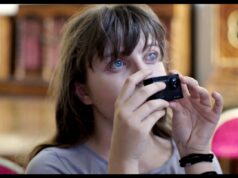
Parts of the documentary deal with the experiences of teenager Olenka, who also featured in When Spring Came to Bucha. “All of the scenes [with her] are critically important for me on many levels.”
The film also shows Elena and other youngsters performing drama exercises based around the war. At first glance, she and her classmates seem just like normal teenagers. “They are doing exactly the same things as their counterparts [outside Ukraine] but if you ask a question about their experiences surviving during the occupation, when they start to talk, it is overwhelming. You understand that it is very deep trauma that will reveal itself much, much later – but it will stay with them. You never know how it will reveal itself or in what form…”
Lenz is German, Teshaieva is Ukrainian. Both their grandparents came through the upheaval of the Second World War. Since the full-scale invasion, Teshaieva, who had been living in Berlin, has been mostly based in Kyiv. Despite Russian attacks, blackouts and the sadness and anger that people feel, the capital city, she says, remains vibrant. “It’s full of life, like any European capital, normal but abnormal.”
The film was produced through wildfilms (Germany) in co-production with Quiet Talks (Ukraine), WDR, SWR, BBC Storyville, 3Sat, the Why Foundation, SVT and DR. It was funded by the Film- und Medienstiftung NRW. A cinema release is planned for the autumn in Germany.
The directors aren’t currently planning a third documentary about the same Bucha protagonists but Teshaieva says their future work is bound to focus on similar subject matter.
“I think [my] next films in Ukraine will be connected to this war because I think every single moment of life in Ukraine will be connected with the war, or the aftermath of this war, for many, many years. I see it in Bosnia, how much society is dominated by the past. I hope it will not happen in Ukraine. I hope it will be a very different scenario – but I will definitely continue listening to the people and when I find a topic, a story or person that resonates with me deeply, I will engage again on this road…”