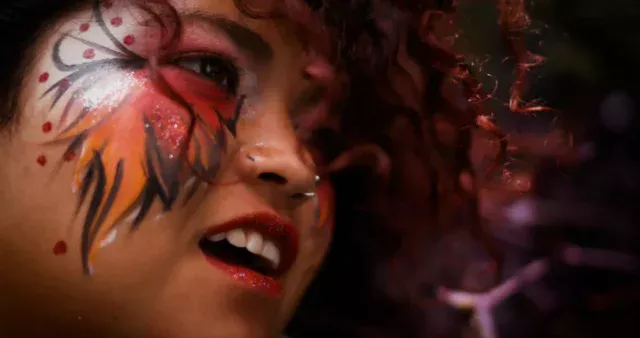
In the Guatemalan barrio of Ciudad Peronia, sisters Lesli and Lupe organise a spectacular comparsa, or street festival, to remember the 41 girls who burned to death in 2017 in a so-called “safe home.”
The girls died, we hear in testimony, because they were locked in the room where the fire started, their pleas to be let out ignored. The previous night, many of them had tried to escape the care home, claiming that they were victims of sexual abuse and rape. They were subsequently rounded up by the police, sprayed with pepper-spray and hand-cuffed, and pistols were held to their heads as they were locked up together. One survivor recalls that when one of the girls started the fire – we are not told why she did this – she heard somebody outside the locked door say, “let these bitches burn. If they were clever enough to escape, they can deal with the fire themselves.”
One of the girls who died was Siona, the childhood friend of Lesli and Lupe, who was desperate to leave the establishment and who had re-established contact with her mother, who was ready to welcome her back.
The tragedy happened within a country that has one of the highest rates of femicide globally. Co-directors Vickie Curtis and Doug Anderson point out that in Guatemala “a staggering 71% of those cases go unsolved.”
Throughout their film Comparsa, we are reminded of the constant threat to women, via new reports of kidnapping and murder. One of the teenagers we meet, Alison, is terrified when she is followed through the streets by a man in a hoodie.
Lesli and Lupe were also the victims of sexual abuse, they tell the filmmakers in a heart-wrenching scene.
But crucially, they are also very much prepared to do something about the violence. Since they were kids, they have been part of a street collective run by their friend and mentor Marta, which is as much about action as about having fun. It is, the directors say, a space “where artistic expression, body autonomy, joy and mutual aid are the norm.”
Fifteen years on, Lesli and Lupe are prime movers and shakers within this group, and decide to put on an exuberant street party, with a set of core objectives: to remember the girls who died in the fire, to expose a power structure that permits and commits violence against women, to offer up a space whereby woman and girls can open up about surviving violence in their own home…and to have a load of fun in the process, alongside the enormous puppets, fire-breathing stilt walkers, booming drums and much dancing.
US directors Vickie Curtis and Doug Anderson have known one another since they were kids in a youth theatre program “that pushed us to question the status quo and embrace self-expression as resistance.” There, they met Anna Hadingham (the eventual producer of Comparsa) who, back in 2007, moved to Guatemala. The pair heard, in dispatches, about Anna’s involvement with Marta and her collective, and the raucous public performances that they arranged, but it wasn’t until almost a decade later that Curtis and Anderson went over to Guatemala check it all out, at which point they met Lesli and Lupe.
“We’d been hearing about it for a 10 years before we realised we should probably see if there’s a story here, a film here,” Curtis, Emmy-winning writer of Netflix Originals The Social Dilemma and Chasing Coral, tells Business Doc Europe. “It really felt like it aligned with the kind of storytelling we wanted to do, that was character-centred and about how real people make real change in their community without waiting for the system to change or without waiting for permission, without waiting for funding to just get started and really start to change the world for one group of people, one group of girls at a time.”
Adds Anderson: “It is definitely true to say that there is just an overwhelming sense among women and especially young women and girls in Guatemala that their society doesn’t have their back, and there is an overwhelming sense that young women feel that their lives are treated as expendable. And so this tragedy of the Ciudad Peronia fire in 2017 that is at the heart of the backstory of our film, is really symbolic of so many problems in the society regarding the treatment of young women and girls.”
Lesli and Lupe are great characters to observe, fun-loving and serious in equal measure, whether in organising the show, sitting in their tiny “cave” of a home, reflecting to camera or performing circus tricks. At one point, the dilemma at the heart of the story becomes physically manifest as a man, whom Lesli identifies as a known, rapist occupies their community space, forcing her into a face-off and his eventual removal.
“Lesli has a deeply felt protective nature…and she has that big sister energy that she’s gonna be the big tree right that provides aid for everyone else, and we see that over and over again in the action she takes in the film,” says Anderson. “She fiercely defends the safe spaces that she creates for young people in the community, and she also has a deep knowledge of the community that allows her to know when to engage and when to not engage with someone who is encroaching.”
Ciudad Peronia, situated roughly 12 miles southwest of Guatemala City, was established in 1986 as a residential area for families who had migrated from rural parts of the country to escape the ongoing civil war.
“We fundamentally see a lot of the societal problems that are experienced in regions like Central America is due very much to a legacy global systems and the legacy especially of our country, the United States’ role in destabilising those places,” comments Anderson.
“It’s not like other places have are free from the consequences of patriarchy, the consequences of misogyny, the consequences of colonialism and racism,” Curtis adds. “But they are really concentrated in this place [Ciudad Peronia] because of resource inequality.”
The Impact potential for Comparsa seems considerable, and in Sheffield the team have been busy with meetings on potential future strategies. A month or so before the festival, they showed the film to groups of teenage girls in Guatemala.
“We were hearing feedback from weeks later about how they were still thinking about it and still thinking about Lesli and Lupe and what it meant to them… and how eye-opening it was that a kid is capable of doing so much without waiting for permission or waiting for funding or waiting for someone else to come along and help them. That was really heartening, to see that this film really resonates with the young people who watch it and want to find lots of avenues for sharing it with young folks.”
All future plans will be drawn up together with Lesli, Lupe and Marta as “we think the impact of the film should be deeply influenced by what they want to accomplish,” says Curtis. “How to prioritise and move the film through Guatemalan society in such a way that we can engage people. The girls want to not only show the film, but also do workshops with other young people throughout [Guatemala] and potentially beyond into Central America or Latin America, where they can say ‘this is our toolbox that you can use to do whatever you want in your community…and make other people feel they can bring their gifts to bear in their community.”
“We already know we want to redirect resources back to Ciudad Peronia and reach lots of young people who can then use these tools and arm them with not only the film but with workshops to facilitate conversations and educational material to make the most of the inspiration that the film can bring,” Anderson signs off.
The Guatemalan/US Comparsa is produced by Olivia Ahnemann, Anna Hadingham, Vickie Curtis, Doug Anderson. Sales are handled by Olivia Ahnemann.