

“In recent years, a revived interest in Alexander von Humboldt has taken over academic and popular discourses as one of two caricatures: a gay proto-environmentalist who predicted human-caused climate change over 200 years ago, or a data-obsessed European colonial naturalist in service of imperial exploitation,” producer Elijah Stevens tells BDE ahead of his June 19 Sheffield DocFest Rough Cut presentation of Humboldt USA by G. Anthony Svatek.
The project began when director Svatek, on first reading about Humboldt, discovered a number of biographical parallels, from a mutual interest in environmentalism, to biculturalism, queerness, and even sharing the same birthday.
Stevens continues, “This proximity provided an opportunity for investigation and introspection, resulting in the film’s honest, self-reflective, and relatable exploration of the complex themes of colonial domination and scientific exploration.”
According to Stevens, Alexander von Humboldt, often called the ‘grandfather of ecology’, had a massive influence on scientists, artists, and revolutionaries, particularly in the United States where they reinterpreted his dogma to fit an emerging sense of environmentalism. “Everything is interconnectedness.” This broad concept defined European science for decades until Darwin’s theory of evolution and competition eclipsed that intrinsic ‘interconnectedness.’
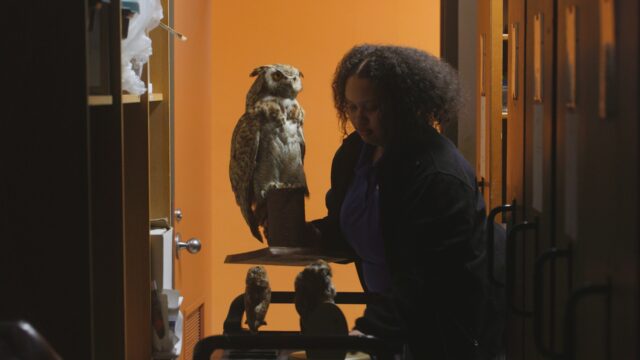
The experimental documentary picks up on these themes, which, as the producer outlines, interweave the stories of people in three ‘Humboldt’ place-names (in Nevada, New York State and California) who are taking unique steps toward tackling environmental concerns in their communities. “These oft-disparate narratives raise the question: in the face of ecological collapse and increasing virtualization of nature, what does it mean to be an environmentalist in America today?”
“Humboldt USA shifts the lens to the present, centring the stories of individuals and communities entangled in a technologized ‘web-of-life,’” Stevens explains. “Despite Humboldt’s prescience, he could not foresee how much science and technological progress would impact our relationship to the environments we live in and care about. Virtual redwood forests, satellite-tracked sheep, and artificial urban green utopias trace a lineage that began with Humboldt and have taken on a life of their own.”
For five years, director G. Anthony Svatek took to the hills, cities and forests of America to gather stories and make connections with the film’s participants, building, “a small but mighty team around the film of incredibly thoughtful and artistic collaborators, including cinematographer Sean Hanley and editor/sound designer Kaija Siirala, to capture and craft the film’s story.”
Cinematically, Humboldt USA is an experimental essay, a “love letter to Humboldt laced with doubt,” Stevens explains.
He further takes us through the director’s approach to the subject. “Crafted in an observational style, the film utilizes naturalistic camera movement, dialogue between participants on-screen, and wide framings to ground the participants in their social and ecological contexts… The editorial style draws on experimental film techniques – layering images, high shutter speeds, and inverted colours – to create a playful, cinematic tableau, building poetic and humorous connections between the different storylines.”
Ultimately the film aims to challenge views on environment, technology and conservation. “In pushing back against the entrenched belief that the environmental crisis can be solved through consumer choices or individual virtue alone, the film embraces the messy, often contradictory ways people connect with and fight for the natural world,” says Stevens.
Humboldt USA is nearing completion and the team hopes to premiere at festivals this Autumn, ideally internationally, with a release strategy that encompasses cross-genre film festivals as well as those focusing on science, nature, experimental film, and LGBTQ+ issues, in addition to the usual circuit of documentary-specific festivals.
“We are also excited about bringing the film to audiences beyond festivals through cinemas, classrooms, broadcast and streaming, throughout the world, who will connect to the universal themes of living in a world in flux, of climate and technological change,” Stevens tells us.
BDE asks Stevens what they hope to achieve at Sheffield. “We’re so honoured and excited to bring the film to Sheffield DocFest in the Marketplace Rough Cuts! We’re hoping to connect with funders who can help us finish making the film, and sales agents, broadcasters, distributors, and programmers to help us bring the film out into the world to the widest audience possible.”
Plans are also afoot for an impact campaign that will see them partnering with organisations across environmental justice, citizen science, education and science communication. “We want to collaborate with community groups and organisations to facilitate dialogue and introspection on how we might rekindle a Humboldtian interconnectedness with the world,” Stevens ends.





