In the days immediately following the vicious attack on Salman Rushdie on stage at the Chautauqua Institution in upstate New York on 12 August 2022, when a knife-wielding assailant rushed the stage and slashed and stabbed him, the author found himself thinking about a scene in a movie. He remembered Max von Sydow as the medieval knight in Ingmar Bergman’s The Seventh Seal (1957), playing chess with the grim reaper and thereby keeping death at bay.
The scene is referred to early on in Alex Gibney’s Knife: The Attempted Murder, the Oscar-contending documentary about the attack, and Rushdie’s recovery from it.
“I’ve always been kind of a movie freak,” Rushdie says. “The Seventh Seal is a film that made a big impression on me. Actually, I was still at Cambridge when I saw it. That scene has always stayed with me not just because it is a great scene, but then it seemed very relevant.”
Like the knight in Bergman’s masterpiece, Rushdie had faced down death.
The Seventh Seal isn’t the only film referred to in the new documentary. Gibney is as much of a film buff as Rushdie. “He used a lot of movie references that I gave him, but also added some of his own,” Rushdie says of the archive clips of Kurosawa’s High and Low and Sidney Lumet’s Twelve Angry Men that Gibney cuts into the documentary alongside the footage of Rushdie, shot by his wife Eliza Griffiths when he was lying in the trauma ward at UPMC Hamot Hospital in Erie, Pennsylvania. There is a grim irony to some of the clips. For instance, we see a rocket plopping into a smudgy moon in Georges Melies’ 1902 silent classic A Trip to the Moon at the same time as we are hearing about how Rushdie was stabbed in the eye.
A film that doesn’t put in an appearance is The Wizard of Oz, one of Rushdie’s favourites, about which he wrote a short book for the BFI. “It is kind of too sweet…and this wasn’t really a sweet event.”
When Gibney was pitching to direct the documentary, Rushdie and Griffiths had shown him footage she had shot of her husband on his hospital bed. Rushdie remembers that Gibney was “very taken” with the material and came up with the idea of using it as “the through line” in the film and then “winding around it” other moments from Rushdie’s life in impressionistic, non-chronological fashion.
Early on, the author was reluctant to revisit the events of 1989 when the Ayatollah Khomeini in Iran had issued a fatwa calling for his death after the publication of The Satanic Verses (1988). “I thought, do we really have to go through that all over again. I had a certain reluctance about that, but what they (Griffiths and Gibney) jointly persuaded me is that it is so long ago, 1989, that any younger viewers would have no memory of it at all. And even people who were alive at that time don’t remember it in detail.”
By the time Gibney began work on the film, Rushdie was well into writing his own memoir, Knife: Meditations After an Attempted Murder, which was published in 2024. “I think of them certainly not as competing with each other but as kind of siblings. They’re not exactly the same thing. The film covers a lot of areas that the book does not – I think they go quite well together.”
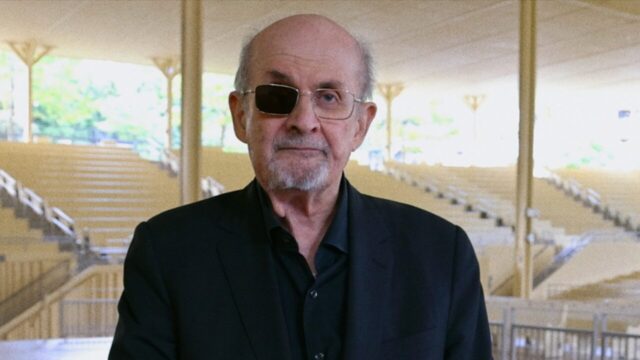
The film ends with Rushdie revisiting the Chautauqua Institution. He quips that he spent longer there with Gibney than he did on the day he was nearly murdered. “I had this very clear idea that I wanted to revisit the scene,” he remembers. “I wanted to show myself that I was OK in the place where I had almost been killed.”
Griffiths initially felt this was a bad idea, but realised it was important to Rushdie. When they arrived in upstate New York, Rushdie had no idea what effect it would have on him being back there. “I thought it could be re-traumatising obviously. It could have been just nothing or it could have been helpful. I had no idea how I would react to it. I just thought I need to do this.”
In the event, while he was there, Rushdie had this “strange physical feeling of a burden being lifted from my shoulders.” This therefore became the natural ending for both the book and the film.
One perhaps surprising element foregrounded in the film is Rushdie’s love of New York. He can’t wait to be back there, among the crowds, the traffic, the restaurants and the ball games. He has lived in the city for 26 years but his relationship with the city goes far further back in time.
“I first came to New York when I was very young, long before I had written a book. I must have been 23, 24 years old. That was a different city, the New York of the early 1970s.”
He waxes nostalgic about watching the Velvet Underground and visiting famous music clubs of the era like CBGB. “I remember thinking I really liked this place and one of these days I just want to come and put myself here and see what happens. When I did, I truthfully didn’t know if I was coming for six months or the rest of my life. It turns out to be for the rest of my life.”
Since recovering from the assault, Rushdie has eased back into New York life, although he is yet to return to Yankee Stadium for the baseball. That’s a regret, even if the New York Yankees have had a relatively disappointing time of late.
His left hand, which was stabbed, now has movement again. He wiggles his fingers to prove the fact. “It’s clumsier than it was. I have to go more slowly, and make more typing mistakes,” he says, but adds that he is hard at work on a new novel and that “the left hand is being used.”
The writing doesn’t get any easier. It is “always painstaking and difficult.” However, it still gives him the same pleasure. “I am one of those writers who is happiest when he is writing. There are writers who claim it is a miserable job which makes me wonder why they do it. But I love writing. As anyone who knows me will tell you, I am always in a better mood when I am writing a book than when I am not.”
As for having only one eye, that hasn’t stopped him watching movies either. “It was a while before I felt able to back to the cinema, but now I go to the movies. The one eye I have got is, touch wood, in quite good shape. I have 20:20 vision in my left eye. Although it is only one eye, it is one good eye.”
And, yes, he has the ability to detach himself from the anger and anguish associated with the attack on him.
“If you’re going to write a memoir or allow a documentary to be made about yourself, you have to be able to be both inside yourself and outside yourself. In order for emotion to come through, you have to write from within yourself. You also have to be able to step outside and observe yourself. That’s just a normal writer’s technique. Anyone who has done this job for a while knows that that is necessary.”
Earlier this month, Rushdie received a National Book Foundation award for Distinguished Contribution to American Letters.
“I am an American author. I have been a citizen for over 10 years and I have lived here for 25 and so I qualify,” he reflects on an honour generally reserved for leading US writers. He may be an Indian-born author who built his literary reputation in the UK, but he has now put down roots in the States. And, yes, he is flattered to have received an award which in the past has gone too figures like Joan Didion and Philip Roth.
As for the man who stabbed him, he doesn’t give him too much thought these days. “There is one step left. Quite soon, on the 10th December, he will be sentenced in the Federal trial. He is already serving 25 years from the State trial. The Federal trial in theory, since he was found guilty of terrorism, that could be life without parole. It is at the judge’s discretion. I want to hear that and then that feels like the full stop at the end of the story.”
Anyone watching the documentary is likely to marvel at Rushdie’s resilience and cheerfulness in the face of calamitous events. After the fatwa, he had to live in hiding. Now, he has endured an attempted murder. “If you had said to me ‘the following things are going to happen to you for the next many years, how do you think you will handle it?’ I would not have bet on myself to handle it very well – but sometimes you discover you have more inner resources than you thought you did.”
He adds that he always felt that “writing saved my life” and that it was “useful” he was a novelist as that was something he could do on his own. “If I had been a playwright, nobody would have put on my plays at that time. If I had been a film person, nobody would have allowed me to put on a film. But if you’re a writer of books you can go on doing that – and so I did.”
Over the years, after the fatwa against him, Rushdie has discovered who his friends are – and has also noticed when people he regarded as allies have spoken out against him. Into this latter camp falls President Jimmy Carter who was sharply critical of him around the time The Satanic Verses was published, calling the book a “direct insult” to millions of Muslims.
“Then, later in life, I was teaching at Emory University in Atlanta. Of course, that was where he lived. He was quite involved with the life of the university. I met him several times and he was incredibly friendly, supportive and sympathetic.”
Carter, it seemed, had simply forgotten what he written and said a quarter of a century before. Rushdie didn’t remind him.
The documentary has passing reference to Rushdie’s days as an advertising copywriter in London. He was responsible for the so-called “bubble” words used to promote Aero chocolate bars. “Adorabubble, irresistabubble,” he remembers some of his contributions.
“I worked in advertising on and off for a while. Lately, I’ve discovered how many prominent writers also began in advertising,” he says, citing Don DeLillo and Joseph Heller among others. “I think there is a doctoral thesis to be written about novelists who started writing out advertising copy.”
As for future film projects, he’ll leave those to Griffiths while he sticks to the writing. “Eliza is very interested in doing more. She has shown herself to be an extraordinary cinematographer and she has lots of filmic ideas – but I don’t know about me.”