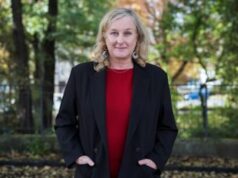
Orwa Nyrabia (pic: Roger Cremers)
“Filmmakers, young and old, showed up when the whole industry needed them. Watching these films makes one confident that cinema will survive,” IDFA Creative Director Orwa Nyrabia tells Business Doc Europe of the IDFA 2020 harvest.
If you want to know how to put on a film festival during a global pandemic, then look to the documentary community which responded in 2020 with much professionalism, diligence and intelligence after the cinemas began to close back in March. (To this can be added a passion both for the documentary form as well as for serving the immediate needs of savvy, cinephile audiences.)
Now the baton is passed to IDFA whose hybrid event this year promises much from its 257 titles, selected from 78 countries. Of the films in competition sections, 57% are directed by women.
“So many good films, a lot of free and uncompromising work, no submission to formatting or easy solutions,” Orwa Nyrabia underlines. “Filmmakers, young and old, showed up when the whole industry needed them. Watching these films makes one confident that cinema will survive. Not because of any spreadsheets or data visualizations, but because it is as genuine and necessary to human life as can be.”
The festival presents ten compact competition programmes, which include the newly established Creative Use of Archive selection of 10 titles. (No more than a dozen titles are selected for Feature-length Competition, likewise First Appearance and Mid-length competitions.)
“We introduced a new way of selecting films that now has a selection committee dedicated to each section of IDFA. This allowed for a more inclusive, more international and even fairer process for all the films submitted,” explains Nyrabia.
Of the pandemic backdrop he adds how, “Covid-19 did not make this or that film more important in itself, after all we’re not commenting directly on what’s happening at the moment. However, it did allow us the time and the clarity to revise the way we work in a very positive way.”
“In a year when film is being challenged, when we find ourselves debating whether film, as we know it, will actually survive or not, it is particularly meaningful that the year’s harvest of documentaries is absolutely marvellous,” Nyrabia further enthuses.
Audiences can also turn to the non-competitive sections of Frontlight, which encourages a deeper understanding of the contemporary world, Luminous, which addresses what it feels like to be alive today and the Paradocs that looks to the fascinating, beautiful margins of documentary making. As does IDFA’s radical immersive/interactive DocLab programme which kicks off 20 November.
Masters and Best of Fests as ever offer up a smorgasbord of delights, with works from such doc talents as Hubert Sauper (Epicentro), Jerzy Sladkowski (Bitter Love), Simone Bitton (Ziyara), Ulrike Ottinger (Paris Calligrammes) and Ai Weiwei (Vivos), among many others.
Of course, next year may be a different story, and a whole set of challenges, choices and decisions as to where priorities lie, will demand attention when the doors close on this edition. “2021 will be the most interesting year for festivals in my opinion. We will have a great debate and will see many different approaches play out and compete. How much we take from what we learned in 2020 into the future is to be seen. Will “online” really grow, will it add value beyond the pandemic? In what particular parts or types of programming?” Nyrabia ponders.
“Also, we will certainly witness more conservative views that will defend and protect tradition,” he adds. “I will personally be examining some place in the middle, probably leaning more towards tradition, that of coming together and experiencing film together, rather than staying at home. At the same time, we cannot ignore that tradition is also a ball and chain… that slow-paced and balanced change is coming in ways we cannot already predict today, and certainly should not be easily predicting today.”
But right now the focus is on IDFA 2020, and on the overriding sense of resolve, defiance and hope at the festival and within the sector.
“Solidarity in the film community was rediscovered this year. This might be the best outcome of a rather terrible experience for the film world in general. Festivals are communicating better, support schemes to filmmakers and companies are growing, even if not enough. A new sense of compassion is in the air and that is refreshing, and we all have to invest in cherishing beyond the crisis moment,” says Nyrabia.
“For IDFA, it was a year of looking in the mirror and examining the actual value and the profound reasoning behind all of our many activities. We were forced to stop relying on many of our usual processes, and that opened windows of imagination and allowed us to reinvent our whole structure and to redesign many of our programs. We will continue doing this.”