A determined Nairobi journalist’s investigation into the complex and dangerously tangled world of land battles in Kenya sees her caught between a faceless multinational corporation, unhelpful local tea growers and a worrying family secret. Co-director Bea Wangondu’s attempt to reveal the truth and unearth the implications of colonialism in Kenya makes for absorbing viewing, though it offers no easy answers. Nor does it hint at any form of justice.
Bea is all too aware that, for the Kikuyu people, land equates to a sense of self. As land rights campaigner Mungai tell her: “You must have land – it is identity. If don’t have land you are stripped of yourself. The colonial governments have taken our land…they raped our land, they displaced us.”
Opening with archival footage of colonial plans alongside images of the lush and beautiful Kenyan landscape, Wangondu’s investigation dwells on the scars of colonial legacy, while also centring the voices of Kikuyus. She comments that there are two version of Kikuyu homeland – “one that the world sees and one that they keep to themselves”.
She and Andrew H. Brown direct jointly (he also shoots and edits) and have woven together a dark and worrying picture of workers facing exploitation, a rallying legal battle for land restitution and also – and intriguingly – a revelation of Wangondu’s own painful family secrets.
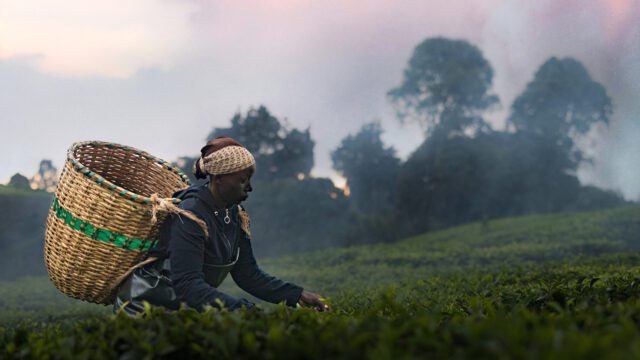
Her homeland is a source of long-suppressed stories: tea fields where women are sexually harassed by field managers; families carrying ancient wounds, and a community bound by both loss and unshakable resolve. As she follows the Kikuyu community’s pursuit of justice, her own family’s past begins to play into her story, as she discovers a darker side to her grandfather and the part he played in taking land away from local families.
She sadly admits her grandfather “behaved like a coloniser” and adds that her family don’t want her to talk about their history. “I’m sad and I can’t change anything. Betrayal is in our family,” she says.
She heads to London in what turns out to be a fruitless attempt to get a response from multinational Unilever (who sold tea producer Lipton to CVC in November 2021). When she returns to Kenya she sits down with family members who grudgingly talk to her, but she is told again things must stay within the family. The return home also ties in with coverage of political machinations that suggest much-needed reparations are unlikely, but that the community’s pursuit of justice would still continue.
Kikuyu Land astutely balances journalistic investigation with a story of homecoming, and is a journey (at times a justifiably angry one) through memory, land and legacy. Bea Wangondu – a key component of the on-screen narrative – makes for an intelligent and passionate storyteller, and while the film offers no easy answers, it does an excellent job in unearthing uncomfortable truths, both in the country, community and her own family.
Kenya, 2025, 96mins
Dirs: Andrew H Brown, Bea Wangondu
Production: The Bea Company, Ragtag Collective
Producers: Moses Bwayo, Andrew H. Brown, Bea Wangondu, Mike Morrisroe, Joseph Njenga
Cinematography/Editor: Andrew H. Brown
Music: Nyokabi Kariũki, Keir Vine