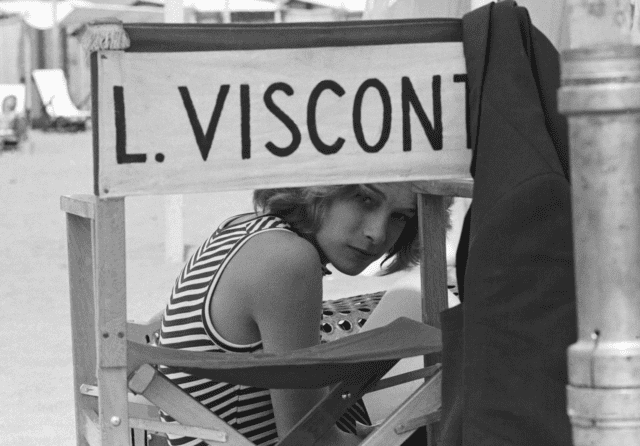
Björn Andrésen on the shoot of Death In Venice (Photo: Mario Tursi)
Björn Andrésen was a very shy and sensitive boy who was only fifteen when Luchino Visconti cast him to play Tadzio in his adaptation of Thomas Mann’s ‘Death in Venice’. After Visconti proclaimed Andrésen to be ‘the world’s most beautiful boy’ the label stuck – with lifelong consequences for Andrésen. In their documentary feature, Kristina Lindström and Kristian Petri set out to make a film that finally gives him back his own voice.
The Most Beautiful Boy in the World is produced by Stina Gardell (Mantaray Film) is selected for the World Cinema Documentary Competition at Sundance 2021.
Before the opening credits, we hear a haunting soundtrack and amateur recording of a very young boy telling a brief but evocative story in which he asks where his father and mother are. Then we hear some serious sobbing as the boy calls out for his mother. From the back of the frame a tall figure appears, walking through a dark corridor within a dilapidated hotel.
Over past years, co-director Petri has made a trilogy of films about travelling, the last part of which was The Hotel (2016). In this film Petri talks to people about what hotels have meant to them, and among others in the film he meets Björn Andrésen who, at the now derelict Grand Hôtel des Bains, played young Tadzio in 1970. We see how, after the premiere of Death in Venice in London and Cannes, Björn was catapulted into unprecedented, and unwanted, stardom all over the world.
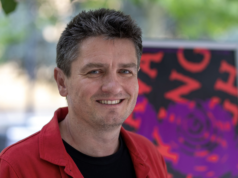
“I have known Björn for about 30 years, we hung around in the same circles,” comments co-director Petri. “He also worked for me as an actor in a children’s series. He was one of the main characters.”
Adds Lindström: ‘’When Kristian introduced me to him [Andrésen] I got to ask him about his background. He is a very special person and I got intrigued by his family and his life story. And I got the idea for a full length feature about him.’’
In The Most Beautiful Boy in the World the filmmakers, and Andrésen himself, slowly but surely peel away the many and complex layers that make Björn who he is, a damaged and deeply vulnerable soul, who started out on a trajectory that was certainly not of his own making.
For the filmmakers it was important to take it slowly and had up to 50 meetings with the former actor before they even decided to make the film. Even then, it took them a further two or three years before they entered his apartment for the first time. ‘’Trust, courage and willpower was needed and it had to be mutual exploration,’’ says Petri.
During the production process Petri and Lindström discovered a lot, but they also realized that Björn did not know some crucial things about his own past. The bottom line for the directors was that the film would give Andrésen the cinematic opportunity to explore who he really is.
‘’Björn did not know in advance that we would hit extremely sensitive issues. It happened on the way,” Linström explains. “Patiently we waited and all of a sudden he was ready to talk about it.’’
Within the film’s many moving scenes it looks like this approach worked well for Andrésen as he seems to experience a real sense of much needed catharsis. ‘’It was not an easy film to make in the sense that it simply had to be ‘right’, and it was essential that he did not feel exploited again,’’ comments Petri.
Once Andrésen agreed on the film, he was all in. Lindström adds that, “it made Björn comfortable that Kristian aimed for the film to be highly cinematic,” which chimes well with the boy star commencing his acting career with one of the greatest ever filmmakers. Lindström certainly does not lack cinematic vision herself and Petri returns the compliment by saying that, “Kristina is like a badger, always digging deeper, creating tunnels, going all the way. She is a fantastic interviewer but above all a fantastic listener. People always feel comfortable with her.”
The directors are a couple in real life which makes it possible to divide their work efficiently. It also makes it easy to continuously synchronize their visions, not only in the editing suite but also by just talking. This enabled them to created the implicit, but effective and engaging, chapter structure. They also agreed on asking Anna von Hausswolff and Filip Leyman to create the allusive music in the film, which works very well.
The film also contains fantastic visual archive footage as well as unique and highly enigmatic audio material that was recorded in the 1960’s by the aunt of Andrésen There is one long fragment where his own mother seems to talk from her grave about herself, a scene that suggests strong parallels between her and her son. This material, and the film as a whole, seems to help free Andrésen both from the iron shadow of Visconti but also from other shocking traumas that have been part and parcel of his life. It is hoped that the scattered pieces of the puzzle of his life finally found its rightful place so that he can at long last recognise the person he has become.
The Most Beautiful Boy in the World was developed with the support of the Creative Europe Programme – MEDIA of the European Union, The Swedish Film Institute and Jonas Gardell Produktion, in co production with SVT and ZDF/ARTE, in collaboration with YLE. Sales are handled by Films Boutique, Juno Films has acquired U.S. and Canadian rights and Triart is distributing the film in Sweden.