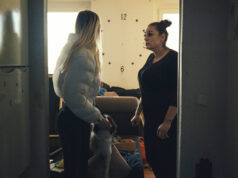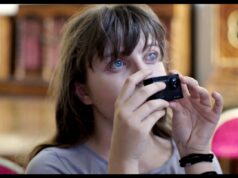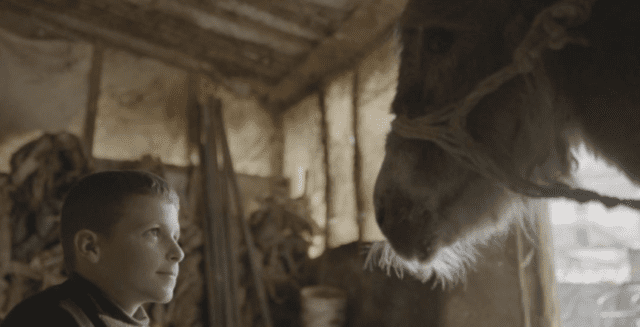
In post-war Kosovo, a filmmaker and her exiled father return to his childhood village to recreate his memories with the help of local villagers, reads the logline of Dea Gjinovci’s The Beauty of the Donkey, set for a Spring/Summer 2025 release. As they unravel the past, they uncover the mysterious disappearance of the filmmaker’s grandmother, revealing a deeper connection between personal and collective memory, and the resilience of a community held together by oral history.
The budget is complete on the 80-minute Swiss/Kosovan/French co-production. At Visions du Réel, the director/producer is looking for sales representation.
“In Kosovo, 25 years after the war, the country’s landscape has been completely transformed,” Gjinovci explains her film. “More than 90% of its villages were destroyed, stone houses replaced by concrete structures, artisanal crafts lost, and personal photographic archives burned. This extreme material and human loss is being echoed today in Gaza, Ukraine, Sudan, Yemen, and other places in the midst of conflict. My film contemplates the traces left behind and asks: Can they be woven back together? Often, what remains are the memories of those who survive—and how they pass them on.”
“I believe this universality resonated with funders like the Sundance Institute, which supported me at the very beginning, along with FOC in Switzerland for development,” Gjinovci adds of the film’s appeal. “Convincing institutional funders in Switzerland and France took longer due to my creative approach. I had to expand my search to funders willing to support ambitious and daring documentary forms. The Facet Foundation and Maida Lynn epitomize this kind of backing—Maida came on board because she believed this approach to filmmaking could stand the test of time, gaining relevance throughout its distribution journey.”
Gjinovci further underlines how her dual role in the project engendered a sense hesitancy among certain funders who saw the project as too ambitious. “To address this, I strengthened my production team, bringing in experienced producer Palmyre Badinier, whose artistic insight and solid production background reassured funders and motivated me to push the film further,” she tells BDE. “We were then fortunate to receive support from Momentum-Suissimage in Switzerland, which funds films in urgent need of additional resources. After that, we secured further backing from Cinéforom and our co-production partner RTS, which had previously supported my film Wake Up on Mars.”
How does Gjinovci describe her filmmaking strengths, as well as those of the production? “My strength as a director lies in my fascination with the idea of construction—not just in crafting a film, but in creating an experience during filming that benefits both the film itself and its participants. With The Beauty of the Donkey, we fully integrated the creative ambitions and well-being of our young protagonists into the design of our sets, costumes, and scenes. For me, it’s crucial to foster an atmosphere where everyone feels invested in the vision and understands their role as essential to bringing it to life.”
She also seeks out collaborators from diverse disciplines, not just film, she elaborates to BDE. Talents in her production design team include French scenographer Aurélia Martin and artists Jesse Wallace and Armand de Benoist de Gentissart. “By blending disciplines, we achieve a creative output that is distinctive in form. Additionally, I work with a core team—Maxime Kathari (cinematography), Lizi Gelber (editing), and Gaël Kyriakidis (music)—who collaborate on multiple projects with me and stay engaged from inception to completion, ensuring a deep creative exchange throughout the process.”
“I also bring a can-do attitude that pushes the limits of what seems possible. For example, we shot half of the film’s fiction scenes with a full crew of just eight people, including production.”
“On the production side, the key is working with people who are open, hardworking, transparent, and genuinely committed to the film. Swiss-Kosovar filmmaker Ilir Hasanaj, who began as our first assistant director, exemplifies this dedication—his relentless effort on set made him the ideal co-producer in Kosovo. A strong production team is built on trust between producers, and fortunately, we had that throughout the process.”
As she approaches completion on the project, she is carefully eyeing up a festival premiere. “Given the film’s hybrid nature, we are aiming for a festival that showcases both fiction and documentary films,” she says. “The fictionalized aspects of the film expand its audience reach, and we believe the right premiere will help shape its trajectory. Our strategy will, of course, be influenced by the sales agent we choose to work with, but also by the programmers who champion the film. For me, finding a festival that truly embraces and nurtures the film is crucial.”