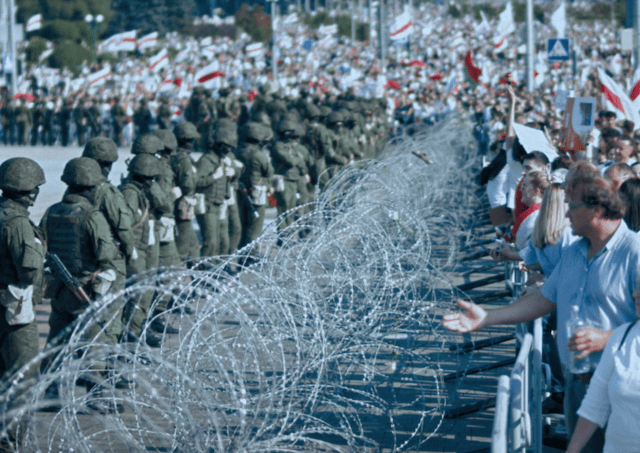
Courage (pictured) by Aliaksei Paluyan
“Our festival has come full circle,” points out upbeat Krakow Film Festival director Krzysztof Gierat. “A year ago, cinemas opened the day after the awards ceremony. This year they opened right before our festival. As if it was done with us in mind. I hope that it’s a symbolic exit from the pandemic and a final farewell.”
Every year the festival places its focus squarely on documentary, animated features and shorts within three competitions and 12 non-competitive sections. Mateusz Kudła and Anna Kokoszka-Romer’s doc Polański, Horowitz. Hometown, in which Roman Polanski and Ryszard Horowitz visit Krakow, the city in which they grew up, will open the festival on May 30.
“I’m extremely excited because the tension among the audience and our guests is enormous. We all want to meet, to talk about films. I hope that we will meet these expectations by organising the festival in a hybrid formula,” director Gierat underlines.
The seventeen films in the International Documentary Competition, in which “all hues of the documentary genre are represented”, compete for Golden and Silver Horns, with success paving the path towards Academy Award and European Film Award consideration further down the line.
The National Competition offers up 36 recent Polish films, 20 of which are documentaries which are “dominated by contemporaneity but not the pandemic; some focus on returns to the past, both distant and nearer, but the major theme is a human being and his or her fight for a fair life,” as per the festival website.
The Short Competition is the oldest competition of the Krakow Film Festival and this year presents 12 documentaries, 11 fiction films and 13 animations “representing a variety of styles and themes compete for the Golden Dragon, three Silver Dragons and a fast track to the European Film Award and an Oscar.”
Gierat explains his documentary selection rationale. “I wanted to show the complexity of our world and the documentary genre is a perfect fit. I would also add the protagonists’ determination in their search for the truth and their fight against adversity,” he says of the International Documentary Competition programme that includes the likes of Courage (pictured) by Aliaksei Paluyan, about the protests that ensued after the corrupt the Belarusian election of 2020, Firouzeh Khosrovani’s Radiograph of a Family about growing up before and after the Iranian Revolution in 1979 and Joonas Berghäll’s The Red Ring, in which the director meets people who, like him, suffer terribly with debilitating Lyme disease.
“It’s difficult for me to pick one particular film [for special attention],” he adds. “They are all my children, I selected them. I really appreciate the films you’ve mentioned [as outlined above], because they connect the individual fates of their heroes with historical events. I really like when family secrets are uncovered before my eyes. It’s probably not a coincidence that we have several such films in our program.”
Gierat reserves special comment for the Polish films in selection, articulating the qualities of his home docmakers. “When it comes to Polish documentaries, I appreciate how meticulously they approach film work. These productions are often masterpieces. For example, our contestants in the International Competition (Walk With Angels, No Hero At All) are both fascinating stories with charismatic heroes, made with great knowledge of film language.”
“There’s a generational change in documentary filmmaking taking place right before my eyes,” he adds. “Young people are becoming classics, [but] the generation of current forty-year-olds graduated from the Wajda School is interesting…Tomasz Wolski (1970, in National Competition), a long-time master of observational documentary, has been exploring the archives of the Institute of National Remembrance for some time now, breathing fresh air into the found footage formula and verifying the view on our recent history.” Gierat also points to established Polish talents such as Maciej Cuske (The Whale from Lorino, 2019) and Piotr Stasik (A Diary of a Journey, 2013).
The non-competitive sections of Krakow 2021 include a Polish Panorama of recent documentaries, which includes Krzysztof Kasior’s Fury, about a young woman who dreams about being an MMA champion, and An Actress in Wonderland (Maciej Kowalewski and Piotr Konstantinow), about legendary Polish actress Barbara Krafftówna. There will also be (self-explanatory) sections dedicated to Docs+Science, Kids&Youth and the Sound of Music.
Norway is in the frame with a program of 12 films, six of which are documentaries, including Victor Kossakovsky’s Gundaand Aslaug Holm/Sigve Endresen’s Generation Utøya. “Norwegians do not close themselves off in their own world,” points out Gierat, adding how films from Norway are often victorious at his fest, such as last year’s The Self Portrait(Espen Wallin, Katja Høgset, Margreth Olin), and the 2019 docs Once Aurora (Stian Servoss, Benjamin Langeland and The Men’s Room (Jo Vemund Svendsen, Petter Sommer).
“They [Norwegian producers] often enter into co-productions, which makes it easier for them to create films and distribute them later. It’s a great, though small, industry,” Gierat concludes.