

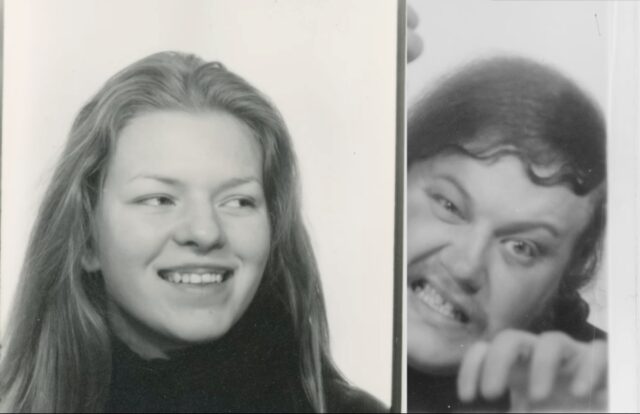
As a child, Karin Pennanen was always very close to her uncle Markku. He was eccentric and a little aloof, spending much time in a separate apartment (Apartment B) within the large family home built by Karin’s grandfather. In family pictures, he always seemed disconnected, but for youngster Karin, Markku was great fun, and a bit mad, like all favourite uncles. He was also a great babysitter and excellent at magic tricks, as well as being a talented artist and musician.
While kids loved him, adults didn’t quite understand him. “We’re herd animals; we follow one another, says Pennanen of the human condition. “He, however, kept his inner child alive. Children think freely and play; adults often lose that connection to what they truly want. He never lost the ability to play. It’s sad that so many people forget it.”
But then, when Karin was 11, Markku disappeared. One day he was there, the next day the apartment was empty, soon to be occupied by Karin’s mother, the textile artist Agneta Hobin.
When, decades later, Karin Pennanen settled on filmmaking as a vocation, she and Markku rediscovered their bond and kinship, and entered into a meaningful and very enthusiastic correspondence on the nature of art and filmmaking.
But it was only after his death in 2021 that she learned of the enormous artistic legacy he left behind, as well as some of the strange secrets that he harboured…and of his decision to record every phone-call he made.
In her debut documentary Pennanen attempts to piece together the disparate elements of Markku’s life, even while much of it is cloaked in secrecy, and to reconnect with her dear friend and uncle.
“Days of Wonder is a film about real freedom, which, more than any external circumstances, is an inner state,” Pennanen writes in her director statement. “The film is about the passion for life and a quest for a genuine existence instead of external success. This is not to say that Markku’s life was easy or [was] only sunshine and smiles. I do not believe that anyone who is sensitive and gifted makes it through life without being wounded in the soul. But Markku’s stamina and creativity, his ability to remain open to all the wonders of life, fascinate me because they are so unusual.”
In the film, we see how Markku was always a maverick, and a loner. He gained places at the Sibelius Academy and the Academy of Fine Arts, but dropped out of both courses. In much later life, he is strapped for cash (we hear a phone conversation with Pennanen’s mother in which he bemoans not having cashed in a vast number of shares) and takes a job as a paper delivery boy. In the line of his new work, he starts a touching platonic romance with a married woman, Marja-Leena, whom we later meet in the film, and who is amazed to discover that the man who was wooing her was an amazing artist who made the most elaborate mosaics from the pages of old newspapers. In a later aerial shot, we see director Pennanen sit within a vast room surrounded by her uncle’s brilliant collages.
“He had been making collages for years,” she says. “We saved sixteen big boxes of these clippings. But there are nearly a thousand collages. He was incredibly productive. It felt like a huge relief for me when I found out he had been making art all along.”
While, for the rest of the Pennanen family, Markku was something of an awkward “burden,” for director Pennanen he was a soul-mate and inspiration. And the feeling seems to have been very mutual. “He was super intense and kind of passionate about things,” she tells BDE. “His emails were like pieces of art…he had been rewriting them and they were they were full of plays with words, and so it was always like giving getting a gift whenever he wrote to me.”
Markku furthermore recorded his reflections on cinema – on what a film should be and the nature of dramaturgy. “In a way, he’d unconsciously been preparing this film himself by documenting his life,” Pennanen observes. “I was simply continuing what he started. It took me a year just to listen to the tapes – and then there was all the other stuff. The dialogue in the film exists on many levels, in a wider, cinematic sense – not just words. Sometimes I respond to his recordings directly; sometimes I answer through images, in a visual, emotional, conceptual dialogue. It’s a cinematic conversation between two worlds.”
As we hear in taped conversations, Pennanen’s uncle was also immensely curious about the afterlife. A priest warns him away from contact with the dead and with angels, reminding him that such other-worldly communication must be undertaken via recognised Church outlets.
The two-world aspect of the film is further underlined by Pennanen’s contact with a medium, who tells the director of Markku’s admiration for Finnish actor Martti Suosalo, whom Pennanen engages to read her uncle’s final email, the one left unsent before he died. As Suosalo narrates the unnervingly lovely text, she stands before the screen that Markku erected in his house, which acts as a “place of transition” between life and death. In a beautiful final shot, we imagine that uncle and niece are once more united.
“For me, the canvas became a border between life and death – my uncle on one side, me on the other – and cinema the tool that allows a dialogue across that border. I like the idea of the cinema canvas being a place where I could meet my uncle,” says Pennanen.
An early qualm that the director felt was in unveiling the artworks of a man who lived such a solitary life, but she soon overcame these fears. He was a man who wanted to show his artworks, but displayed no desire to be part of the process of accompanying them to market. She found notes he made about potential exhibitions, and what’s more the windows that he built in his house were vast, and designed to allow for the removal and transport of larger artworks.
“I actually believe, even more, he was so focused on the process that he didn’t have time the and energy to do it, but at the same time I know he was shy and was criticising himself,” Pennanen says. “Now he has died, I’m the person who took the decision to make his art public and I do that because I think it’s so fantastic…I don’t know if it’s right or wrong, but I just have to take responsibility of that and I have thought through it very carefully.”
When asked to offer a final assessment of Markku, she confers on him a semi-mythical status, one which underlines the depth of a love she feels for her late uncle.
“When I watch the videos that Markku filmed of himself and in which he performs as if for an invisible audience, I cannot help but associate him with a kind of archetypal figure that recurs throughout the history of humankind,” she says. “Chaplin’s tramp, the jester of the gods, the eternal outsider observer… I see my uncle as one of them when he observes the world and the people around him with a keen eye and laughs heartily at our existential, tragicomic struggle.”
Additional questions posed by Dimitra Kouzi.





