

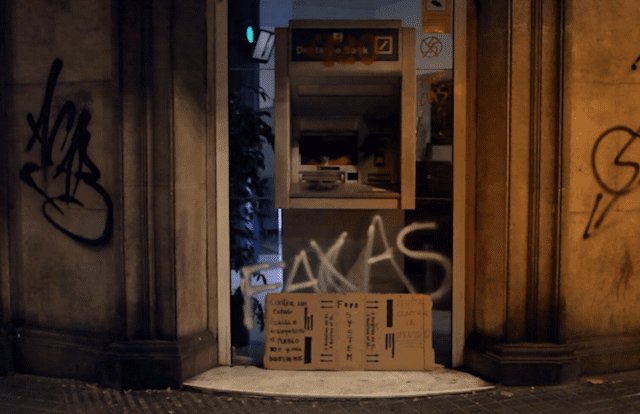
Enric Duran was ingenious, courageous and very intelligent. During the financial crisis just over a decade ago, the Catalonian political activist became a folk hero, nicknamed ‘Robin Bank.’ He worked out a way of securing loans from banks that the banks couldn’t subsequently trace. He wasn’t taking the money for himself but wanted to show up the greed and corruption of the banking system – and of early 21st Century capitalism itself. After a spell in prison, he went into hiding.
Duran is the subject of Catalonian director Anna Giralt Gris’ new feature documentary Robin Bank, a world premiere in the Newcomers Competition in Thessaloniki and also screening in ‘Change Makers’ at CPH:DOX.
The film makes extensive use of animation to get inside Duran’s world – to show his thoughts and his dreams – but also to reconstruct parts of his past of which there are only scant visual records.
“It [animation] was one of the first things I was really clear I wanted to use,” Giralt Gris notes of the work she did with lead animators, Laura Ginès and Pepon Meneses. “One of the things in the character I was really keen to dig in was his way of looking and seeing the world…I really thought that animation was the way we could portray this idealistic world he is trying to create.”
Early on in the documentary, there is a poignant encounter between the director and her subject’s mother. Enric has been on the run and so hasn’t seen his mum for many years. Giralt Gris therefore became a go-between. The mother wanted to hear how her son was getting on. Was he looking after himself? Was he eating enough?
“Through the movie and through my relationship with him, she [mother] knows more about Enric. She asks me typical mother questions.”
She also makes it clear that she is happy that her son is still free, even if he is in hiding, because she knows how much he suffered when he was in jail. “She truly believes in what he is doing,” says the director.
Over the years, Giralt Gris’ own feelings toward Enric have changed. “Of course, when I started the movie, I totally admired him, like a hero,” she says. “When you get to know him more, it is difficult to describe, to summarise…Enric is a really particular person. He is not a person who opens up easily. He is a person who has a super mind. He has a 150 IQ which is super-high…he understands the world very well through the numbers.”
When it comes to emotions and empathy, Enric is less assured. He has a brilliant intellect but, as the director puts it, “there are these huge variables that are not in his equation.” He can analyse why the banking system is rotten but he doesn’t always have a nuanced view of human behaviour.
“Through the years, I have got to know him better. I understand that he is a naive person that truly believed [in] what he did…sometimes, I think, he makes mistakes but he really doesn’t realise. There is this part of the world that truly he is not connected with. That is why animation was helping me.”
The director and her subject are friendly enough to be honest with each other. “But there are certain points where there is this barrier because there is this lack of even vocabulary.”
As the documentary makes clear, Enric is sometimes lonely. He has to live an isolated life.
Late last year, Giralt Gris made another clandestine visit to Enric to show him the documentary. “He was quite OK [about it]. He liked it. It was the first time I saw him completely focused on one thing. Normally, Enric is doing a hundred million things at the same time…”
The director had been worried that Enric might react badly to moments in which she questioned or criticised him, but he had no complaints. “He is used to being a public figure where he is either a hero or a villain.”
One aspect of the film really pleased him. He told her: “You portray my mother very well. She will be very happy.”
As for the director, she relished the chance to delve into Enric’s secret John Le Carré-like world. “At the beginning, it was super-exciting. I was entering in another reality where I didn’t know how it worked and I had to learn many things like encryption of my email,” she remembers. She was “totally guided” by Enric as to what she could or couldn’t do. His safety was paramount and she was determined not to put him in jeopardy.
“[But] I was a little more worried when we were pitching the project at some markets and looking for funding. At the beginning of the process, I was not using my name.”
Now, though, the film Is ready to be presented to the public. The director is looking forward to returning to Greece, a country where she lived for several years – and where she worked on a project about Greek neo-Nazi group, The Golden Dawn.
Giralt Gris continues to work as a producer. She is also an expert on Artificial Intelligence, and is part of the Artificio project, analysing ways of using AI for creative tasks. On the directing front, her next project will likely be about the rise of the “extreme right wing movement here in Spain because it is really bothering me at the moment.”





