

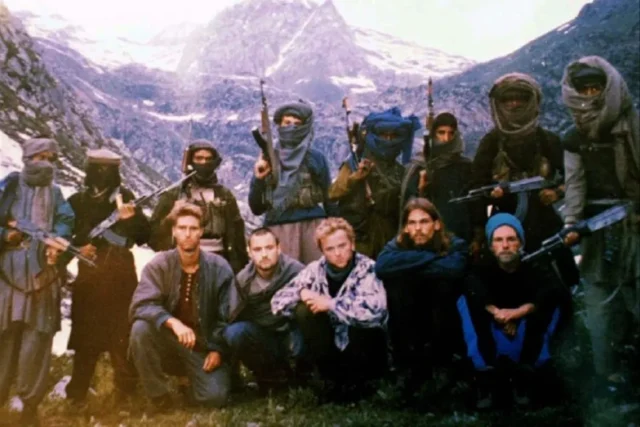
When Norwegian filmmaker Anette Ostrø began work on The Golden Swan, premiering in the International Competition at the Thessaloniki International Documentary Festival, she was stepping into territory that few directors would ever dare confront: reconstructing the abduction and murder of her own brother, Hans Christian Ostrø, kidnapped in Kashmir in 1995 by the militant group al-Faran.
Built around poems and letters found on his body after his execution, the film skilfully blends personal archive, abstraction and reflection to tell a deeply human story rooted in global politics.
Speaking to Business Doc Europe about the project, Ostrø explained that the first challenge was deciding what to disclose from the extensive writings her brother produced during captivity. She revealed she had access to a large amount of material, which made careful selection essential. Together with editor Siv Lamark, she chose texts that could offer insight into his experience as a hostage, illuminate his emotional life and convey his inner transformation. “Much of the material had to be left out simply because there was no room for everything in the film,” she notes, stressing that narrative clarity and emotional integrity guided every decision.
Finding the right cinematic form proved equally demanding. Ostrø said she spent a long time searching for an approach that could honour both the poetry of the texts and the emotional complexity of the story. In essence, she was looking for “a visual expression that could deepen the poetry and emotional layers of my brother’s texts,” while also working with “the contrasts between light and shadow which are constantly present in this story.”
Nature became central to the film’s imagery. Ostrø stresses how she wanted landscapes to function as a narrative element, since “the mountains and landscape were the reason Hans Christian and the other hostages travelled to Kashmir.” The terrain, she said, offered a way to evoke both beauty and danger without literal reconstruction.
At first, she explored a more conventional approach, considering staged re-enactments with an actor because there was very little archival material from captivity. However, she said that when they tested this idea, “the reconstructions did not feel right.” As a result, she shifted toward abstraction and symbolism. “I therefore chose to move toward a much more abstract, poetic and artistic visual style,” she explained.
One of the pic’s most striking choices was to film a dancer representing her brother’s inner life. Ostrø said she wanted to evoke what she described as his “inner feminine dimension, his Anima,” as a way of expressing emotional states that could not be documented. Editor Siv Lamark then layered imagery and varied exposures, and together they developed what Ostrø called “the film’s visual language.”
Because the film touches on terrorism and the history of Kashmir, Ostrø said she was careful to avoid simplifying a complex political situation. She decided early on to tell the geopolitical conflict through the perspective of the hostages themselves. “The film offers insight into a macro-level political conflict by focusing on the human consequences experienced on a micro and deeply personal level,” she says. Hans Christian, she added, arrived in Kashmir as an unaware tourist drawn by the beauty of the mountains, and his story allowed her to explore the consequences of conflict without taking a political position.
Research was extensive. Ostrø confirms that she consulted journalists, books and intelligence reports, noting that the kidnapping and murder were widely covered in 1995 and analysed in later studies. This helped ensure historical accuracy while preserving the doc’s intimate focus.
Representing the captors raised another ethical question. Ostrø explains that her brother’s writings themselves suggested an approach, since he described his captors with nuance. She therefore chose not to demonise them, saying they remain largely in the background and are seen through his perspective.
Financing such a personal film might have seemed difficult, but Ostrø said international partners responded to the project’s universal themes. Although the story was deeply personal, it was framed within an international context, and its core idea—choosing reconciliation over hate—helped financiers connect with it. She added that political sensitivity did not ultimately deter broadcasters or co-producers, who appreciated the film’s artistic ambition and topical relevance.
Archival rights were secured through long-standing relationships. Ostrø said she had stayed in touch with other hostage families over the years and received their approval to use materials. She and her mother hold the rights to Hans Christian’s writings.
Understandably, balancing her roles as sister and director required great care. Ostrø said she had spent many years in therapy working through the trauma and was determined that the film should not become “a grief-therapy film.” Throughout production, she continued speaking with therapists and credited her producers Beathe Hofseth and Siri Natvik, and editor Siv Lamark, with supporting her dual perspective.
Her mother and stepfather were closely involved, she added, watching and approving the final cut. “They are deeply grateful for it,” she said.
Returning to her brother’s writings also revealed new insights. Ostrø says she was struck by his courage and inner strength, and by the way he searched for the best in people even in captivity. What surprised her most, she notes, was “the depth of his awareness,” and how much he was processing internally during those weeks.
If he could see the finished film, Ostrø believes he would recognise its spirit. She describes him as an artistic soul and poet, full of contrasts like the film itself, and said she thinks he would have liked it.
Through its blend of archive, abstraction and reflection, The Golden Swan demonstrates how non-fiction cinema can transform private grief into a shared meditation on memory, ethics and resilience without losing sight of the human story at its core.





