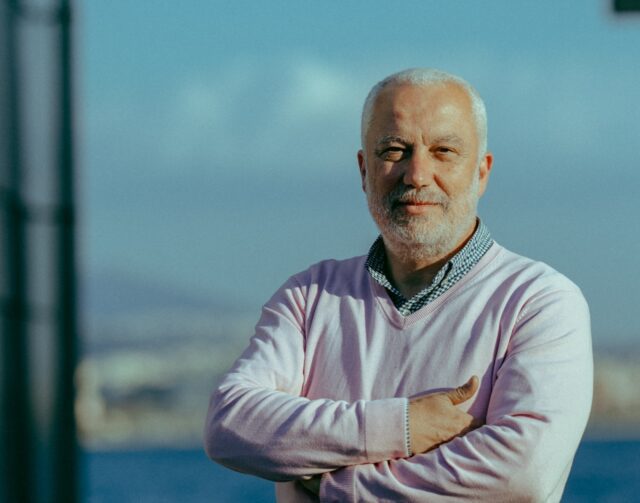
“Finding interesting stories, told in interesting ways is our main concern,” Thessaloniki Doc Fest’s Head of Programming Yorgos Krassakopoulos tells BDE on the eve of the festival’s 26th edition.
“These stories can be huge or tiny, universal or personal, as long as they share something that we believe can be felt in a similar way by two completely different people in different parts of the world. What we mostly look for is that spark that lights up when you’re watching a film that hooks you and won’t let you go till the end credits.”
This year’s Thessaloniki International Documentary Festival, which runs March 7 to 17, boasts 250 films of which 112 are world, international and European premieres.
A dozen films, three of which are Greek, take part in the International Competition. All will compete for the Golden Alexander award, which is accompanied by a €12,000 cash prize, and the Silver Alexander, with a €5,000 euro cash prize.
The Newcomers competition section, featuring debut and second films of up-and-coming film directors, includes another 12 films (once again, three Greek), competing for the Golden Alexander – Dimitri Eipidis prize, valued at €10,000 euros and the Silver Alexander worth €4,000 euros (both are cash prizes).
The >>Film Forward competition section, which “challenges cinematic conventions and showcases unconventional films,” hosts 11 films (two Greek). The Golden Alexander >>Film Forward is accompanied by a cash prize of €6,000 while the Silver Alexander is valued at €3,000.
Within the Immersive: All Around Cinema competition section, eight “pioneering” films will vie for the Golden Alexander Immersive, with a cash prize of €2,000. The art installation The Eye and I by the legendary electro-muso Jean-Michel Jarre will be screened out of competition.
Inevitably, the films that Krassakopoulos programmes are, much of the time, serious works that reflect the serious world in which live right now. Is there ever a danger that aesthetics/cinematic value can suffer, or be sidelined, in the face of an urgent need to tell a story?
“There’s no doubt that exploring an important or urgent story, or following a captivating character is something that most documentary filmmakers start from when setting out to make a film that will take at least a couple years of their life,” he responds.
“And such themes or stories can be a hook for a festival programmer or a member of an audience when the film gets selected,” he adds. “Luckily at this day and date most documentary filmmakers understand that the cinematic value of their work is equally important with the message they want to convey or the story they’re trying to tell. The importance of great cinematography, the mood or rhythm of a film is something that I feel is on the mind of doc filmmakers from the get go nowadays. In most of the cases with this year’s selection, we never had to deal with great stories being told inadequately in technical or aesthetic ways, so no hard decisions had to be made.”
“Also in a program as broad and varied as the one we’re aiming to compile, we have more room to explore and include films of many forms and shapes,” Krassakopoulos continues. “However, in the end, yes, a great story or an important subject matter can make or break a documentary and I will definitely be more open to a technically flawed but really powerful or impactful film, than to an aesthetically perfect one that was lacking the same power.”
The opening film of the 26th TiDF is the animated They Shot the Piano Player by Fernando Trueba and Javier Mariscal. Revolving around the real-life disappearance and (presumed) murder of Brazilian pianist Francisco Tenório Júnior in 1976, the doc stars Jeff Goldblum as an American music journalist investigating Tenório’s case. The Academy Award-winning Trueba will be in attendance in Thessaloniki, where he will be granted the Festival’s honorary Golden Alexander.
“Fernando Trueba is a filmmaker that we admire deeply and someone who has always been working between fiction and documentary, making wonderful films despite their form,” Krassakopoulos comments of the Spanish master filmmaker. “We also fell in love with his latest film They Shot The Piano Player (co-directed with Javier Mariscal), a film that combines a thrilling story filled with music and laced with political undertones, wrapped in amazing visuals. It’s a true gift of a documentary from a filmmaker that has always been a true artist at heart. We couldn’t be happier that he accepted our invitation to be present in Thessaloniki and the Honorary Golden Alexander is a token of our appreciation to his work so far and the work that he will do in the future.”
Unsurprisingly, Greek docs are in the frame at this year’s fest, with 67 full-length and short-form local works in selection, 35 of which are in the international programme. This year, the duration of the digital Platform+ section is increased to 14 days (from March 8 to 22), enabling audiences from all over Greece to watch that 21 Greek films that are available on it. What’s more, the Thessaloniki Doc Fest is hosting a tribute to the “fearless and pioneering cinema” of Panayotis Evangelidis, which “places the issues of the visibility of the LGBTQI+ community under the spotlight, intertwining the personal element with social reality and the necessity of change.”
“The Thessaloniki Doc Fest has always supported the Greek Doc industry and I know that one of the reasons [why] Dimitri Eipidis, the founder of the festival, started it was to create a space where the local talent could be exposed to the international community and the rest of the world could discover Greek docmakers,” Krassakopoulos underlines of the Greek component.
“I feel that through the years this relationship has only deepened. The festival has showcased, nurtured and helped discover filmmakers that have grown and flourished and I know that the local industry acknowledges this help. It’s a symbiotic relationship and one that it’s in the core values of the festival. We couldn’t have been happier to see, only in recent months, Greek docs to be featured in festivals like Rotterdam, Berlin, or the upcoming CPH:DOX. All congratulations for this success should go to the filmmakers of course, but we can’t help but feel proud that the Festival has been there for 26 years now, enabling (in smaller or bigger, in material or even spiritual ways) these filmmakers to do this kind of work.”
How does Thessaloniki’s Programming Head assess the current shape/state of the doc industry? Is the current age as ‘golden’ as we are told? Does this epithet merely apply to the giant streamers or can the independent creative sector be described in equally gilded terms?
“Documentary filmmaking has matured and grown so much in recent years and it’s wonderful to see some of the biggest barriers being broken,” Krassakopoulos responds. “It’s clear that for the majority of the audience, stale, narrow minded ideas of what a documentary film can or cannot be, do not exist anymore, and it’s thrilling to see docs competing with narrative films and getting major awards in festivals like Berlin [where Mati Diop’sDahomey recently won the Golden Bear].”
“It’s also true that certain markets have needs for a certain kind of documentary and yes, sometimes you can feel a sort of formula being at work, in a specific kind of documentary,” he continues. “However, there is a huge wealth of docs being made and is something that we happily re-establish every year during our selection process. Even though there are filmmakers, producers and sales that we know well and work with – or projects that we have been following though labs, pitching or works in progress sessions – every year a big part of our program comes through our submissions. In many cases this means that we’re watching films that we had no idea were being made, and these come from every part of the world.”
“There are some wonderful surprises in there and great talent to be found and that’s nothing less than reassuring. Certainly, independent filmmaking has, and will always be, harder than what it is for someone working for a streamer for instance, but especially after months of programming for the doc festival and seeing wonderful work being made, I can’t help but feel optimistic,” Krassakopoulos ends.