It’s a strange detail in history not widely known. The Cambodian dictator Pol Pot, responsible for killing around a quarter of his own people during the period of the Khmer Rouge, spent part of his childhood at the Cambodian royal court. He was brought up there by his foster mother, Chea Samy, a celebrated dancer who had married Pol’s older brother.
Pol Pot Dancing, the new feature documentary directed by Enrique Sánchez Lansch, looks at this surprising episode. The film, sold by New Docs, is a world premiere in competition at the Thessaloniki Documentary Festival.
Samy survived the killing fields and eventually returned to Phnom Penh where she became a dance teacher. Among her students was Sophiline Cheam, one of the main protagonists in the documentary.
All in all, the director visited Cambodia nine times during the making of the film. He started work on it in 2015 having originally travelled to the country to take part in workshops with young Cambodian filmmakers.
Lansch quickly became fascinated by Cambodian dance. Cheam is now a prominent choreographer and uses her routines to cast light on her country’s recent tragic past. She invited him to watch some of her rehearsals.
He also heard through her about Pol Pot’s links to dance and to the royal palace. “Not something he advertised later in his life,” Lansch reflects.
The director started to “make connections” and to see the narrative possibilities in this tangled tale about a dancer and one of the 20th Century’s most notorious dictators. Pol Pot persecuted intellectuals and artists – and yet had himself grown up in a very cultured background, “in the heart of the royal dance company” as the director puts it.
Lansch can’t answer why Pol Pot turned against his people (and his own family) in such murderous fashion. That doesn’t stop him, however, from asking probing questions about the dictator’s behaviour.
Pol Pot Dancing includes some very rich archival material including rarely seen footage of Pol Pot talking about his youth. “He almost never granted interviews to anybody, let alone television from abroad. But during his student years in Paris, he went for a few months in the summer to work in Yugoslavia. Apparently, he had very fond memories of his stay there. One day, when a Yugoslavian journalist approached the government for an interview with him, he surprisingly granted it.”
This footage, now kept in the archives of Serbian TV, has rarely been seen but is included here. “I think you get much closer to him [through the footage] than through the usual propaganda footage.”
There is also material of Chea Samy. “That I found through an anthropologist from the US who in very difficult circumstances in the years between 1990 and 1994 spent most of his time in Cambodia.”
Structuring the film was challenging. There are many strands there. The film deals with Pol Pot’s childhood and with the period of the killing fields. It also shows the contemporary dance rehearsals, and the filmmaker accompanies his subjects on trips back to the countryside where they’d spent their childhood under the Khmer Rouge.
“It was rather complex,” the director acknowledges. He discovered that a more recent generation of Cambodians who came of age after the Khmer Rouge still feel traumatised at what their parents and grandparents endured. Some would break down on camera even though they were talking about events that happened 40 years before. The director was also intrigued by the way they use ritual to confront the past.
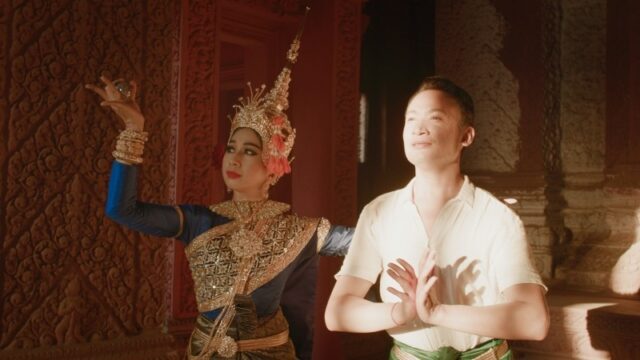
Hands feature very prominently in the documentary.
“I realised that generally dance does not involve only legs and feet but is an expression of the entire body. Particularly in this type of dance, the hands are so important,” the director explains.
The smallest gesture with a finger can change the meaning of a movement. The language of the dance is extraordinarily complex.
But during the reign of the Khmer Rouge, dancers like Samy suddenly found themselves in the fields. Their hands were no longer being used in their routines, instead becoming worn and calloused by the drudgery of manual labour.
Lansch has an unusual background for a documentary maker. He has been involved across disciplines from opera singing to philology and philosophy as well as filmmaking. The director believes this helped him understand better “people who use their own art form to digest the past and to deal with hard historical facts.”
The director accepts that some will ask if he, as a European and an outsider, is entitled to tell such a quintessentially Cambodian story. In recent years, there has been extreme sensitivity within the documentary world about filmmakers appropriating stories that are not their own.
“It’s a question that in 2024 needs to be raised. I started this project in 2015 when awareness and sensitivity about these issues was different… I might not have touched it had it been in 2024,” Lasch states. “[But] I think intuitively I tried my very best to involve my protagonists not only in helping me make the film but also I tried to follow their way of dealing with the past.”
Pol Pot Dancing was made as a co-production with Fruitmarket and Up North. It has support from ZDF/ARTE, Film-und Medienstiftung NRW, BKM, DFFF, NFI and The Fritt Ord Foundation. It is expected to be broadcast on ARTE next year. In the meantime, it will hit the festival circuit and is expected soon to have a theatrical release in Germany. And, yes, the director is determined to screen the film in Cambodia. “That is certainly something that is part of our planning,” Lansch insists.