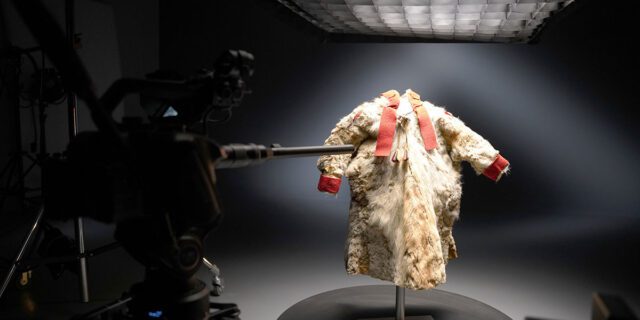
Sámi filmmaker Suvi West muses over why she decided to make her latest film Homecoming (Máhccan), co-directed with Anssi Kömi, a personal story about the return of Sámi artefacts long held in museums, to their homeland, “I have been dealing a lot with representation,” she tells BDE. “So, I think this was one of the reasons why it felt so important to cover this story.” The film world-premieres at TIFF Docs.
Homecoming is one of three Sámi films screening at the festival. West underlines the significance of this, as well as the fact that they are all directed by women. “I think the majority of Sámi filmmakers are women. It’s a matriarchal society, so Sámi women have always been leaders and equal to men. So, it’s not a big deal that women are leading the Sámi film industry,” she explains, but adds that she understands from discussions in the “Western film industry” that equality and female voices are needed, “I totally understand where it comes from.”
The film is set at a turning point where the leading cultural institutions have to deal with their country’s questionable history. “Museums, unfortunately, have this colonial background, so when you go to museums, especially national museums, and you see items from other countries, they are many times stolen, and sometimes, they carry blood with them,” West clarifies. “Museums really have to [start] dealing with the questions of colonialism.”
Will museums cease to exist therefore? They will not, West opines. But repatriation could be the beginning of a new chapter as it gives museums the chance to not only “get rid of the colonial burden,” but also rectify historical facts and provide a more accurate context for the collections of artefacts on display. West adds that instead of talking about facts, museums tell stories, “And those stories are told through the colonial gaze.”
In the film, the process of repatriation provokes tears of joy, but also brings back repressed collective emotions from the nation’s torn history while offering Sámis, for the first time,the possibility to take control of their legacy, culture and self-image.
In that sense, just as the national museums have to deal with their colonialist history, the Sámis have to redetermine their relationship to identity. “I think it was important to me,personally, to make the film because I wanted to get rid of that ethnic burden that has been given to me by the outside researchers throughout the centuries, because [they] really made definitions of what the real Sámi is, how the real Sámi lives and it still has effects in the modern days,” West comments as she ponders the image others have both of the Sámihood and herself.
In the film, West and Kömi take their audiences into the world of museums, which is a spiritual, philosophical and visual space. Even though the objects raise sensitive questions, without connection to the rightful owners they lack emotion or spirit. So the filmmakers tryto connect to their own ancestors and other historical figures. “They are not just items. They carry meaning to those they originally belong to,” shares West.
The makers don’t believe this to be only a Sámi story. It’s set in the Sámi culture but to them it’s a universal story. Even so, West can’t predict the film’s potential impact on other museums around the world and in Scandinavia, where national museums have collections of artefacts pertaining to Sámi groups from Norway and Sweden. “I think the worst situation is in Sweden right now because they are not happy. They don’t want to give back any items to the Swedish Sámi. And there are, I think, drums and human remains, so I don’t know why they are holding them there, but I think they have also started repatriation discussions,” West concludes.