

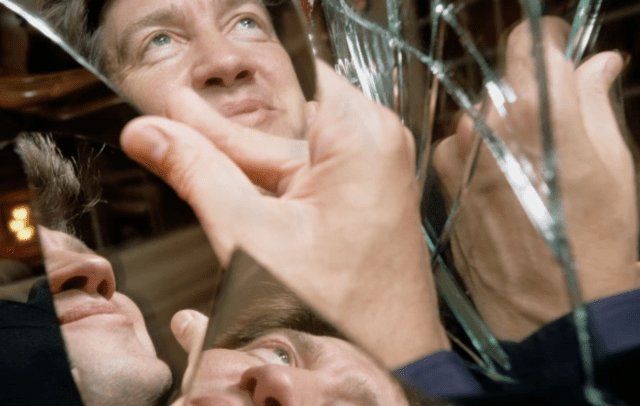
“A certain sort of rabbit hole opens up and I feel like I want to go down [it],” Alexandre O. Philippe explains of his highly cinematic, entertaining and academic [but far from stuffy] exploration of the much-attested to relationship between The Wizard of Oz and the films of David Lynch. “I wanted to see how far this actually goes…it’s a film about, if you will, the mysteries of influence and inspiration.”
“The long-standing symbiosis between America’s primordial fairytale and its greatest, most popular surrealist is not only a Hollywood phenomenon without precedent; it stands as one of the most fascinating puzzles in the history of cinema,” adds Philippe in his notes for the film.
In Lynch/Oz, sold by Dogwoof, the director is joined down the rabbit hole by five filmmakers and a critic whom he invited to provide detailed observations on the conjecture, which were subsequently shaped into essays narrated by each and illustrated with hundreds of clips from Oz, the films of Lynch himself and scores of other works influenced by Victor Fleming’s 1939 masterpiece.
The contributors are film critic Amy Nicholson (essay title: Wind) and filmmakers Rodney Ascher (Membranes), John Waters (Kindred), Karyn Kusama (Multitudes), Moorhead&Benson (Judy) and David Lowery (Dig).
“It’s a multi-step process that we went through, and the first part of the process was what I call having sort of a jazz interview with them over the phone,” explains Philippe of his modus operandi. He would “riff on the idea of Lynch and Oz” to each contributor for hours, recording the conversation, after which he had the basis for his script. This was then returned to each subject for tweaks, notes and approval. “I was amazed at how deep down the rabbit hole we ended up going,” says Philippe.
The observations are continually fascinating, presented with rigour and against a panoply of relevant clips. Critic Nicholson talks about Lynch’s fascination with curtains as a gateway to magic hence marking the divide between reality and fantasy, as well as the concept of wind that both drives the Oz narrative and as a metaphorical force that invigorates the performances in Lynch’s films. Rodney Ascher cites the notion of Dorothy living across parallel worlds but how, within Lynch’s films, the membranes between the layers of reality are altogether thinner, between which exists a nostalgia for a [kind] of ‘Paradise Lost’, “perhaps one that never really existed in the first place,” he narrates.
Jon Waters notes the feuding senses of love and hate both he and Lynch feel/felt for 1950’s America, which are key visual references within the cinema of both. He also references their shared love of villainous over good characters. In Waters’ case, villains were his ‘childhood playmates.” The Good Witch in The Wizard of Oz, on the other hand, “looked like she went insane going to the prom.”
For filmmaker Karyn Kusama, Lynch’s Mulholland Drive is an inverse of Oz, “a much darker register of the Oz narrative.” She also notes how Lynch’s delight in extreme make-up and obvious lip-synching can equally be traced back to Fleming’s 1939 film. She further references the “kind of unconscious courage [whereby] the character is willing to keep opening doors they shouldn’t be opening, to keep going to addresses they shouldn’t go, to keep spying on those they shouldn’t spy on. They invite chaos into their lives because they have to know.”
Moorhead&Benson (Justin Benson and Aaron Moorhead) highlight the array of films across all genres that have been influenced by The Wizard of Oz, such as Pan’s Labyrinth, The Big Lebowski, Apocalypse Now and After Hours among many, and how Lynch’s Wild at Heart references Oz at every turn. The pair quote Lynch in archive: “There’s something about The Wizard of Oz that’s cosmic, and it to talks to human beings in a deep way,” he says. They also riff on Kusama’s notion of duality, that Lynch’s films offer up view of America and its legion of dark doppelgangers of itself, which is also reflected in the dark divide that Judy Garland experienced in her own life.
David Lowery explains how he had only ever seen The Wizard of Oz on a b/w television until seeing it for the first time in colour in 1989. He refers to the film as “a quaalude for the proletariat,’ but while the return to normality at the film’s end may be disappointing and prosaic, the reversion is actually performing a valuable and necessary function, he argues. Such returns to quotidian reality “implicitly promise us that the journey into adulthood will not be as bad as we think it is, and that we don’t have to leave everything behind.”
Lynch/Oz director Philippe underlines the fluid structure of his film, specifically in relation to the ordering of the contributions. “What I love about this particular structure is that it feels that you’ve got one person making essentially a thesis and planting the seed for something. Then the next chapter takes that seed and expands upon it.” And Philippe own role in the process? “[I was] kinda the man behind the curtain on this particular film.”
The clips are not only pertinent and entertaining, they are also abundant. But the process was never going to be easy on this labour of love. “It’s a very grueling, very intense process, and this is certainly […] the most difficult film that I’ve ever made in many ways, but this is a fair use project,” Philippe underlines. “It’s a very, very rigorous process. We take this very, very seriously. My producer Kerry [Deignan Roy] is extremely hard on this. We take copyright very seriously and we take fair use very seriously. So there’s a number of limitations. You can’t just use clips because you want to use them. Each one has to be used in a very specific way, so that’s what makes it so difficult when you have a project of this magnitude.”
Lynch/Oz marks Philippe’s first time at Tribeca, after three bows at Sundance with 78/52: Hitchcock’s Shower Scene (2017), Memory: The Origins of Alien (2019) and Leap of Faith: William Friedkin on The Exorcist (Venice Film Festival 2019, Sundance Film Festival 2020).
The new film is lined up for a further fifteen film festivals, although Philippe wasn’t at liberty to divulge which. “I’ve always wanted to premiere a film [at Tribeca] one day, especially because it is the location of my alma mater. I went to NYU, to the writing program. It’s really great to come back to New York City.”
“So there’s no place like home,” I suggest. “Yeah. In a way,” Philippe laughs.





