

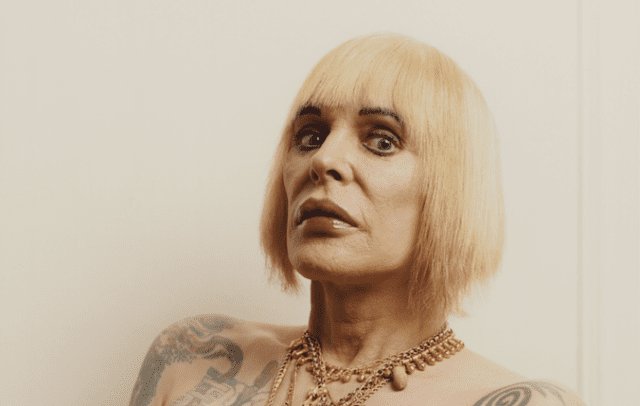
When I was a kid, Throbbing Gristle was one of those bands whose name you just loved to say, especially in the presence of uncomprehending and disapproving adults for whom the term ‘industrial’ was to be applied to the workplace, not to ear-splitting musical anarchy.
The founders of Throbbing Gristle were Genesis P-Orridge and the equally notorious Cosey Fanni Tutti, both of whom who shocked London’s chattering classes in 1976 with their highly transgressive, sexually explicit ‘Prostitution’ exhibition, presented under the guise of Coum Transmissions.
For Genesis, Cosey was the first of three ‘cosmoses’ he experienced throughout his (subsequently her) life. (He defined ‘cosmosis’ as the “transference of positive energy from one human being to another.”) The others were Paula, the mother of their two daughters Genesse and Caresse, and the astonishing Lady Jaye, initially a paediatric nurse by day/dominatrix by night. Over the course of 14 years as they lived out their Pandrogeny Project, Genesis and Lady Jaye sought to morph both physically (via surgery) and cerebrally. Theirs was a huge love.
Between times Genesis was a friend of William Burroughs who advised him that his “job is to learn how to subvert control,” which he did with Throbbing Gristle, the outfit he describes as “a successful, radical, innovative band with people who can’t play.” The gigs back then were wild and charged, and death on stage always seemed a possibility.
David Haskins, bassist for the legendary Goth band Bauhaus, describes Genesis as an “arch provocateur” and advised him to “stay alive out of spite” to scotch the hopes and wishes of audience members desperate to witness the ultimate end to the show. Haskins further opines that Genesis was “highly manipulative, seductive and alluring.”
When Throbbing Gristle split up, Genesis formed Psychic TV (described as “the other side of pop” and “too shocking, even for punks,”) whose posse of devoted followers were, we are told, “the last major network before social media.” Activities within their Brighton HQ were highly sexualised, uber-libertine and ritualistic, and it wasn’t long before Scotland Yard (the London police force) got hold of a video tape detailing lewd goings-on, at which point Genesis and his new family hot-footed to Kathmandu, then onto the US where they remained.
“There’s always a very thin line between jail and creativity,” Genesis says. “Why are there laws about sexuality? To control you.”
His meeting with Lady Jaye in 1992 was transformative, a person who helped him answer the deep questions he always had about gender. “I feel really uncomfortable being a man,” he says on tape.
And so s-he devised a manifesto with Lady Jaye whereby they would fuse into one pandrogenous entity. “Both subsume our separate bodies, individuality and ego to an ongoing and substantially irreversible process of cutting up the identity to produce a third being, an other entity that we are calling the pandrogyne,” they announced. “We are challenging DNA and refusing to accept DNA as the final…programme that records our biology of life.”
The film thereafter records his life with Lady Jaye, and his life without her after her sudden death in 2007. The Pandrogeny Project and Genesis’ gender transformation continued through to her death in 2020.
Director David Charles Rodrigues describes the extraordinary way he came to make his feature doc about a person he had never hitherto met, although he was an admirer of Genesis’ art and music.
“Gen came to me in a dream and I never have these vivid dreams – ever,” says Rodrigues who still registers surprise at the story he is telling. “[In the dream] Gen came into my house and like a nerd, I was like, ‘oh, let me show you the art of yours I have.’ And every time I went to show her the art, it would disappear and it would be a blank wall. And I was so embarrassed. And I was like, ‘no, I swear I have the art.’ And then Jen put her hands on my hands, and it was like this weird, energetic current that was happening. Gen looked at me and said, ‘darling, don’t worry. I’m transferring all of my knowledge to you right now.’ And I woke up super impressed with that dream. It was a rare occurrence.”
So, fast forward a few months when Rodrigues was introduced to Genesis by a mutual friend. “I went to Gen’s house, we start chatting, and I finally have the courage to tell her about this dream. Gen laughs, pulls out a book she had just published with her conversations with Brion Gysin [painter, writer, poet and friend of William Burroughs]. And to be totally honest, I didn’t really know much about Brion Gysin up until then. And she opens the page, and the only part of the whole book that’s in all caps is a quote from Gysin. It says, ‘knowledge can only be passed through the touching of hands.’ And we look at each other and we just start laughing. And that was the moment where we kind of did this spiritual agreement that I was going to make this film with her.”
Genesis P-Orridge’s deep ruminations on the politics of the body pre-dates by half a century the debates which are currently raging, Rodrigues tells BDE. A fortnight before Genesis’ untimely death in 2020, the director visited her at her apartment in New York. “She pulled out this notebook from maybe the late sixties, early seventies, and in the notebook it already had the word ‘pandrogyne’ in the concept of the art exploration that she later did with Lady Jaye. Since Gen’s late teens, early twenties, she was already thinking of that, which means it was what, 50 years ahead of its time?”
“Especially after Gen met Lady Jaye, [her mission] was really to transcend the shape and the conventions of the body, ” Rodrigues continues. “Gen met the person who he always wanted to become, and Lady Jaye allowed him/her to become that. It was almost like Lady Jaye became his permission to be himself. And it’s so profound because being himself was also becoming her and, for me, that’s just such a profound [thing]…After the tragic death of Lady Jaye, I truly believe that Gen became the embodiment of both of them.”
One can be pretty certain that in these deeply conservative and litigious times, a show such as the political and culturally challenging 1976 ‘Pornography’ would never be countenanced. How did Genesis view such 21stCentury conservativism within the artworld? Did director Rodrigues discuss the issue with her?
In essence ‘no’ is the answer, but Rodrigues has his own response to the question.
“The answer truly is the commodification of art. And not just in the art world, but in music,” he says. “I think film is maybe the last bastion of expression where you can get away with some things… In the sixties and seventies, even until the early eighties, art was the transference of knowledge and of expression. And I think now art is the transference of capital, and that’s very clear when your main art stars are Jeff Koons and Damien Hurst (who I actually admire because he was able to subvert that).”
“I think that’s the main difference, and that’s why I feel like after finishing the film and just watching it through myself, I was like, man, with this film I think I can help a lot of people by showing show that there was a time, and there are still ways how you can live this purity and this naivety, that art can be the ultimate form of self-expression if you’re willing to take those risks, and if you’re willing to be your true self. [The story of Genesis] is almost like the coming-out story of being a true artist with no strings attached, and no other goal,” Rodrigues signs off.
S/HE IS STILL HER/E – The Official Genesis P-Orridge Doc by David Charles Rodrigues world premieres at Tribeca June 7 before its selection for Sheffield DocFest.





