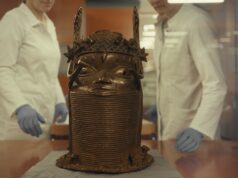
“It’s always good to tell sad stories with a glimpse of burlesque humour,” Italian-Swiss director Davide Tisato reflects on his new project Two Donkeys and a Saint (Il Nostro Miracolo, presented this week in Visions du Réel’s ‘Swiss Films Previews’ strand).
In the film, a motley crew of inhabitants from rural Tuscany set out on a 200km walk to the Vatican in Rome to petition the Pope to intervene on behalf of their struggling community. They’re accompanied by two donkeys and a statue of a local saint, ‘Santa Caterina.’
“It’s a very idiosyncratic group of people. It is a bit of a Don Quixote-esque endeavour they embark on,” agrees his Zurich-based producer Michael Graf of Cloud Fog Haze Pictures.
Everything started when Tisato, who has lived in Switzerland for many years, returned to Montegiovi, the Italian village where he had grown up. “It’s the non-touristic part, the forgotten part of Tuscany,” the director explains.
Tisato was startled by how much the community had changed for the worse. The population had dwindled. Across the village, buildings were crumbling and in a shocking state of disrepair. The sewers weren’t working properly. Even the rectory was showing cracks. Any sense of shared values was “fading away” too. Young people had fled the village to look for jobs in the big city.
“Now, there are only 150 [people] left,” Tisato notes. When he was a boy, over 800 people lived here. A little further back in time, the population was at over 1500.
Seeing all this change and decay, the director was determined to improve community fortunes. Neither the church nor the local authorities were doing anything to help and so he took matters into his own hands.
Producer Graf had been in touch with Tisato since 2020 when he saw Carbon, a short film by the young director in an online festival. This was about two ageing coal miners in Cuba. Graf immediately noticed the director’s talent and originality. “I just basically told him that whatever you want to do, I am here to support you,” Graf recalls his message to the producer.
The donkeys are lovable and very stubborn. “As stubborn as we are in our village,” Tisato states. “I really liked the donkeys because they are a good symbol for our world. Farmers were working with them until the 1980s and had a strong relationship with them.”
He adds that, in Greek mythology, the animals are often linked with defiance and subversion of traditional power relations. “Also, you don’t do war with donkeys. Donkeys are humble…but they have their own way of thinking. That’s why we thought that having the donkeys with us was good.”
This was Tisato’s first feature. Not only was he making a movie. He was also organising an epic two week walk that involved characters of every age. The oldest of the modern-day pilgrims was 84-years -ld. They all looked to him for guidance and leadership.
“For Davide, it was a very hard shoot,” Graf acknowledges. “He was also one of them [the villagers] and it was a difficult role for him to navigate.”
No, the travellers didn’t get to meet the pope. At the end of the journey, once the convoy reached the Via della Conciliazione, just before they arrived at St Peter’s Square, the donkeys were turned back.
Nonetheless, in the course of the historic walk, friendships between the villagers were reignited and old enmities were forgotten. “People started to talk to each other who hadn’t spoken in years,” Graf notes of the camaraderie that the film has renewed.
Media outlets picked up on the story and the travellers were featured on national TV in prime time as well as in many newspapers.
The travellers may be carrying a statue of a saint with them but the director says that religion isn’t really what drives most of them. Sabrina may be a devout believer but Giovanni is an anarchist and many other shades of opinion are also represented among the pilgrims.
“It [religion] is a framing device. It [the film] is more about finding ourselves and finding our community. In this sense, it is a spiritual journey.”
“There could have been a version with a Hollywood-like happy ending which would probably have made for quite a soapy film but what we have captured is a bit more profound and a bit more truthful,” Graf suggests. “It is quite a divided country between the hinterland and the cities. What we are hoping for is to foster a dialogue between those two parts of the population.”
Tisato emphasises that Montegiovi is far from unique. “Italy has so many small towns and there is this movement [of young people] leaving to go to university or to find work. So they [the towns] get more and more abandoned…”
The hope now is that there will be more public support to keep the rural communities alive. Graf observes, though, that “grassroots activism” and “doing it yourself” is often the best strategy.
Nyon marks the “industry launch” of the project. The filmmakers are a few weeks away from picture lock. They will do the post-production over the summer with the aim of having the film ready for autumn festivals. In Nyon, they are screening an eight-minute excerpt and are looking for sales agent representation and to entice festival programmers.
The documentary has been made with mainly Swiss support but there is an Italian co-producer, Chiara Galloni, and the film has received Italian tax credit support.
Tisato is now back living in Tuscany. The statue has been returned to the village church. The two donkeys are living in the director’s olive grove – and are much in demand at the local primary school. When he is not directing documentaries, Tisato makes his own olive oil – which he says is the prefect relaxation.
Swiss distribution of Two Donkeys and a Saint is handled by Frenetic.