

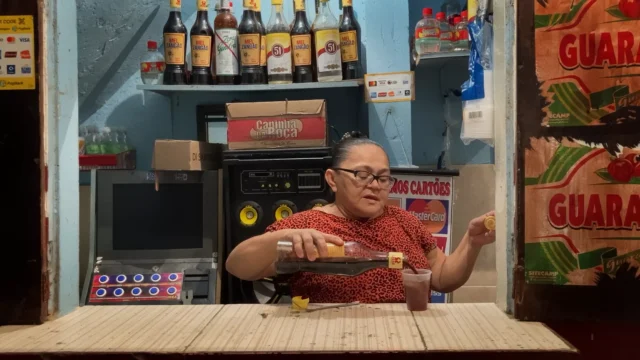
Gunshots can sometimes be heard in the Chapéu Mangueira favela in Rio. Drug traffickers and police are engaged in a long running war of attrition. But people live here too. Kids are raised, businesses are run. It is also here that Emma Boccanfuso has made her new documentary, Saudades Eternas, a world premiere in International Competition in Visions Du Réel.
In the film, she follows the remarkable Mother Courage-like Sueli, a flamboyant local woman fighting to hold her extended family together, running her own makeshift bar and enjoying plenty of gossip with the neighbours.
“It was in 2015, quite by chance, during my first trip to Brazil, that I discovered Chapéu Mangueira. I was there as part of a university exchange with the Beaux-Arts de Paris. I got lost in the narrow streets and met Sueli, who was hosting a barbecue, and with whom I immediately felt a connection,” the director explains her very close links with the subject of her film.
“I went back to see her, and I very quickly found myself propelled into the heart of the home and the intimacy of this family. From there, a deep friendship was born, to the point that I have been coming back several times a year to see them for the past ten years.”
Spending time with Sueli, Boccanfuso, an artist and filmmaker who spends her time between France and Brazil, began to understand the challenges facing the community. Life in Chapéu Mangueira is cheap. The cops might kill a man just because he is carrying an umbrella (and then they’ll claim they thought it was a gun). Money is tight. Even so, there is a strong sense of community and optimism.
“Intrigued and moved, and despite the obvious violence, I decided to move to Chapéu Mangueira,” Boccanfuso continues. “It is a way of existing that moved me deeply. My desire to make a film was born from this encounter. Over the years, filming became a way of paying tribute to them, with all the affection I have for them, for what they put in place on a daily basis in order to survive in the turmoil of violence and death that they are constantly confronted with.”
Sueli’s children and grandchildren soon began to regard Emma as part of the family. She has watched them grow up over many years and has always been struck by their resilience.
“While Sueli, physically affected by the anxiety linked to the drug trafficking, watches over her grandchildren, they themselves seem much less sensitive to the bursts of gunfire that punctuate their daily lives,” Emma observes. “In the film, it is also through their gaze that we experience the war. In particular through play, the reproduction of gestures, and the mimicry of traffickers.”
Filming was done in an intuitive way, over a long period of time. “It became like a kind of ritual each time I came back. I filmed alone with my phone, which allowed me to work in a light and spontaneous way.”
She evolved a very particular way of working, using fixed frames “like paintings” to observe, but to still leave room for “unexpected events.”
“The characters are free to move; they come closer to the camera, enter and leave the frame… These static shots, slightly distanced, also help establish our relationship. It is through my gaze that we access them, but I also want the film to make visible what is happening between them and me. Sometimes we return to the same framing to capture moments that will echo others, filmed in a similar way. This device reflects a shoot spread over a long period of time, and gives each captured scene a sense of familiarity.”
Sueli’s house was always busy with friends and relatives. The camera may be still, but there is continuous activity. The good humour within the household is only partly undermined by the sounds from outside – the arguments and the gunfire.
“In this film, I chose to depict violence without showing it. We experience violence through off-screen sound. We hear the gunshots, the traffickers’ radios, Sue speaking to them from the window… It is a deliberate choice not to show the traffickers, and to make this war visible and tangible through the power of sound.”
“When I arrived in the neighbourhood, this daily life marked by the fear of shootings was completely foreign to me. I instinctively relied on the reactions of the people around me. At first, I experienced this external violence in a very visceral way, like Sueli. Then, I would not say that I got used to it, rather that I chose to adjust my emotions by aligning myself with those of Wendel and Jaqueline, in order to experience these episodes in a less anxious way.”
The violence hit home in devastating fashion when Rodrigo, a close relative, was murdered by the police. The fury over this random killing helped draw the community yet closer together. Boccanfuso regards her film partly as a tribute to his memory.
The screening in Nyon marks the world premiere of Saudades Eternas. The director did screen some of the footage earlier at an event at the Centre Pompidou, organised by La Cinémathèque du documentaire at the Bpi, in partnership with the CNC.
It was agreed with the family, from the very beginning of the project, that Saudades Eternas would not be screened in public in Brazil, in order not to expose the protagonists to any potentially embarrassing situation related to the conflict taking place in their favela.
Now, though, Boccanfuso is back working in Brazil, preparing a new project looking at Copacabana beach “from the inside.” Her intention isn’t to take the point of view of the tourists but instead to explore from the perspectives of those who rent out the parasols and “turn this space into a daily place of work.”
Saudades Eternas is produced by Flavia Zanon of Close Up Films (Switzerland), and Anne-Catherine Witt of Macalube Films (France).





