Two parts of Peter Mettler’s planned seven-part series While the Green Grass Grows world premiered in International Competition at Visions du Réel. Centred around the last days of his mother and father respectively, the films are a meditative experience with a calm and clear flow. As easy as floating down a river.
Whether a film is long or short – or feels long or short – has very little to do with its actual duration. A ten-minute film can drag; a ten-hour film can be over before you know it.
Especially when the filmmaker masters what Andrei Tarkovsky described as the time-pressure of a film, creating the subjective experience of a continuous flow of time (Andrei Tarkovsky: ‘Sculpting in Time,’ 1986). Contrary to the dialectical approach of his compatriot Sergei Eisenstein, who sought cinematic meaning by juxtaposing images through editing, Tarkovsky wanted you to experience time flowing through the shots, and continuing seamlessly from one shot to the next. If the viewer is in tune with this filmic flow, they can let themselves be carried along, as if floating on a river.
And a river is precisely the recurring motif of While the Green Grass Grows by Peter Mettler, who mentioned Tarkovsky’s book during a masterclass he gave at Visions du Réel in 2020, as reported by Business Doc Europe. Referring to his film The End of Time (2012), Mettler said: “[T]he very experience of watching the film that you are watching is a process of contemplating what it means to be, what it means to be in time.”
The same could be said about the two parts (1 and 6) of Mettler’s planned seven-part documentary series While the Green Grass Grows, which Visions du Réel is screening this year in International Competition.
If all this sounds too academic, rest assured: the film is anything but. It is, for the most part, a tranquil stream of thoughts and impressions, with one moment leading naturally to the next. As if the narrative, as Mettler describes of the Rhine, simply follows along “the path of least resistance.” It is meditative, in the sense of both calming and clearing the mind. It is about letting go and letting life lead you.
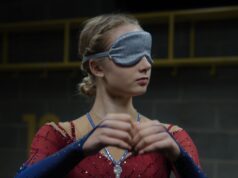
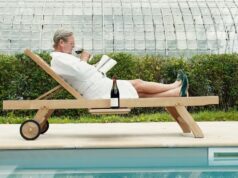
Which was very much the original plan Mettler had for his project. He was going to ask people what the phrase ‘the grass is always greener on the other side’ meant to them, and have them imagine someone they would rather be – say, a film journalist – and then look for that kind of person and repeat the process. Thus weaving a tapestry of human longing.
It was a wonderfully open-ended plan which he started filming in 2019. But then, as often happens with documentaries, life intervened. Both of his parents passed away, and the Covid pandemic interfered with travelling and meeting people. However, having seen only two of the seven intended parts of While the Green Grass Grows, it’s too early to know the effects on the project as a whole, which is looking for financing in the “Work in Progress” industry section at Visions du Réel, to complete the largely edited other five parts.
For now, we have these two finished parts with their feeling of life flowing from one moment to another – without being necessarily in chronological order, interestingly. What Tarkovsky called ‘time-pressure’ depends on everything that’s in the frame (the amount of movement, sounds, things, people, information, change, emotional impact et cetera), which together determines the subjective experience of the flow of time within shots and from one shot to the next. As Tarkovsky demonstrated in The Mirror (1975), which is based on memories, you can jump through space and time as much as you like, once you master that time-pressure. Just as our minds can jump all over the place, and still flow naturally.
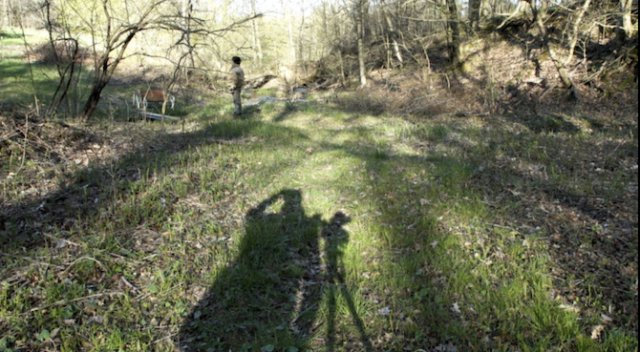
At times, While the Green Grass Grows seems close to such a ‘stream of consciousness’. Especially when Mettler films nature (a forest, a river, falling snow, a setting sun) and when he contemplates matters in voice-over. Apparently I’m in tune with his aesthetics, because I find his way of filming nature endlessly easy to watch. Each shot seems to last exactly as long as it should, allowing me to look around, take in a detail or two, and then ending just before it might possibly get boring. Meanwhile the layered soundtrack, which itself is something of a rhythmic and musical stream, helps to guide our attention smoothly from one scene to the next. Because in Tarkovskian editing one should feel neither rushed nor bored. In both cases, it would mean the disruption of the flow.
Which does sometimes happen in While the Green Grass Grows. In the first part, which is centred around Mettler’s mother, this Tarkovskian flow only really gets interrupted when Mettler turns to vérité filmmaking for certain scenes. For example, when he follows a neighbour into an abandoned mine. It’s an interesting trip and they’re having an interesting conversation, but you can feel the change in the film’s rhythm. Instead of the clearly controlled flow of images of rivers and trees, here the camera searches and follows. It is sometimes late, and sometimes shaky. When we get back to nature after this scene, I feel a certain calm returning to me. It’s as if we moored our boat, had a walk around, which was interesting, but now I’m happy to be back on the river, floating downstream.
In the second part of this presentation – intended as the sixth chapter of the final seven-part series – the flow gets interrupted more dramatically. Which makes sense, since all our lives were interrupted by the global Covid pandemic. Suddenly Mettler is (often) stuck indoors, and sitting behind computer screens. Interestingly, this noticeable disruption of the filmic flow actually captures something intangible about these days – I think that in ten years or more, when this global pandemic has truly passed into history, these scenes might well recall something of how it all felt.
This sixth part focuses more on Mettler’s father – although his mother still makes a few endearing appearances. There is some talk of reincarnation, including an interview with the Dalai Lama that Mettler filmed years ago, which didn’t impress me much intellectually. But it works cinematically. By not filming chronologically, but having his parents return alive and well after we have already seen their funerals, Mettler underlines what film is and does: holding on to life beyond death. These scenes with his parents – both of whom seem like lovely people – are there for as long as anyone wants to watch them. It’s a resurrection every time we press play. So that even after her passing, we can hear Mettler’s mother say: “Hopefully it all will go by, and it will be in the past, and I will kick my heels again, and go dancing – somewhere.” This is about filming time – time spent with loved ones, time spent with beauty – and moulding it, repeating it, and combining it into the flow of memory, contemplation, and art.
Remarkably, even those scenes where Mettler was stuck inside simply talking to his father, where the control necessary for Tarkovskian editing would seem unattainable, somehow they still flow. I still have the feeling of being carried along by life, instead of factual information, dramatic logic or emotional manipulation, as in most films. I think it is because Mettler’s filming, and especially his nature scenes, does not feel driven by awe or even curiosity, but by a basic friendliness to his surroundings. And to us, his audience. It’s about looking calmly, accepting what’s given, recognising the beauty and sharing it.
Switzerland/Canada, 2023, 166 minutes
Director Peter Mettler
Production maximage, Grimthorpe Film
Producers Cornelia Seitler, Peter Mettler
International sales maximage
Cinematography Peter Mettler
Editing Jordan Kawai, Peter Mettler
Sound Peter Mettler, Jordan Kawai, Massimo del Gaudio, Jacques Kieffer, Peter Bräker