If you can’t stand blood, you should sit tight for Yamina Zoutat’s multi-layered, sometimes poetic, at times investigative, at other times very explicit documentary about blood. The film constitutes an equally personal and universal reflection on the importance and significance of the liquid of life.
Reporter Zoutat first takes us to a court case in the early years of her journalistic career, in the late 1990s. The case concerns the death of a young woman and her young child. Both died of the then-deadly disease AIDS, which the woman had contracted during a blood transfusion.
During the coverage, the television reporter Zoutat (as she was then) was strictly instructed not to show any blood, a restriction she eschews in this film with greedy pleasure. The fluid is the inevitable red line running through the story, from the donors in the sterile hospitals to driver Mohamed’s car equipped with flashing lights and sirens, transporting the precious commodity to another hospital in Zoutat’s hometown of Paris, where specialist Stéphanie is ready to administer it to patient Isabelle. Blood as the precious saver of life.
But Zoutat does more than just portray the physical path of this blood. Each of the characters involved in this process is gradually developing. They are shown in fragments of their daily life. They talk about the blood ties with their loved ones, what those ties mean to them, and explain what else, other than blood, defines their origins and identity.
This information bleeds through the characters’ casual conversations and their interactions with others, which gives you time to ponder. What makes each person who he or she or they is, when apparently you can have all your blood replaced by someone else’s – complete with different chromosomes and DNA. We learn that a female patient can have new XY chromosomes in her blood when it is replaced by that of a man. How does that affect her femininity? And can she still talk about a direct blood line with her children or her parents?
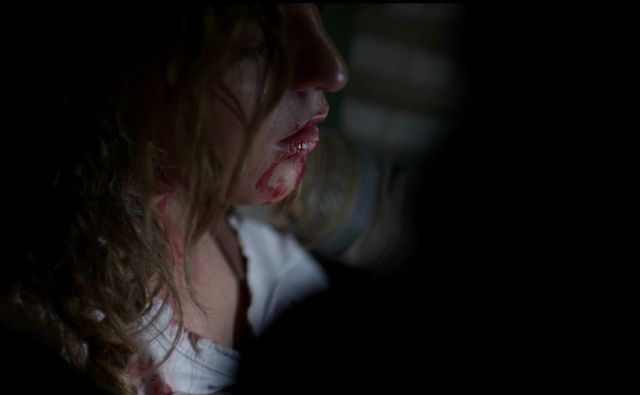
The more conventional documentary footage of the blood transport speeding through Paris, medical examinations and surgeries is interspersed with poetic and sometimes disturbing images of the filmmaker’s quest for blood in a forest, accompanied by a blood hound (or chienne de rouge). In extreme, disorienting close-ups, she indulges her bloodlust, and gives it the space it had hitherto never been granted before.
This obsession with blood turns out to be rooted in her having to undergo a blood transfusion as a baby because she could not tolerate her mother’s. In her veins, which occasionally feature prominently, flows the blood of a complete stranger.
Chienne de rouge is a film that demands all your attention because it has so many different components, and generously sprinkles facts, philosophy, science and emotions in a manner which is not overtly logical or orderly. More or less linear narratives, such as about the process of blood donation, the court case (and those of other victims of contaminated blood), are randomly interrupted by Zoutat’s reflections and musings, accompanied by images that are not for everyone: menstrual blood dripping down a toilet, nosebleeds, a roe deer’s open belly, and blood-red fragments from old films.
Those who can get over their perhaps very human aversion to blood and allow themselves to be drawn into this journey full of side paths and diversions will be rewarded by a new perspective on this substance, as natural as it is magical, which very clearly for Zoutat runs thicker than water.
France, 2023, 97 minutes
Director: Yamina Zoutat
Production: Joëlle Bertossa, Marion Chollet, Richard Copans
Cinematography: Clément Apertet, Hugo Orts, Yamina Zoutat
Sound: Sylvain Copans
Editing: Damián Plandolit