My Skin And I, the new project from artists and filmmakers Milton Guillén and Fiona Guy Hall, is generating buzz even before its completion. It won two awards at VDR Industry this week after being presented in the Works-in-Progress section and has already secured funding from both US and European sources. Backers include Chicken & Egg Films and ZDF/ARTE.
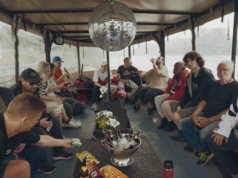
This is a story about an exiled Nicaraguan music producer living in Berlin who pursues a dangerous creative obsession that, he fears, clashes with the needs of his family.
Interviewed in Nyon, the filmmakers remain coy about giving away too much about My Skin And I (which is still a working title). However, the American and her Nicaraguan partner do talk about the roots of their creative relationship. A few years ago, multimedia visual artist Guy Hall was brought in to work on an experimental music film that Guillén was making in collaboration with other artists. Her job was to create a “sculptural mask” for the performer.
That was how the duo first met, and they went on to collaborate on the documentary short Tierra De Leche (2023), about Central American dairy workers in the north-east of the United States, reflecting on labour practices, colonialism and their relationship to the land.
What Guillén will say about My Skin And I is that it is “aesthetic, political and emotional” in its account of the experience of the Nicaraguan exiles. “It’s a film that starts in a place of lyricism and it goes toward a place of a bad trip,” he states.
The project began because Guillén wanted to return home to Nicaragua to make a fictional film. Then, when his protagonist went into exile, it was reconfigured as a documentary. “The project really lives in this space where the political intersects with the personal and [looks at] how these two aspects of our lives are fundamentally intertwined,” Guy Hall adds.
The filmmakers have moved to Berlin themselves because of the film, working closely with an exiled family there. Their documentary explores what they call “a space between observation and more fictional techniques…we have a lot of fun on set exploring that whole spectrum with them.”
“Music, performance and partying, all these elements that are part of their lives, are coming into this,” Guillén observes.
Both of the filmmakers have been fellows at the Harvard Film Studies Centre, developing the project. “We’ve been filming the project through fellowships in the US, Firelight, ITVS and others. That gave us for the first two or three years enough rhythm to continue shooting. Then, eventually, we found co-producers in Germany,” Guillén explains how the financing was drawn together.
Guillén and Guy Hall have been making the film through their US based outfit, Solaris Film. The German partners are Mayana Film, the Berlin-based company set up by Zorana Musikic and May Odeh in 2022. The German partners were able to source financing for the film both from the German Federal Film Board (FFA) and Creative Europe MEDIA.
“The film is operating in multiple registers in which we are interweaving things that ground us in Nicaragua both as a place of history and a place of possibility,” Guillén reflects.
The filmmakers uses archival footage to “contextualise how a family can be displaced.”
“The film incorporates archive in more of the traditional sense of found footage, and it has an archive of its own because the project began in one place and was completely changed when our protagonists left Nicaragua,” Guy Hall elaborates. “It has the sense of an archive of an older film, a film that was never finished, and there is then a new film that takes up the reins in a new place – so it has different layers in the way it engages with active.”
Both of the film’s protagonists were working in the music industry in Nicaragua.
“This is their world and the film inhabits this with them, both in terms of the score being an important place where different musical influences are coming together and in scenes that play out both the joy and ecstasy that comes with music and also the catharsis and deep release,” Guy Hall says.
They were working with Diego Noguera, a Chilean-born, Berlin-based artist and composer. The crew also includes technicians from Cuba, Nicaragua, Yugoslavia and Palestine, all of them either living in exile or part of the diaspora from their homelands.
Ten minutes of the film, which is at rough-cut stage, were screened in Nyon. The filmmakers have been attending Visions du Réel looking for some extra funding for visual effects and sound editing. They’re also trying to find the right festival for the film’s launch.
“We are not rushing it but the film is very [nearly] ready…” Guillén says.
On April 22, the project won The Party Film Sales Award in Nyon, worth €3,000 in cash but also important as an endorsement of its international potential. It also picked up the Masé Studios & Color Grade Award, which will help with the creation of a DCP package of the film.
Guillén and Guy Hall now have their main base in Berlin. “But we have been bouncing about quite a bit,” Guy Hall says of their continuous travelling. She is soon to head to Massachusetts Institute of Technology [MIT] for grad school in Art, Culture, and Technology (ACT). Meanwhile, Guillén still teaches film production at the University of Vermont.
My Skin And I addresses “authoritarianism” but, as both filmmakers point out, this is far from being an exclusively South American problem. Artists across the world are starting to “self-censor” their work in a way that would have been unthinkable a few years ago. Exiles who fled repressive regimes in search of freedom of speech are increasingly finding their voices muzzled.
In 2024, Guillén participated in the Venice Biennale with the video installation piece Torita Encuetada, made in collaboration with multidisciplinary artist Elyla and combining Nicaraguan folklore with an exploration of sexual and gender-diverse identities.