Depending on your vantage point, Ted Hall was either a naive idealist trying to stop another nuclear tragedy like Hiroshima or he was a traitor who betrayed his country. Hall gave secret information about the bomb to the Soviet Union. The young American was a prodigiously gifted physicist, recruited to be part of the Manhattan Project when still a teenager. Inevitably, his decision to share confidential information with the Russians had a seismic effect on his own life.
Hall’s story is explored in Steve James’ new feature documentary A Compassionate Spy (screening Out of Competition in Venice).
Asked how he feels about Hall’s actions and the veteran documentary maker (whose previous credits include such classics as Hoop Dreams and Stevie) gives a measured reply.
“I would say going into it [the film], I was predisposed to be supportive because I felt like what he [Hall] did, whether it was right or wrong, was done for the right reasons. His intentions were good,” James reflects. “For such a young guy – he was 18 when he went to Los Alamos and 19 when he decided to share secrets – it was an incredibly bold thing to do.”
James is convinced that it wasn’t ideology that drove Hall. As the title of the film suggests, it was simple human compassion.
“He did it for the right reasons. He didn’t do it because he wanted the Soviet Union to dominate the world. He did it because he was worried about what the US was capable of.”
Hall died in England in 1999. The FBI had been investigating him for years but only very late in life did he admit the accusations against him. Unlike the Rosenbergs, the couple sent to the electric chair for spying in the early 1950s, he wasn’t prosecuted.
The scientist’s story is fascinating but James admits he was as intrigued by Hall’s wife, Joan, as by the scientist himself. Joan had known all about his espionage from the start of their marriage. A free thinker and political activist, she shared his secret.
“This is obviously a story about a world event but it is also a kind of beautiful love story to me,” James suggests. “I was really taken with that and I liked the idea of telling this story from a very personal standpoint.”
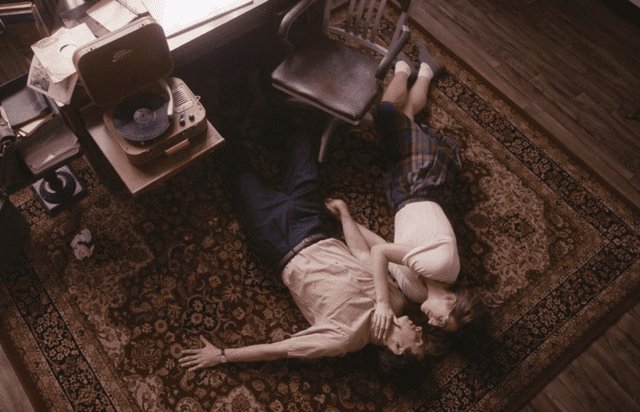
Joan’s reminiscences have a strongly romantic tinge. She talks about how, as youngsters, they would lie on the floor and listen to music. Ted was a non-conformist with an ironic sense of humour. To her, he was ‘beautiful.’”
Ted’s roommate at Harvard, Saville Sax, egged him on to share the atomic secrets. They were close friends but Sax was in Hall’s shadow.
Hall clearly had little idea of the atrocities committed in Russia under Stalin. On one level, that was understandable. In the mid-1940s, before the Cold War started, the Soviet Union was portrayed in the US media as a friendly country and an important ally. President Roosevelt himself had extolled the Russians’ virtues. Nonetheless, it still seems strange that someone of such obvious intelligence didn’t question the wartime propaganda about the Soviet system.
“I think the film is sympathetic toward Ted and Joan. I probably wouldn’t have made the film if I was looking to do the exposé. What would be the point in drumming up a story from the past to put him out there for severe criticism? I just wouldn’t have made that film,” James muses. “At the same time, I wanted to leave room for the viewer to wrestle with what he did. If viewers watching this film come to the conclusion that what he did was wrong, I am fine with that.”
The documentary is appearing in the wake of the Russian invasion of Ukraine. Hall has some responsibility for Russia being in possession of those nuclear weapons which President Putin has threatened to use. (Russia would almost certainly have developed its own nuclear arsenal anyway but Hall’s leaking of information speeded the process up.)
James has included references to how Stalin “starved the Ukrainians…that was in the film before the Ukrainian war started. Once it started, I was like ‘well that is not going anywhere. That needs to stay in there.’”
The director wants audiences to think hard about the moral dilemmas with which Hall was faced. “I hope people wrestle with that.” He includes archive footage of Hall in which the scientist’s anguish about his actions is apparent.
At the same time, the argument can be made that Hall’s actions may have worked, albeit at “great cost.” After all, the Americans and Russians haven’t yet bombed each other. The uneasy balance just about remains.
At one stage, Ted had wanted to intervene on behalf of the Rosenbergs and to tell the authorities what he had done in the hope that they could be saved. Joan talked him out of his confession. Nonetheless, it was clearly a struggle for a man who prided himself on being open and honest but having to hide the truth about his behaviour for more than half a century.
A Compassionate Spy was made through Participant. It was one of the last films produced by Diane Weyermann. Two weeks before her death last October, Weyermann sent her final set of notes to James.
“I had known Diane for a very long time…we’ve been friendly over the years,” James says. “This is the third project I’ve done with Participant which Diane was involved in [following the series America To Me (2018) and City So Real (2020)].” He describes her as “one of a kind, a brilliant person, incredibly great with filmmakers and in your corner always.” She was “captivated” by the relationship between Ted and Joan and by the way the film combined geo-politics and romance.
James is known as a verité filmmaker. However, in A Compassionate Spy, he includes dramatic reconstructions of Ted and Joan as young lovers behaving like US counterparts to characters in a Truffaut French New Wave film like Jules et Jim. “This is the first time I’ve done anything like this is any of my documentaries…” He felt, though, that there was no other way to do justice to Joan’s stories about her youth without dramatising it. Archive footage wasn’t available. He is not dogmatic about documentary purity and doesn’t have any issues about using reconstruction as long as it is done well and helps the film.
A Compassionate Spy will now begin its festival journey. It is expected to be at Telluride and IDFA. And, yes, James wants to see it in movie theatres. “But it’s an interesting time for documentaries and theatrical release,” he cautions. “There is a real question as to how many films are going to get a legitimate theatrical release as opposed to a very limited qualifying release because of what is going on theatrically in general.”
Sales for A Compassionate Spy are handled by Autlook.