

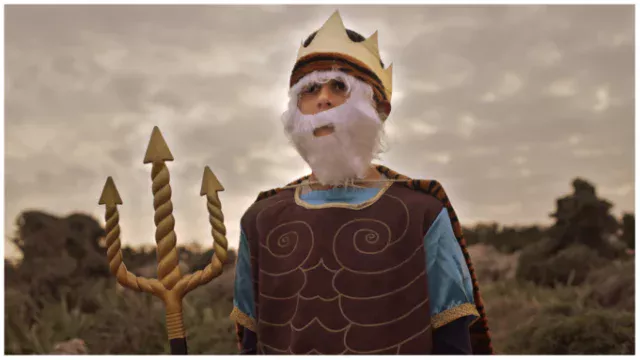
The Greek island of Arki is as remote as it gets, a tiny rock on the Dodecanese archipelago which is closer to Turkey than to mainland Greece. What’s more, Arki has a mere 30 inhabitants, the youngest of which (and the only person of school-age on the island) is ten-year old Kristos, a kind, clever and loving child, who is also, perhaps unsurprisingly, very shy and lacking in communication skills.
The absence of other kids on the island is made obvious in Giulia Amati’s film as Kristos tends his herd of goats in isolation, and is the sole flag bearer during the annual celebrations of Greek independence.
The boy adores his father who wants him to work the land and become a shepherd, like Kristos’ four older brothers. But teacher Maria has other designs, to help deliver the boy a more rounded education on the island of Patmos together with kids his own age, and to enable his personality to develop within a normal set-up. Will Kristos stay on the island to become a shepherd like his brothers or will he leave Arki to continue his education far away, on the other side of the Aegean sea?
Director Amati knew the island as a child, as her father was a keen sailor. She revisited it after his death and was further alerted to its uniqueness when a journalist friend sent a newspaper cutting about the boy Kristos and his status on the island as the sole child. “I just thought, God, I need to meet this boy. So in September 2019, I took a flight, ended up on the island and I met Kristos and Maria for the first time. And that was the beginning of a long journey.”
Amati was amazed by a lad who was supremely adept at taking on great responsibility at such a young age. “It was impressive. Because on one side he is so mature. Kristos has a huge sense of responsibility. When you work with animals, the animals need to eat at a certain time of the day. And there is no way that you cannot do that. He has been trained from a very early stage to be very responsible and a serious worker. It started when he was a small child… it was his responsibility and he it took it very seriously,” she says.
But his weakness was “social skills,” explains Amati, which were severely underdeveloped. “It was fascinating. I graduated in philosophy of language, so to see a kid that was not really communicating through language, but somehow in another way, it was really fascinating,” Amati underlines of a kid who, despite lacking communication abilities, nevertheless had what the director describes as an ‘incredible’ capacity to hold a scene “even without speaking, because he has such an empathic way. This is, I think, quite amazing.”
The film is shot from Kristos’s perspective using a handheld camera and a single lens so the perspective remains singular and consistent. “We tried to always have his eyeline point of view.”
Was Amati in any way fearful that the arrival of an international crew (albeit a small one) would be an encumbrance within such a small and close knit community? “With observational documentary it’s always an issue because people and the characters of your story don’t really understand the level of engagement you are asking [of] them,” she responds, especially when it came to returning to the island again and again to chronicle developments. The folk would tend to enquire if something went wrong first time, Amati jokes.
“So all of the circus was a little awkward for them because they’re very private people. They’re not used to have foreigners coming inside the house. So I put a lot of energy into…making them follow the process, even if I could never really count on the fact that they would fully understand what I was doing.”
On occasion we do see Kristos leave the island to sound out educational options elsewhere, which result in some moving scenes of farewell. But as to whether the move is permanent, no spoilers here! Nevertheless, we can be confident by the end of the film that his future education may well be assured, as will the opportunity to mix with kids his own age. “I thought, we have to show that the ending is a new beginning and that life is a series of cycles…and we see that Kristos [still] has a few challenges ahead of him,” says Amati.
And as with so many documentaries, what is fascinating from a psycho-developmental perspective is that the process is likely to have a significant impact on the life of the subject being recorded. “It’s the first time that I have worked with a child… and I had this awareness when I was filming that I was doing something that for his life would be important,” the director comments.
“I don’t know what Kristos will be like when he is 30 but I think it’s gonna be incredible for him to have this as a testimony of that time of his life… I mean, the movie in a way, I think influenced a little bit his choice. I’m not saying it determined it, but our presence and bringing back the movie to the island, and to bring him [Kristos] to the Greek premier…it all opens up a little bit the range of opportunities that can come in the future. I don’t know in which way, but I think the movie can have a positive effect on Kristos’ future life. I think, in a way, it already has.”





