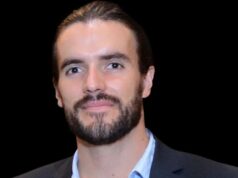
Revered US documentary director Ross McElwee acknowledges to Business Doc Europe he has “no idea” how accompanying his new feature Remake to the Venice Film Festival will feel. The documentary (sold by Cinetic Media) is a raw and harrowing affair in which the filmmaker explores his relationship with his son, Adrian, who died suddenly in late 2016 after a drugs overdose.
“It represents both my attempt to hold onto my son, and to let him go,” McElwee wrote recently in a director’s statement.
The interview with BDE is the first he has given about Remake. “I know I have to break the ice. I think it will be very hard,” he observes of the media duties awaiting in Venice and other festivals. He “can’t imagine” what the public screenings will be like for him, and is relieved he won’t be doing a Q&A. He adds, though, that he has “gotten used to the notion of the film by working on it for so long.”
In some ways, he reflects, the new film is a companion piece to his 1993 documentary Time Indefinite. “One of the things that was about was the loss of my father suddenly as a young man. He was still working as a doctor…but it is very different to talk about the loss of a parent than it is about the loss of your own son.”
Over the years, McElwee has been asked frequently if he finds it “therapeutic” to make films so closely focused on intimate aspects of his own life. He always answers ‘no.’
“It has the opposite effect of therapy. It makes me more anxious about living,” he says. In the case of Remake, there is “no consolation that I can fathom at this point: no consolation in making this film, little consolation in actually working on it.”
To begin with, McElwee couldn’t even bring himself look at the images of his son. He hired an assistant to go through the material and select “frame grabs” for him so he could begin to think about the project “pictorially as opposed to writing about it or verbalising about it…that was a kind of half step in the right direction.”
At one stage, he considered writing a book about the ordeal of losing Adrian and drafted a few initial chapters. “I am not a writer. I have never written a book before,” he states. “There was something about it that felt like the proper thing to do. I needed to keep moving forward. I needed to find something in my work that could express what I had been going through.”
The director was very conscious that he is generally the main character in his own movies and wanted to make sure to give equal space in Remake to his son (who was also a filmmaker and whose footage also features prominently). “I wanted very much to share the spotlight with him. It was imperative that he had a role in the film as strong or maybe even stronger than my own.”
Throughout the filmmaking process, McElwee was teaching non-fiction film courses in Harvard’s Department of Art, Film, and Visual Studies. (He is now retired but his stint there helping undergraduates with their documentary projects stretched back 20 years).
“At a certain point in my career, there was a lot of cross-pollination between watching these kids struggle with making films and also watching my son who was also becoming interested in making films,” the director remembers.
Remake touches on other pressing and often painful issues in its director’s life: his separation from his partner after many years of marriage and his own potentially fatal brain tumour. “An annus mirabilis – a miserable year,” the director laughs ruefully as he remembers how his health problems and his divorce overlapped. “A tumour is a tumour. You just hope it [the operation] is successful and it was…my main reason for allowing that to occupy the length of time it does in the film is that it really made me think about what memory was, and I appreciated my son’s interest in my life at that point.”
In the documentary, McElwee is also looking back at one of his own most celebrated movies, the rambling, charming Sherman’s March (1986), made when he was a young man worried about everything from the threat of nuclear war to whether he would ever find true romantic fulfilment.
Steve Carr, Hollywood bigwig and director of goofy comedies like Daddy Day Care and Paul Bart: Mall Cop, wanted to make a fictional movie out of Sherman’s March. McElwee liked him, hoped he’d pull it off, and planned to make a documentary about his attempts to do so.
When it had first come out, McElwee had no idea it would turn into such a cult hit. He thought that, at best, it might be shown in museums and university film programmes. Back then, there was no streaming, and festivals were far smaller. Distribution opportunities were very limited.
“What I didn’t foresee was its afterlife; how it kept going and kept going.” To his surprise, the film developed a strong European following. It seemed like quintessentially American material but the Berlin film festival showed it. “That really helped it a lot. Once it had been recognised abroad, Americans became more interested in it, American programmers.”
Even so, he’s still “astonished’ to get messages from kids in film classes who want to tell him how much Sherman’s March meant to them.
Son Adrian was delighted at the idea that his father’s documentary might turn into a “real” movie. Remakeincludes some tongue in cheek chat between father and son about the Carr adaptation.
At one stage, there was even talk of an AMC TV sitcom. Names were bandied around as possible stars, with Adrien Brody suggested to play the McElwee role, and Amy Adams mentioned as a potential cast member.
Ultimately, Carr and his team couldn’t work out how to fictionalise Sherman’s March. Instead, to everyone’s surprise, the documentary was successfully re-imagined as a chamber opera. McElwee is “no expert on opera’ but admired the professionalism of the singers. (The performance features briefly in the documentary).
Any humour in his latest documentary Remake doesn’t last for long. There’s no escaping the tragic event at its core.
When his children were growing up, McElwee would film them almost every day. As the years passed, he would film them less. After Adrian’s death, for a while, he stopped altogether. What has made him resume?
“I think there were a couple of instances where the Sherman’s March remake project had events tied to it that seemed worth filming. I would go to film those. It had nothing to do with my son’s death, so I could allow myself to do that.”
As he also writes in his statement, “eventually I started watching my home movies again – movies which sometimes captured little moments featuring my son.”
From these beginnings, the project picked up momentum. He produced it alongside Mark Meatto and edited it with Joe Bini.Now, Remake is complete and premiering in Venice. McElwee isn’t sure what will happen to it next, but he’d like to see it in Sundance. After all, that’s where Sherman’s March won the Grand Jury Prize almost 40 years ago.