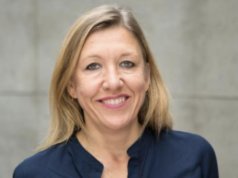
This is not a review, rather an interview. Nevertheless, I am going to go out on a limb from the start to say that there is something masterly about Diana El Jeiroudi’s Republic of Silence, whether regarded as a paean to love and unity, or a chronicle of the Syrian conflict as experienced both from within and from without – as an exile living in Europe. It is a film that registers the passing of time among friends and family (and within a working and personal partnership), in which the camera reveals, observes, records and intrudes in equal measure, all the time infusing the senses with a seriousness born of purpose and an accompanying measure of melancholy. It is part odyssey and part cinematic stream of consciousness, but presented with both control and an abundance of tenderness.
Republic of Silence is comprised of personal footage that Syrian filmmaker El Jeiroudi has compiled over decades since the age of seven, when her father gave her a movie camera, plus footage she shot after embarking on the feature in 2016. We also see snippets of previous diary entries which continually serve to punctuate the visuals. In her notes for the film she explains of her diary text how, “it proved its worth not only as a good framing device but a good presence for my character that is neither too dominant nor too withdrawn. From then on, it was a task of shaping it into a relatable inner voice, like the whispers of a filmmaker trusting her audiences.”
Even after receiving her camera, her diary entry is painful to read. “Evil has a very loud and terrifying sound,” we read on screen, the words belying the film’s title. “Our windows are shattered. We’ll be fine as long as we can hear explosions.”
The equally dramatic corollary to this is the silence produced by the ongoing negation of the spoken word. “How does my silent inner world reflect that unspoken world, or echo an era of revolution, war, immigration, and world politics? How to negotiate in a world uninterested in negotiation?” she asks.
El Jeiroudi may be the soul and driver of the film, but the person whose face fills the screen throughout is her husband Orwa Nyrabia, filmmaker, activist and fellow exile, as well as the documentary’s producer (and of course, Artistic Director of IDFA). He is recorded intimately and at all times of the day and night, whether in his home town of Homs (Syria) or in their new home in Berlin; listening to news reports in his vest, present at the funeral of a torture victim, addressing European audiences on Syria, bemoaning the sense of “solidarity fatigue” exhibited by public and governments alike, or simply expressing loving affection for his wife to camera.
We are also present with El Jeiroudi after Nyrabia’s arrest and incarceration by Syrian intelligence services in September 2012 and subsequent release after a prolonged campaign that included the likes of Martin Scorsese, Annemarie Jacir, Nabil Maleh and Robert DeNiro.
When El Jeiroudi is asked whether it was a brave decision to reveal so much of herself and her husband (both high profile sector figures) within the documentary, she responds how, having worked much of their professional lives under censorship and authority, she felt compelled to “liberate myself from thinking those thoughts.”
She also speaks about the benefits and difficulties of making a film with a partner who is as crucial to the film’s realization as producer, as he is in front of the camera as a core protagonist.
“Yes, of course it’s complex,” she stresses. “I don’t know if I can sum it up, but I mean, there are points when Orwa says, ‘I don’t know how to judge this or how to give a good opinion.’” At which point the services of co-producer Camille Laemle of Les Films d’Ici proved invaluable in helping to co-navigate the production as well as being part of “a buffer zone” that would protect El Jeiroudi and Nyrabia, thereby allowing for greater clarity as they made their ongoing creative decisions.
El Jeiroudi adds of her husband how, “me and Orwa, we started working together when we were 24. So we were very young, we moulded each other, so we have this business life/partnership complexity for years, and I think it’s essential…I can’t put a label to it, because it’s very close, but it’s kind of ‘this is home’ in a way. Critical advice and partnership and work and cinema and life is a whole thing that you subscribe to for a long period of time.”
Republic of Silence is lengthy, coming in at three hours but, for the director, the film’s duration was unavoidable. “There are those things that have to be made this way,” she comments. “I don’t think that it is otherwise. I mean, if I forced myself now, for any reason that I cannot think of, to edit it down, it will be a completely different film…For those faithful audiences of such a genre, for people who would enjoy and appreciate this film, I think it’s a betrayal to try to fit it into another format.”
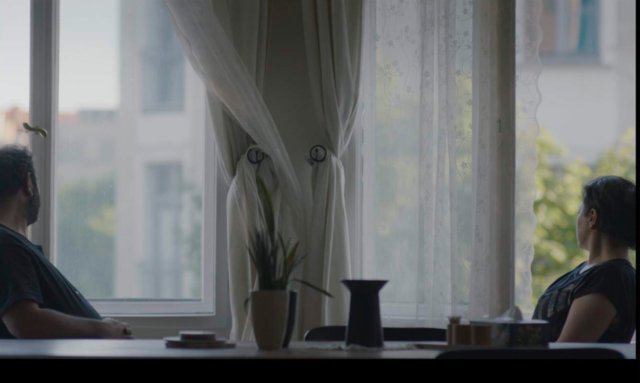
It is also a film whose pacing is guided, or determined, by motifs to which we consistently return. These can be dramatic, such as when she films Nyrabia asleep, speaking to himself as he suffers what seem to be disturbing dreams. Or they can be benign and homely, as when she is applying make-up, or as she and her husband sit together in a living room, scanning the road outside, both tilting back on their chairs as if something in particular has caught their attention. And all the time we are reminded of time passing, with a succession of clocks, always accompanied by a ‘tick tock’ either presented audibly or in text on the screen.
“We wanted, me and Katja [Dringenberg, co-editor], to create some [sense of] clear time passing. And I think it helped me also to look at this as an external viewer, to see it within the context of time, in a very controlled manner, in a way that forced me to see the flow [of the film],” says El Jeiroudi of her wish to stabilize the presentation of elements within the narrative. “Suddenly everything stopped interrupting each other.”
What heralded the documentary’s sense of completion was when El Jeiroudi took a break after the latest of many rough cuts, only to return to see something approaching readiness. “It surprised me… you know, like after probably three weeks, it suddenly became a film,” she says. The documentary had also undergone an evolution. “So much is like the film [of my] imagination or intention and the treatment and all, but at the same time, it’s really different. It’s calmer, it’s longer, it’s more relaxed.”
In her notes for Venice, El Jeiroudi underlines how cinema “saved our sanity and probably our lives.” She further explains the medium’s mesmeric effect.
“It has such a power to transcend the audience to a new possibility of themselves and their perception and hearts. I don’t believe in films made with actionable plans, I enjoy them and know they are there. But I am always interested in those filmmakers of all generations who treat their imagined viewers as themselves, who approach them with versatility, multiple interpretations, and allow them to escape, imagine, wonder, wander and return.”