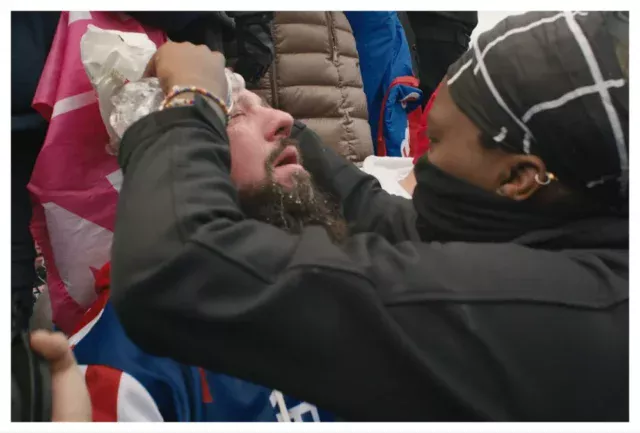
When American director (and prominent Occupy Wall Street activist) Michael Premo started filming Chris, a member of the far-right Proud Boys, there was no way he could have known they would end up together on the frontlines of the storming of the US Capitol on January 6, 2021.
These scenes gain their extreme intensity not only from being right there in the middle of this chaotic assault on democracy, but also from the previous hour or so, in which we have gotten to know New Jersey father-to-be Chris, and the other Trump followers Premo portrays, in the run-up to the 2020 Presidential election that preceded this chilling historical moment.
There are many criteria we can use to analyse documentaries, but surely one of the most basic and important one is access. And while Homegrown impresses with its clear storytelling, which suggests Premo must have shot an enormous amount of footage, it is the almost unbelievable level of access to America’s self-proclaimed Patriot Movement which is most striking.
It’s a level of access to the media-weary movement which would be impressive for any documentarian, but even more so because Premo is a filmmaker of colour. Is that relevant? In this case, yes. As Premo writes in the press notes: “All films are emotional for their makers, but this one has been particularly affecting as a Black filmmaker without the privilege to turn away.” He elaborates: “Polite society would have us believe that violence is a fringe or extreme(ist) aberration; an anomaly, not the norm. But for me, and people who look like me, we viscerally understand that the very ideas of race and class were invented, and are maintained with violence.”
And violence is never far away from the heavily weaponised movement; especially when, more than once, members point to the unavoidability – possibly even desirability – of an upcoming civil war.
Still, there are more people of colour who associate with this proto-insurrectionist movement than I realised – even at the frontlines. This was an eye-opener for me, as I tended to associate the MAGA movement with racism and White supremacy (although I recognise no fast-growing mass movement can be monolithic in either its membership or its ideas). Although that last term is floated by some, other members of the Patriot Movement strongly disavow it. And while the Black Lives Matter movement (‘BLM’, for short) is an oft-mentioned antagonist, I don’t recall the N-word being used even once in the documentary.
Given the number of questionable and even illegal actions and remarks people let Premo record – again underlining his unprecedented level of access – and the chaotic, sometimes drunken social gatherings he was allowed to film, this seems to indicate more than a polite front for the media. It seems that MAGA is less clearly defined by racism than I previously thought – again, as a non-American (and White) outsider. As Premo writes: “National and battleground state polls consistently show that Trump has more support from Black and Latinx voters than any Republican nominee since at least 1960. Liberal anti-racism is not prepared for a multicultural far right.”
Indeed, one of Premo’s protagonists is Thad, a Latino Proud Boy from Texas, who has struck up an unlikely alliance with Jacarri, a representative of the BLM chapter in Northern Utah. And although Jacarri never hesitates to call out racist statements, policies and history, she respects Thad enough to attend rallies together. It’s not all rainbows and roses, though: at the end of the documentary, a text informs us that Thad’s contacts with the BLM were among the reasons he was expelled by the Proud Boys. Still, he was a member until then and, on camera at least, never less than a sympathetic presence, willing to engage in discussion. That is something I, as a viewer, also take from this documentary: there is at least one MAGA member, a Proud Boy even, I could probably get along with just fine – and thus there are, presumably, many more.
Homegrown can be described as cinéma vérité. For although the camera is acknowledged and people often speak straight into it, we hear no voice-overs or questions and are given no explanatory texts to provide a clear authorial position on the issues discussed. It is what Premo describes as a “no judgment study of the people heeding the clarion call of us vs them politics.” But here arises a danger: is an honest, non-judgemental representation of a dangerous movement not tantamount to a recruitment video? I can certainly see the MAGA movement itself organising internal screenings of this documentary – perhaps pointing out mistakes by individual members or the movement as a whole as learning opportunities. The fact that we see members often saying one thing and doing another is hardly enough to call Homegrown a demasqué – if these things don’t bother existing members of the mass movement, there’s no reason to think it would deter new recruits.
François Truffaut once stated that, “Every film about war ends up being pro-war.” In the same way, any honest registration of an exciting, dangerous movement could end up promoting it. At least for those of us not already convinced of the contrary.
It’s a difficult criticism to level at the film, because at the same time I’m grateful for Homegrown, a truly exceptional account on a human level of current societal tensions, and I feel I’ve learned important lessons from it. So I can’t denounce this approach as ‘wrong’, yet at the same time, the potential enthusiasm some viewers might feel for certain scenes terrifies me – just as it does in real life.
I wonder how this film will be seen thirty, forty years from now – depending on the state of our societies then. As a warning of an extremist attack on democracy which was defeated, or as a record of the triumphant first step in the MAGA revolution.
United States, 2024, 109 minutes
Director Michael Premo
Production Storyline
Producers Michael Premo, Rachel Falcone
International sales MetFilm Sales
Cinematography Michael Premo
Editing Kristen Nutile, Shilpa Kunnappillil
Sound Rachel Falcone
Music Khari Mateen
With Chris Quaglin, Thad Cisneros, Jacarri Kelley, Randy Ireland