The English title of the documentary La Muraille is The Other World. This refers to the book by the Jesuit Remigio Vilariño titled Cartas de Otro Mundo (or ‘Letters from Another World’, first published in 1944), which was found by director Callisto Mc Nulty and inspired the film, world-premiering in VdR Burning Lights.
Cartas de Otro Mundo contains around one hundred letters, written by Vilariño between 1913 and 1924 about his visits to the Fontilles sanatorium (opened in 1909), near the small village of La Vall de Laguar in Alicante, in south-eastern Spain. This sanatorium represented this ‘other world’, where lepers, who until then would withdraw from society and live in caves in the mountains, could reside, albeit sick and suffering, but with a reasonable degree of dignity.
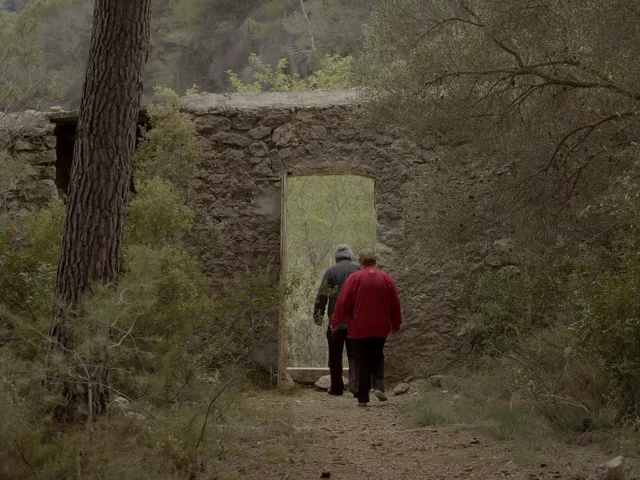
In Mc Nulty’s voiceover we hear passages from Vilariño’s book over quiet images of the somewhat isolated sanatorium and its natural surroundings. The shots of nature are both simple and lovely, often in greyish light, with a beauty that, seen from another angle (or with different, more eerie music) might suggest a kind of horror. The way Mc Nulty frames and presents it, this otherworldly sense of being haunted by history remains somewhere just below the surface.
This uneasy feeling, which conflicts with the love, gratitude and freedom described by Vilariño, is represented by the two-and-a-half-metre-high wall surrounding the sanatorium complex, ‘the wall’ of the title – Mc Nulty even talks to someone whose grandfather was forced to work on its construction. This wall is the border between this world and the other. A border which isn’t only physical, but also social and – especially in this documentary which is mostly looking back one, two or three generations – historical.
As the film progresses, it becomes clear that the wall wasn’t there to keep people out. It was there to keep people in – and especially, to appease surrounding communities who were fearful of the lepers who were housed there. Even though, as the documentary points out several times, there was no great risk of infection – leprosy is not very contagious and seldom affects people who aren’t genetically predisposed to it. “That wall is Fontilles’s shame,” one elderly, modern-day ‘healer’ living near the site tells Mc Nulty.
But the villagers around the sanatorium feared the disease so much that even the relatives of lepers were often shunned. This, Mc Nulty makes clear, is the real ‘wall’: the invisible and largely insurmountable barrier between the lepers, their loved ones, and society. Mc Nulty interviews people who used to work there and people who were patients. One man recalls his family leaving him there and never visiting again – his mother ran a pub and if the customers would find out her son had leprosy… He doesn’t finish the rest of the sentence.
Mc Nulty edits this remark immediately after another lyrical account by Vilariño. Of course, it was a different time: it’s possible lepers in the 1910s didn’t expect to be accepted by society and certainly life at Fontilles was an enormous improvement on living in caves. Still, La Muraille subtly questions the veracity of Vilariño’s enthusiastic remarks by contrasting them with the perspectives of the only patients we still have access to.
On the other hand, when Mc Nulty quotes Vilariño writing, “believe me, one cannot arrive here without their heart leaping. The first time, it beats because this world is unknown to us, and the following times, the heart throbs out of attachment to it,” it is undeniably touching. As is his evocative description of leprosy as “death within life.” And the aforementioned ‘healer’ recalls that the sanatorium even used to have a bar, a theatre and a cinema: “They had a very comfortable life.
Fontilles is like paradise. Even though obviously, you’d rather be healthy than in their shoes.”
It’s a small film, in certain ways. La Muraille keeps circling the same locations, calmly, methodically, in uncluttered 4:3 images, in which people are often silent and the sound is provided by birds in the distance and a gentle wind rustling through the sun-drenched leaves. And in a number of shorter and longer montage sequences, Francisco Ferro’s music almost seems to dissolve into the quiet serenity of village life and ancientforests.
It feels almost out of time – but not quite. Just as Fontilles almost seems like another world – but not quite. What La Muraille lets us experience are the last quiet echoes of a certain history, still being carried across these landscapes within the minds of the last surviving generation to remember Fontilles as a fully functioning leper sanatorium, with about thirty nuns and six or seven Jesuit priests, and separate buildings for male and female patients, all surrounded by that high wall – which had glass shards cemented into it.
Fontilles still exists, still appearing beautifully among the forested mountains, still fighting leprosy throughout the world – now as an NGO. The men’s quarters are today a hospital; the women’s a nursing home. The documentary is dedicated to Mariano Morales and Abilio Segarra, two of the elderly residents who share their thoughts with us through Mc Nulty’s film, and who have since passed away.
Switzerland/France, 2025, 65 minutes
Director Callisto Mc Nulty (the space after ‘Mc’ is intentional)
Production Alva Film, Barberousse Films
Producers Britta Rindelaub, Thomas Reichlin, Delaunay Mathilde, Enguerrand Déterville
International sales Charlotte Rey (Alva Film)
Script Callisto Mc Nulty
Cinematography Frederico Lobo
Editing Yaël Bitton, Márton Tarkövi
Sound design Philippe Ciompi
Sound Amaia Yáñez
Music Francisco Ferro
With Mariano Morales, Mari Camen Rueda, Abilio Segarra