

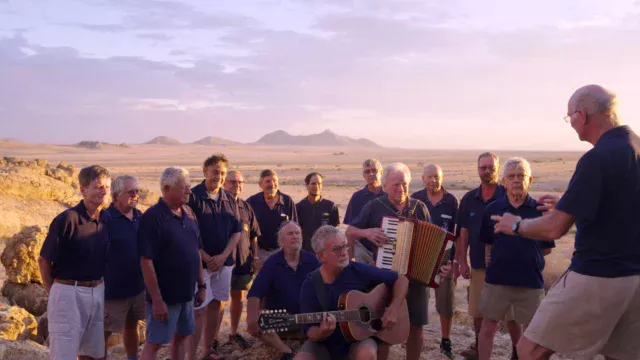
Jonas Spriestersbach makes his films in “a rather neutral” style, he tells Business Doc Europe. The German cinematographer and director tends to let the images speak for themselves, without narration. However, his new documentary, Meanwhile In Namibia (screening in International Feature Film Competition in Visions du Réel), isn’t neutral at all in its depiction of the aftershocks still being caused in Namibia by German colonialism.
The German Empire was behind a genocide in the region in the early 20th Century. As many as 80,000 of the local people were killed between 1904 and 1908. The area now known as modern-day Namibia then became a German colony. It finally gained independence from South Africa in 1990.
German tourists still love to come here but the German government remains wary about either fully admitting to the mass slaughter 120 years ago or paying reparations. Instead, money is being pumped into development aid and cultural initiatives including so-called ‘living museums’ in which Namibians recreate their ‘traditional’ lifestyles before the Europeans arrived.
Spriestersbach warns that his documentary contains “explicit racism” and “trivialisations of colonial violence.”
“It’s not like I tricked them into something – this is how they want to present themselves,” he says of the Germans featured in the documentary behaving in haughty and offensive fashion toward the local people.
Before he began work on the documentary, the director didn’t have any personal relation to Namibia, he tells BDE. The project was sparked when he heard the German foreign minister at the time, Heiko Maas, seem to acknowledge the genocide “but not in a legal way.” By using semantics and pointing out that the mass-murder happened before the term ‘genocide’ was established in the 1940s, the Germans attempted to sidestep their own culpability.
“This was how I got interested in Namibia,” Spriestersbach recalls. He wondered how “the narrative of the nation” was now being told. “I found these living museums and I wanted to make a film about these.”
The documentary shows present-day German visitors milling around the museums, and how the local people are uncomfortable at the way the tourists ogle them and patronise them.
Spriestersbach started to make the film as soon as he arrived in Namibia, even before he had fully developed the concept. “What interests me is structural phenomena. It’s not about the individual person,” he states. “My wish is that everyone is seen and heard in the same sharpness, detail, and clarity…[but] the camera is not neutral, obviously. Some people are able to decipher that. Others won’t.”
On a personal level, Spriestersbach had perfectly cordial relations with his fellow Germans. “Very much so,” he says. “For me, it’s just people after all, very normal, friendly people that I can easily relate to.”
That’s what makes the film so unsettling. These genial westerners don’t even try to hide their prejudices. “People being racist is something that to me is no surprise at all,” the director says.
Although there is no voice-over, the director provides inter-titles which give details about the dark side of Namibian history. “They began, like, as crutches, for missing links, context, information, that I felt I could not bring across in this observational style. I feel it’s a very difficult style especially when people don’t have the background information.”
He talks of the “lies” and “wrongness” that we hear constantly from people talking in the film. “You can pause the film almost everywhere and in the smallest phrasings I could say no, ‘wrong, incorrect, lie!’”
The director acknowledges that as a white European in Africa with a camera, he has questions to answer too about his own role. What is he doing there and what gives him the right to tell this story?
“It’s a commonly asked question. It’s a big question, a very political question and it has been a super important question through the process of the film because the film did not get any funding…I was financing it with my own savings which was a pain. It’s going to be an ongoing pain, even.”
Broadcasters shied away from supporting the project. “They had this fear – am I allowed to tell [a story] about Black peoples’ problems?”
The director’s response is that, yes, “it is a dangerous field. I am not fully aware about how people are going to react. The reactions are going to be various and it might be that the film is going to be cancelled for that particular reason, I don’t know.”
He adds that he “believes in the equality of people…skin colour shouldn’t be the final hurdle that I can’t cross while thinking I can cross all other sorts of hurdles.”
“I think what the film is talking about is a problem brought by white colonialists, and so I feel it is very much our own problem. People wouldn’t have the problems that are debated in the film if the Germans had never arrived.”
Spriestersbach doesn’t attempt to show the enormous economic gaps in Namibian society, or the poverty in which large swathes of the population still live. Instead, he focuses on the vexed relations between the Europeans and the Namibians – and the way the former wilfully ignore the suffering of the latter.
“The injustice is obvious,” he insists. “How could you even live in that country while being conscious about the inequalities and injustice? It’s impossible.”
Furthermore, he is startled that Germany has refused to pay proper reparations. “Hopefully, there will be political shifts, mentality shifts…[but] it’s sort of like a system that reproduces itself, because each person born into it has to justify the inequality – and the only way to justify the inequality is by looking at the people as unequals.”
This may be disturbing subject matter but, at some stages, it has a deadpan comic quality.
“I have a good friend that I trust and she was so offended by the humour,” he says. “Fundamentally, I believe this story is well researched. It’s all there. Germany’s political stance is clear. It’s not a story I open up for the first time and now people discover it…society had a chance to react to it and chose to ignore it. Therefore, I feel the irony is like a provocation.”
The irony, he adds, is also laced with bitterness. Even so, in the final stages of editing, he tried to tone down the dark humour.
This is not Spriestersbach’s first trip to Visions du Réel. His earlier film Animals (2019), about humans’ bizarre relationship with the animal kingdom was also at the festival. He doesn’t yet have sales or distributor support – but being in official selection is bound to draw attention to the film. “I became producer by accident. I have no expertise and experience with that, so I am just getting started. Also, I just finished the editing,” he says. “I am positive that people want to see it. In Nyon, I am going to try to understand the market…”





