When I first watched the trailer for Zinder, it almost scared me off. The documentary seemed to take the viewer inside a violent, criminal subculture. A worthy subject, but I braced myself for what I expected to be a disturbing experience. Maybe I felt a bit like director Aicha Macky once did. She herself was born in Zinder, Niger’s second-largest city, but ‘on the right side of the tracks’, as she writes in the press notes. Her upbringing was peaceful, after which she left to study and work elsewhere, returning only for brief visits to her family.
Her documentary focuses on Kara-Kara, a poor and neglected neighbourhood where lepers and other outcasts were sent, without medical support or full civil rights. This gave rise to unemployment and eventually a violent gang culture. The stories she used to hear about Kara-Kara seemed like ‘horror films’, Macky writes at the site of the IFF Marrakech, with ‘group rapes, arranged brawls, armed robberies, crimes and trafficking of all kinds’. It was something she wanted to keep as far away from as possible. And let’s be honest: as documentary viewers, we often have that same gut reaction.
But let me reassure you: the trailer is misleading. When Macky, after the success of her 2016 documentary The Fruitless Tree (L’arbre sans fruit), decided to return to Zinder and specifically Kara-Kara to learn more about the neighbourhood that she, like most Nigeriens, had been actively avoiding, she went to look beyond the horror. She focussed on getting to know the people, seeing which processes had led to the gang culture and, more importantly, if there were any ways out. That meant she had to build rapport and that’s how Zinder feels: as if we are taking our time to observe, not just the people, but also the streets, houses, social life, radio station, taxis and everything else that makes up their world. We’re observing the vibe of this neighbourhood and city.
Also, the homemade swastika flag of the ‘Hitler gang’, which figures prominently in the trailer, will feel a lot less intimidating when you’ve heard their explanation that it’s “the name of a guy in America; we heard he’s an invincible warrior” and that they only chose him as their mascot because “we’re like him: we’re not scared.”
Macky, who is also a social change activist and sociologist and calls herself a ‘socio-filmmaker’, seems to be able to get access anywhere. She hitches a ride in a police car to accompany an arrested gang member to his trial; she walks the streets at night in the dangerous red light district; and she drives to the Nigerian border with petrol smuggler Ramsess, a self-described “half-woman, half-man” who plays a central role in the district’s infrastructure.
And yes, there is danger, just as there is unemployment, illegality and the threat of Boko Haram, which hangs over everything like a shadow – a clip of a stoning that is watched on a phone being the only direct violence we see. Not too clearly, fortunately. Macky doesn’t shy away from the violent history of her interlocutors, but mercifully refrains from showing images of rape and bloodshed. Instead, she observes their faces when they talk about it, seeing their sorrow and their shame. And as she films their scars, one after the other, slowly, carefully, while they explain how they got them, she is recording this biography of violence written on their bodies with such an attentive gaze, as if she could look through them to the corresponding scars within.
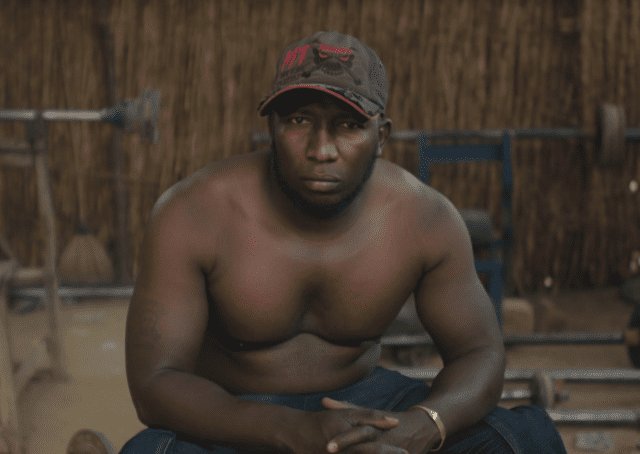
That is the wonderful thing about Zinder: almost everything is presented calmly, measuredly. The music is soothing, the camerawork elegant, and the unrushed editing gives her subjects the time to show parts of themselves the outside world would normally not get to see. Zinder contrasts this with the gang members proudly showing off their bodies during bodybuilding, teasing and cheering each other on for each stunt. These are moments of happiness, and there are moments of tenderness too, as when a gang member puts his ear to his pregnant wife’s belly. Life goes on.
We hear stories of what happens to unemployed and disillusioned youth, who sell their votes to the highest bidder, get recruited by terrorists or migrate. But Macky decides to focus on those inhabitants who, against all odds, try to build up a life in Kara-Kara itself. Either by driving a taxi, selling petrol or, when that illegal trade gets shut down, breaking their backs in a quarry. Anything to feed their family and send their kids to school. Because that, according to one gang member, is the biggest difference between him and Macky, although they’re both from the same city: “education.” And when a taxi driver tries to convince a teenage prostitute not to emigrate but to return to her family, where she could maybe even go back to school, her wistful “Hmm, back to school…” tells us more or less everything we need to know.
Niger/France/Germany, 2021, 82 minutes
Director Aicha Macky
Production Point du Jour-Les films du Balibari, Tabous Production, Corso Film
Producers Clara Vuillermoz, Ousmane Samassekou, Erik Winker
International sales Andana Films
Script Aicha Macky
Cinematography Julien Bossé
Editing Karen Benainous
Sound design Andreas Hildebrandt
Sound Abdoulaye Adamou Mato
Music Dominique Peter
With Siniya, Bawo, Ramsess