

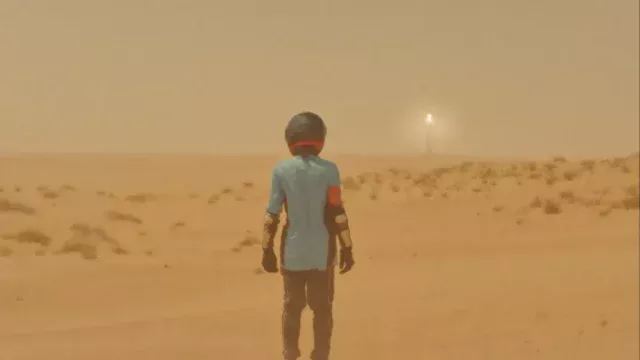
The Persian Gulf experiences some of the highest temperatures on Earth, at times reaching up to 52 degrees. These temperatures may be rivalled by areas such as Death Valley in the US, but the crucial difference is that parts of Kuwait and the United Arab Emirates Dubai are very heavily populated, numbered in the millions, whereas population numbers in the US desert rarely exceed 1000 people.
This situation in the Middle East leads to what Swiss director Jacqueline Zünd terms “a capitalistic nightmare.” In order to remain cool and comfortable within such oppressive, humid heat, vast amounts of money must be spent, and resources used, all of which comes at a very human cost.
“It’s like a magnifying glass amplifying all these differences, especially the economic and social disparities,” Zünd tells Business Doc Europe. “Because there is a certain [very high] temperature, rich people do not leave their houses anymore.They just stay at home and they get everything they need delivered by migrant workers. Maybe they go to the garage. They go into their air-conditioned car. They go to the mall. They jog in the mall. They go to ice bars. They can live a life completely away from the heat, which is really crazy to see.”
“Meanwhile, the poor people are dying out there, or maybe having heatstroke, while delivering food at noon when they call for lunch. It’s really crazy,” Zünd despairs.
This is all exemplified by the story of Sophy, a young Kenyan single mother who works at an ice bar kept at -6° Celsius, serving hot chocolate to the rich who rejoice in the cold despite the desert heat. Sophy is rendered ill, at time voiceless, by the constant changes in temperature she has to endure.
Essa Ramadan, a renowned meteorologist, tries in vain, Cassandra-like, to promote climate awareness in Kuwait. He hosts a radio programme offering advice to residents, such as to avoid driving in the midday sun in a dark car, when temperatures inside the vehicle can rise to 80 degrees Celsius. “I had this idea to have him and his radio show as a red line throughout the film… I didn’t want to have interviews with specialists.” Essa represented the “science” within her film, she agrees.
Meanwhile Francis, a Ugandan delivery driver services rich folk while enduring 12-hour shifts in intense heat. Now back in Africa, Francis tells how his employer denied him access to the money he was owed. He complained, but was eventually deported after alleged trumped-up charges were brought against him.
Then there is the curious story of Carina, a real estate agent, who loads her car with huge blocks of ice and then drives to the shore, where she places the ice at night between the rocks to save wild cats from heatstroke. Her anguish and tears, and excessive care for the cats, hides, one feels, a trauma experienced outside the parameters of the film.
Director Zünd hatched her feature doc plan when researching her fiction feature Don’t Let the Sun, a film about the excessive emotional effects engendered by heat, which premiered at Locarno 2025. ‘I discovered so many interesting facts and stuff and stories which didn’t find a place in my fiction film. So I felt like this is an invitation to do a documentary about it at the same time.”
She was particularly fascinated by the importance of the dichotomous element of ice within the overall story. “I was just interested in how it is the opposite. I mean, where there is life, you need ice.”
Aside from its use in cooling cool down over-heated (rich) locals, it is used extensively within the construction industry, Zünd points out. “They need ice blocks because otherwise the cement would melt. It’s really something that it’s important to have. This Indian ice seller in the film (Jerin Jerald), I met him in the very first days and he was so kind. Then he told me about this crazy lady coming for ice blocks every morning to cool down the cats and to prevent them from heatstroke. And I was like, wow, I want to meet her.”
Zünd reflects further on the hazardous state of the gulf right now, and its dependency on both oil and electricity to maintain temperature balance. “They built houses with huge windows, which is super stupid in such regions. If the electricity cuts out, then they will die very, very soon. It’s like an oven. It would be easy to attack countries like these if you just cut their electricity systems.”
Visually and sonically, the film is very impressive, with its oppressive heat hazes and soundscapes, and an ominous soundtrack, all working in palimpsest sync. “I work with making states and conditions cinematically tangible and experienceable. I wanted to translate heat visually. I always had this image of a cinematic mirage. This was my aim. I wanted to capture the vertigo, the loss of control. I wanted to make it very physical.”
Speaking to Business Doc Europe at Nyon 2025, Swiss Producer Louis Mataré (Lomotion AG) underlined Zünd’s qualities: “Jacqueline brings a unique vision to Heat, rooted in her signature blend of poetic realism and emotional authenticity. She explores existential states — insomnia in Goodnight Nobody, family separation in Where We Belong — and now turns her lens toward climate-induced heat. Her strength lies in making the invisible felt. Through carefully captured scenes, she creates intimate psychological landscapes. Her use of inner voice narration, observational intimacy, and stylized imagery makes the abstract tangible.”
Towards the end of Heat, Zünd calls on meteorologist Ramadan to summarize the perilous state in which we collectively find ourselves, whether assessed ecologically, economically or within societal terms.
“I think soon, most of our areas will be unliveable. It’s either death or emigration. But nobody listens. May God have mercy on us,” Ramadan concludes.





