From the very first moment, Nostromo is framed as a horror film. During the opening credits flashes of torchlight move nervously through a nightly forest, while the soundtrack’s eerie and drawn-outtones evoke a creepy atmosphere. This horror framing, unusual for a documentary, is continued throughout Fisnik Maxville’s film, whose title, perhaps unintentionally, also recalls the name of the spaceship in Ridley Scott’s classic sci-fi horror Alien (1979).
Nostromo shows a man living alone in one of the most horror-prone of all film dwellings – a remote cabin in the woods. We’re somewhere in the Canadian Northwest Territories and, although the man says he likes his life, he also mentions he once felt some malicious presence watching him in the forest at night. And that he was told of ghosts haunting these parts. His family doesn’t understand why he lives here, he admits, and none of them has visited him. And yes, he believes in the afterlife, he answers the filmmaker (whose voice we never hear), adding ominously that it would simply be too strange if this would be all there is. If all this wasn’t enough to set the mood, his mobile phone can’t seem to get proper reception – a horror trope if ever there was one.
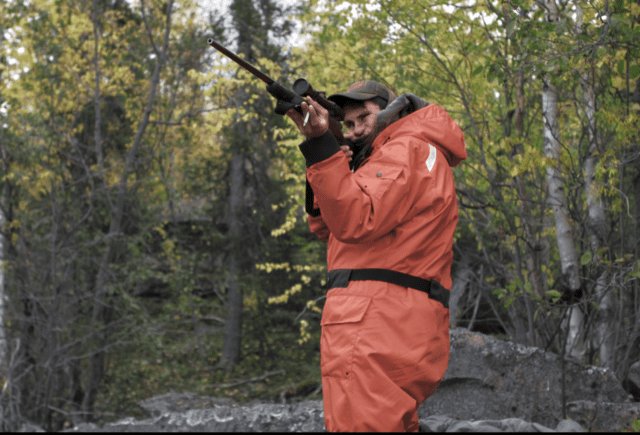
Edited in parallel, we follow three hunters, one of whom mentions he just spent eighteen months in prison. His face seems disfigured under his scarf – he explains he once accidentally shot himself and came within an inch of death. The three manage to shoot a moose; gory close-ups show the dissection of the carcass. One hunter also believes in life after death, he asserts, but the priests have brainwashed us and that’s about all he has to say about it. He laughs.
And all the time, that eerie music (by composer Nicolas Rabaeus) keeps reappearing. Sometimes almost subconsciously, edited into the sound of a strong wind; sometimes up front, dominating, unsettling. In between there are close-ups of the full moon, shots of the ghostly northern lights, and even images of a dead fish floating in the river – and a black bird on a cross. Sometimes, the frame just stays black for seconds. The hunters carry guns – and are good shots, as we have seen – and carving knives. The man in the cabin also has knives, for gutting fish, which he cleans carefully in close-up, like a knife-shaped Chekhov’s gun. We even see him fire up a chainsaw.
Really: if this wasn’t a documentary, but a fiction feature, all this would have been a set-up for a bloody confrontation.
But Nostromo isn’t fiction. And for a documentary, one which isn’t a reconstruction but a registration of events as they happen, the horror mode is a puzzling choice. Intriguing – and the film does retain its thriller-like tension throughout – but puzzling. Why film the man at the cabin as if something horrible is going to happen? And why film the hunters as ifthey are part of a sinister story? Documentary-wise, neither we nor the filmmaker can know at this point.
Of course, the stylization can have been determined mostly retrospectively, based on what eventually happened. But after having watched the full film, I’m still puzzled. As a record of a way of life, Nostromo is captivating enough. Especially the man in the cabin, who turns out to be a French immigrant – an ‘alien’, if you will – who left his family and French society where he never felt at home. He’d always wanted to be in nature and, although he admits he would have liked to have some neighbours – but “not too close” – he seems genuinely happy where he is.
The hunters are from the indigenous Chipewyan people (of the Dene Nation), as one of them mentions, and despite the recent incarceration of one of them, seem to be having an excellent time hunting. One is a young lad, who is being taught to hunt by his father, and shooting a moose together is of course a festive occasion.
According to the description on the festival’s website, the meeting of the three hunters of a First Nations people with the French settler should be seen as re-enacting the original colonial confrontation. An interesting concept for sure, but not one that struck me while watching. I don’t want to spoil too much, and there does seem to be a difference in how the two parties react to each other’s presence (which could be viewed through a historical lens, once you acknowledge this intent), but in the end it all doesn’t seem very horror-like. After the whole build-up of suspense, their meeting – or the little we get to see of it – actually seems quite cordial. A bit awkward, yes, but that’s to be expected when you normally keep to yourselves. Plus, one thing I can spoil: no more use gets made of the chainsaw.
Switzerland, 2021, 82 minutes
Director Fisnik Maxville (as Fisnik Maxhuni)
Production Close Up Films
Producer Flavia Zanon, Joëlle Bertossa
International sales Close Up Films
Script Fisnik Maxville (as Fisnik Maxhuni)
Cinematography Jules Guarneri
Editing Kostas Makrinos
Sound design Kostas Makrinos
Sound Fisnik Maxville (as Fisnik Maxhuni)
Music Nicolas Rabaeus
With Olivier Duret, Sheldon Boucher, Donovan Collins, Talon Boucher