Oscar-nominated Swiss director Christian Frei talks of the “moment of epiphany” that always sparks any new documentary he makes. Frei (whose latest feature Blame opens Visions Du Réel this week and is sold by Rise and Shine) knows instinctively just when he has found the perfect subject matter for a new film.
“Five years ago, early during the pandemic, I stumbled across a 2005 science article. In it, a group of researchers began to warn that bats might be natural reservoirs for SARS-like coronaviruses.”
These scientists, Zhengli Shi, Linfa Wang and Peter Daszak, linked the 2003 SARS outbreak to a bat cave in China. They wanted to warn the world of the dangers of a new pandemic. Instead, when COVID-19 closed the world down in 2020, they somehow ended up being blamed. This was a classic “Cassandra story” in which the messengers caught all the flak.
The British scientist Daszak [former president of the NGO EcoHealth Alliance, dedicated to preventing pandemics] has suffered particular abuse and even death threats. Critics have tried to link the COVID pandemic with a lab in Wuhan. This was where Zhengli Shi had been doing her research.
Frei’s most famous film, the one for which he received his Oscar nomination, is War Photographer (2001), about US photojournalist James Nachtwey. The director points to certain similarities between Nachtwey and Daszak. Both are stubborn and complex personalities.
“I am interested in deep layers,” Frei states. “I have the time for that. That’s my huge advantage.”
Blame opens with a disclaimer. “Disinformation has become a deliberate instrument to attack and discredit scientists and health professionals for political gain.”
We are told early on that the story is being told from the perspective of the three scientists.
Unlike the media commentators, politicians and bloggers who’ve often attacked the scientists from a position of ignorance, Frei has actually done his homework. He has gone to extreme lengths to ensure that his information is accurate, “double-checked and triple-checked.” He has also taken scientific advice from leaders in the field including David Quammen, Edward C. Holmes, Hume Field and Jane Qiu.
“This is not about an absolute truth. I just wanted to invite an audience to watch two hours of another point of view, the view from the inside,” Frei explains the rationale behind the movie.
The documentary is looking at human psychology as well as at what caused the pandemic. “Why are we so attracted by screaming narratives? Why does the internet reward those who shout the loudest?” Frei asks, noting that the world of journalism and of click bait culture are moving ever closer together.
This phenomenon is examined in the film by molecular biologist Philipp Markolin, who reflects on the “demon haunted world of social media” and on why “uncertainty and suspicion seem to be extremely attractive for our brain.”
Then there is the political dimension. Figures like Trump’s former advisor Steve Bannon saw an obvious opportunity to sow chaos by advancing the theory that the Chinese cooked up Covid in a lab.
“I am absolutely convinced that Donald Trump wouldn’t have returned to the White House without five years of the pandemic, confusion and fear,” Frei states. “Science was needed but science was challenged and overwhelmed. In a media landscape built on simplification and soundbites, it’s so fucking difficult for science to answer.”
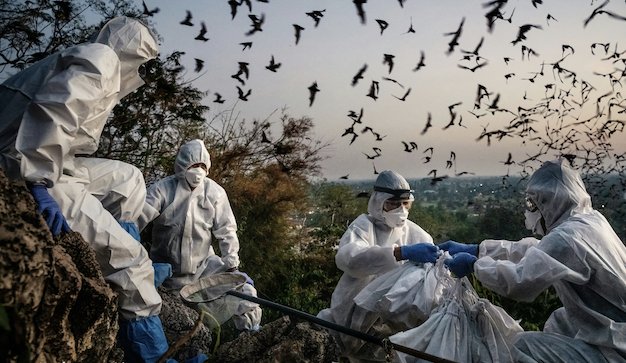
Frei is also standing up for bats, “the world’s most misunderstood mammals,” as the film calls them. Late in the film, we see footage of what look like thousands of the varmints swarming around the mouth of a cave. Frei was in among them with his camera.
“I was not afraid, I was fascinated. These are wonderful animals,” he enthuses. “They are more and more interesting for scientists…I consider my bats as the fourth protagonist [of the film].”
The director worked closely with a top-notch drone pilot in south-east Asia to shoot bats in full flight. “The bats are fascinating and, of course, not to blame for the viruses they might harbour.”
Ask Frei if this was an enjoyable documentary to work on and he makes it clear this is the wrong question. “I do quite a lot of workshops for young filmmakers and I tell them, look, if you come back from your shoot and say you had a great time, that sets off a little bit of an alarm in me.”
Films of his own like War Photographer and Blame are dealing with tough subject matter. “I am used to challenges and somehow I seem to like it but that doesn’t mean I enjoy it. But I feel deeply, deeply grateful for the time, the energy and the passion that I came actually spend on one topic. This is my feeling.”
He adds that it is certainly not enjoyable to film a death threat against Daszak. “It’s just crazy what people do. I am deeply concerned about the safety of my protagonist.”
Five years after the start of the pandemic, some audiences may feel wary about watching a film looking back in the rear-view mirror at a period they’d far rather forget. Even so, Frei was able to raise the budget through the Swiss subsidy system – and to maintain his full creative independence while making it.
Now, there is a hunger to see the film. With Trump again in the White House and arch-Covid conspiracy theorist Robert F. Kennedy Jr, author of ‘The Wuhan Cover-Up’ and now Secretary of Health doing his bit to “make America healthy again,” the film feels more topical than ever. After Nyon, it will screen at the It’s All True Festival in Brazil and Dok.Fest Munich – and far beyond as well.