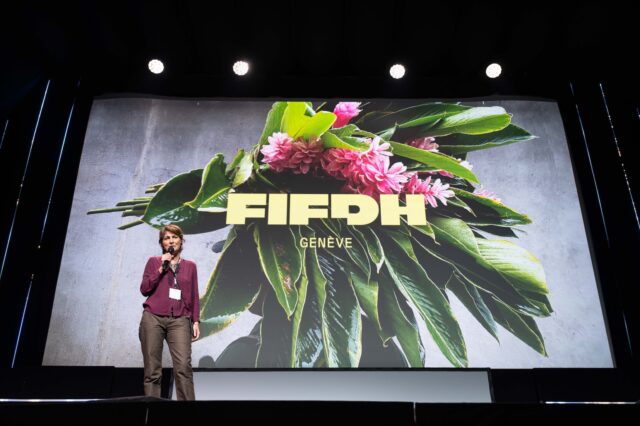
The 23rd edition of FIFDH (Geneva International Film Festival and Forum on Human Rights) saw packed auditoria and a viewing public in excess 31,000, while the 7th Impact Days welcomed over 200 Impact participants from 30 countries for global case studies, panels, pitches, training sessions and much-needed networking opportunities.
“What we learned with this seventh edition of Impact days…is that this connection between filmmakers – who have strong films about human rights and who have this ambition to go beyond traditional distribution with their films – and the ecosystem that we are so lucky to have here in Geneva (with its NGOs, international organizations and philanthropic foundations) is getting larger every year,” says FIFDH co-director Laura Longobardi. “It’s also a very strong network because we’ve been working with these people now for many years.”
“In a way we’ve been ‘teaching’ the NGOs through the seven years of Impact Days,” she adds. “This is a film that you can use for your campaign. This is a film that you can use with your stakeholders. This is a film that you can bring to the political institutions to show what’s really happening, and at the same [use] for a change of law, a change of structure.”
The competition element of the FIFDH festival is in its Creative (International Doc Comp) and Focus sections, the latter being “a competition of films which are still beautifully made, but where the focus is more on the content, on the theme,” says Longobardi. “And many times, also on the protagonists who are activists and who are doing something which is having an impact on their life or the life of their communities.”
The top prize in the International Documentary Competition went to Les Filles du Nil by Nada Riyadh Ayman El Amir, while There is Another Way by Stephen Apkon won the Focus Competition Vision for Human Rights award. “We’re proud to see that the winning films are not only powerful and innovative in cinematic terms, but also warrant international support given the filmmakers’ commitment and courage in confronting the many social, political, and economic challenges in their countries,” Longobardi stressed at the closing awards ceremony, together with co-director Laila Alonso Huarte.
In terms of Impact Days highlights, Longobardi first cites the Jenni Wolfson (Chicken & Egg Films CEO) keynote on the opening morning. “Impact Days is so successful, not only because it’s been the first, but because it happens in a city where you’d never have a really generalist audience in the room, because people here are working for NGOs, they’re working in international organizations, they’re filmmakers,” says Longobardi.
“Jenni has embodied all of those throughout her career because she was working for the UN where she was collecting evidence for putting up cases in front of the international court. She was with [the NGO] Witness, and is now with a funder [Chicken & Egg] that supports social justice films. So she knows the various ways into filmmaking, but also about impact and campaigns, and she could distil all of that into her keynote and speak to everybody [filmmakers, partners and funders] in the room…She speaks to this diversity, and still everybody could find something that matters for them, and that resonates to what they’re doing with their work.”
Longobardi also flags up the two debates that followed the screening of Havana Marking’s Undercover: Exposing the Far Right. The first panel was public-facing, asking how can we limit the Far Right’s influence to safeguard our institutions and values, while the second panel was hosted by Impact Days and interrogated how we can make challenging films within an increasingly polarised world. Participants were director Marking; Sandra Whipham, Co-Director of Doc Society; Anrike Visser, Thematic Lead, Corrupt Money Flows at Transparency International, and Impact producer Vivian Schröder.
“People are afraid to go into paths which are more controversial, so maybe they avoid to finance certain films or broadcast certain films,” Longobardi underlines the dilemma at the heart of the discussions. “So the two panels together were really giving 360 degrees of what’s going on in our societies, but also in the industry.”
She also welcomed the inaugural Swiss Focus Impact presentation of four projects ripe for advocacy investment. “You don’t necessarily need to have a huge international UN-oriented campaign,” the FIFDH chief said of the Swiss projects. “You can have a very local campaign and still be very successful because that’s what you want to reach with your film and with the story that it carries…We can also work with the offices within the city of Geneva, the Canton of Geneva, who are specifically working on local women’s rights or poverty or refugees.”
Longobardi explained to BDE that festival coffers are assured and that the festival’s editorial structure is 90% fixed for future years, taking into account shifts and evolution within the human rights and Impact industries. The operating budget is approximately CHF 2.6 million (€2.7 million), of which around 40% is public money, secured by 2-4 year agreements with institutions such as the city of Geneva, the Canton of Geneva and the Ministry of Foreign Affairs. The rest is secured from private foundations and philantropists. “We have very, very little corporate money. We haven’t really explored that yet,” she stresses. Impact Days accounts for 12-13% of the overall budget.
Doors may have closed on the 2025 public and professional event, but the edition stays open until the end of May, as the festival compiles activity and finance reports, and quizzes/debriefs both staff and participants (such as NGOs) on what they believe FIFDH delivered in terms of its effectiveness, what were its successes and what can be improved for future editions.
Longobardi feels, nevertheless, that this was an “exceptional” year. “The quality of the [Impact] pitches of the projects, their preparation was really, really outstanding. And I’m very proud of the selection and of the teams. The program was very well received and I think the people in the room, every year, come with a better understanding of what we are trying to do. Also the quality of the exchanges and the conversations is better because after seven years, you don’t have to start from the scratch – you can go straight to the point of what can we do together.”
There is no denying however that current global divisiveness was bound to be reflected within the Geneva-based, politically-engaged human rights festival.
“There are some topics which are still very hard, such as the conflict in the Middle East – it’s still very polarizing,” says Longobardi. “It’s hard to do things in a way that please everybody, which is, of course, not the aim of what we are trying to do. What we are trying to do is to denounce the violations in the field, and the violations of human rights and humanitarian law…I think that the general situation makes it harder to work in the human rights space because what was before [commonly] agreed – that there are limits that even wars cannot go beyond – is no longer something that everybody agrees with.”
“This is linked with a panel discussion we hosted about what can we say and what we cannot say. Are we saying only things that please everybody or are we ready to produce, to finance and to distribute and to show films which are not consensual? I think it’s important that we stand for that, and that we give space to independent storytelling that has the courage to denounce things which are happening close to us – or not close to us.”
Longobardi reveals that the festival received requests to de-programme some of the events during FIFDH, such as the screenings of A State of Passion by Carol Mansour and Muna Khalidi, which follows British-Palestinian reconstructive surgeon Dr Ghassan Abu Sittah within the emergency wards of Gaza’s Al-Shifa and Al-Ahli hospitals. These requests were politely declined.
“The film is denouncing the situation of systemic bombing of the health structure in Gaza, which is clearly a war crime, which should be consensually agreed is not something that you can do – even if you’re in a war. So that [film] was divisive. I think it’s a very worrying development, but that’s why it’s important that as a platform for distribution – but also for dialogue and exchange – that we stand for what we think it’s right,” Longobardi ends.