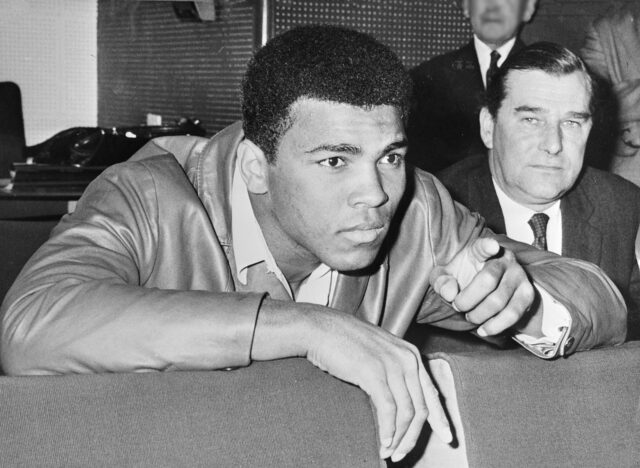
Everybody may think they know the story of Muhammad Ali (1942-2016) already. After all, he is the most famous boxer in history. He straddled the worlds of sport, celebrity and politics. He was as potent with words as he was with his fists. However, new film Cassius X: Becoming Ali, screening at the Glasgow Film Festival this week, offers insights into the ‘Greatest’ that many viewers will not have heard before.
The film, backed by the Smithsonian Channel and Screen Scotland, focuses on the period between 1959 and 1964, the years in which the young Cassius Clay (as he was known) not only found sporting glory but became heavily influenced by the Nation of Islam. This was the period in which the young Ali’s personality and his religious and political beliefs were being shaped.
The film is a true Scottish-American endeavour. It is produced by Glasgow-based Two Rivers Media in association with Paramount Media Networks and MTV Entertainment Studio. The director, Muta’Ali Muhammad is from Westchester County, New York, but he is drawing on the 2020 book, Cassius X: A Legend In The Making, by Scottish author, broadcaster and journalist Stuart Cosgrove.
“It’s a deep dive into a particular moment: a moment that curiously had not been written about that well or that often,” Cosgrove says.
“There’s a lot of great texture there. There is a lot of great action and excitement just culturally, let alone within the boxing ring,” Muta’Ali enthuses about Cosgrove’s book which he first read in 2020. “It was absolutely the blueprint. It allowed us to hit the ground running.”
The film deals with the run-up to Ali’s first fight with the then heavyweight champion Sonny Liston in Miami in February 1964. This bout has been chronicled exhaustively elsewhere but the filmmakers here don’t just concentrate on the boxing. Their focus is also on the music of the era and on Ali’s love affair with R&B star Dee Dee Sharp. (The relationship ended after Ali converted to the Muslim faith). They also look at the growing pains of the small town kid from Louisville, Kentucky, at a time when America itself was going through dramatic social and political change.
“We were very, very keen to bring [aboard] African-American people speaking about Ali and who knew him. Muta’Ali did a great job in identifying the people from within African-American popular culture who could give witness to this important period of time,” Cosgrove says. “In American broadcasting and documentary filmmaking, we’ve gone through a remarkable sea-change in attitudes, I think maybe even since Black Lives Matter, where there is a very, very strong expectation that your project will be diverse. In this case, we wanted to find really, really strong authorial voices that could talk from within the African-American experience.”
Among the figures talking on camera are James Small from the City College of New York, Damion Thomas from the National Museum Of African American History & Culture, and academic Mark Anthony Neal from Duke University. Meanwhile, Attallah Shabazz, the eldest daughter of Malcolm X, reflects very frankly about her father’s relationship with the legendary boxer.
The documentary also includes interviews with “some of the people who had written the best generic biographies of Muhammad Ali” (as Cosgrove puts it), among them Thomas Hauser [author of Muhammad Ali: His Life And Times), legendary journalist Jerry Izenberg and sportswriter Robert Lipsyte. The film combines its account of Ali’s heroics in the ring with an analysis of the politics of the time and of how the young boxer first became aware that Cassius Clay was a “slave name.”
In the film, the story of Ali’s friendship with American human rights activist Malcolm X is dealt with in depth. When Malcolm split from Elijah Muhammad, who led the Nation of Islam, Ali turned away from him.
“I think he [Ali] went with the organisation [the Nation of Islam], not the individual,” Cosgrove says of the painful rupture between Ali and Malcolm X.
The relationship with Dee Dee Sharp is also addressed in far more detail than in other films about Ali. “I personally looked at her story as an example where even love can stop short [when] people have religious differences,” Muta’Ali reflects. ”Personally, I’ve gone through that. I’ve dated women and suddenly they’ve found out that I was raised Muslim and it’s an issue. It informed my decision to make sure we talked about it.”
During his research into Ali, Cosgrove learned about the boxer’s friendship with his sparring partner, Jimmy Ellis. When Ali came over to London to fight UK boxer Henry Cooper for the first time, Ellis came with him. In the summer of 1965, they had an exhibition fight at Paisley Ice Rink outside Glasgow – and so Ali had a Scottish connection even then.
Another insight into Ali is that his first ever paying job was probably as a cleaner for a library in a nunnery in Louisville. The boxer’s most ardent early fans were the nuns he met there. He may have become a key figure in the Nation of Islam but continued to stay in touch with the nuns.
“When people commission books and documentary biographies, there is a very strong cultural pressure on you to tell the cradle to the grave story – to sweep over a person’s life. And if you sweep over a person’s life, you miss out on the detail of certain moments,” Cosgrove responds when asked why almost all the other Muhammad Ali books and biographies have overlooked the very rich material unearthed in the book and documentary. He had originally thought about writing something set in Miami in 1964 in the aftermath of the Bay of Pigs and that Ali could provide a “spine” for such a story.
There are (Cosgrove believes) still misconceptions about the Ali v Liston fight that persist to this day. One is that Liston was a brutal and thuggish figure, in the pay of mobsters, a “horrible, horrible character while Ali was this lovely genius boy.”
In fact, Liston was charismatic and highly intelligent, with a significantly higher IQ than Ali. When it came to promoting a fight – and to riling an opponent – Ali was prepared to use underhand tactics. He goaded Liston relentlessly. His characterisation of his opponent as a monster and a bully was, for some reason, accepted by the media.
Ali went on to become one of the most famous and best loved figures in sporting history. He may have been stripped of his heavyweight crown for refusing to be conscripted into the US army but that added to the mystique of his story. There’s obvious irony in the fact that mainstream white America eventually embraced him, even if he was part of the Nation of Islam.
“He’s regarded as a great athlete and as somebody who wasn’t afraid to speak up,” Muta’Ali says of his subject. “He had to go through a great deal of pain in his career and in his life…it has been suggested to me that after that, people accepted him.”
Cassius X: Becoming Ali has its world premiere on March 9th. Its UK release is being handled by Cosmic Cat and is set for October.