Gunda by Victor Kossakovsky
If there is one filmmaker who can cope with lockdown, it is Victor Kossakovsky. Put it to director of porcine-themed Gunda that you could put him in a shoebox and he’d be able to make a documentary, and he readily agrees.
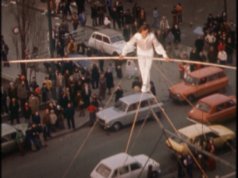
The Russian director (whose latest feature doc Gunda is a leading awards contender) is used to making movies in confined spaces. After all, his 2003 doc Tishe! was shot from the apartment window of the street in St Petersburg where he used to live.
It’s no surprise, therefore, to discover that Kossakovsky, who has been living in Berlin since 2008, has once again been training his camera on what he can spot from his own home.
“It’s amazing what I see!” the director says of the view from his window. “For example, I have a kindergarten [nearby] and a house for old people…old people do not have visitors. Children, what they did, is they are painting pictures. They place them in the [kindergarten] window.”
The old people, he continues, stand by their windows and then look towards the kindergarten and the children’s artworks.
The director has also noticed the changing behaviour of sparrows during lockdown. The little birds that would perch close by cafes and restaurants during normal times, looking for croissant crumbs to pick up, are now gathering together on people’s balconies.
Kossakovsky hasn’t decided yet what he will do with the footage he has been shooting. He will probably “keep it for himself” but hasn’t discounted using the material for a Tishe! 2 at a later date.
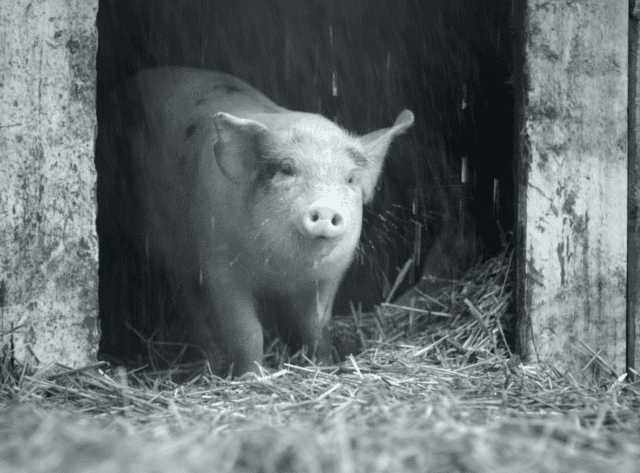
In the meantime, the filmmaker is heavily involved in the roll-out of his highly lauded doc Gunda, which follows a sow and her piglets on a farm in Norway.
When he was a kid growing up in Russia, the future director befriended a pig which he called Vasya. He was devoted to the animal, distraught when it was taken away to be slaughtered and has said in interviews that he has never eaten meat since then. He likes to joke that he was the “first vegetarian” in the Soviet Union.
His beautifully shot documentary highlights the intelligence and sensitivity not just of Gunda and her piglets but of cattle and chickens as well. Hollywood star and fellow animal rights activist Joaquin Phoenix is an executive producer. International sales are handled by Cinephil. Neon (the outfit behind Oscar winner Parasite’s North American success) is handling the US release.
One of the most remarkable facts about Gunda is that Kossakovsky shot only six hours of material – and yet was still to capture the most intimate and revealing moments in his porcine protagonists’ lives. The secret, he suggests, is exhaustive preparation. “It is coming from Dostoevsky. In his diary, he said even if I write about Raskolnikov [in ‘Crime And Punishment’] I have 700 pages, but I know about him 7000 pages,” he explains.
He has to know “a hundred times more” about a subject than he actually films. Before shooting Gunda, he spoke to the best informed scientists, read books and consulted recent research projects. He was amazed by what his discovered.
“I studied very well so I know already when to film, which parts of the day they [the pigs] are more active and which parts of the day they are doing what.”
Kossakovsky realised that Gunda was checking each of her piglets at least seven times a day, making sure they were healthy and moving them to spots where they were safest.
“A piglet, from the moment he is born, from the first time he drinks milk from the nipple, does not do any peeing in his own [bed]. From the first minute of his life, he goes to the corner,” Kossakovsky notes, drawing a comparison with human babies and their toilet training.
Since Gunda’s world premiere at the Berlinale last year, Kossakovsky has received hundreds of messages from viewers. “Many from young people are saying it has ‘changed my life. I cannot eat meat anymore.’” He has been at screenings of his films where kids have screamed, “why did no-one tell us?”, as they realise the brutality of the meat industry. “I’ve said ‘what can I do?’ Talk to your mum, talk to your father, talk to your family.’”
The Russian director is adamant that humans must stop slaughtering animals. Critics may counter that jobs will be lost and economic devastation will follow if humans curb their carnivorous tendencies. He points out, though, that exactly the same arguments were made at the start of the Industrial Revolution. “People were afraid. Oh, train! Oh, tractor! They were afraid they would lose jobs. Then, they realised it was maybe not bad. Then it was the technological revolution, the digital revolution…it’s time to realise we have to move.”
When it comes to Kossakovsky’s films, Europe’s gain has been Russia’s loss. He left his homeland because of the corruption he encountered from officials involved in the film industry. “On top of the corruption came ideology. You not only needed to be corrupted, you had to support Putin,” he remembers. “If you do not make patriotic films, you cannot get support from government.”
Since Kossakovsky came to live in the west, European and US financiers, sales agents and broadcasters have flocked to work with him. Thanks to projects like Aquarela and ¡Vivan las Antipodas!, he is recognised as one of the towering figures in world documentary. Nonetheless, he says, his films are hardly shown at all in Russia.
Yes, the director does have a couple major projects in the pipeline. Among these is Architecton, a modern architecture film which will focus on the work of a leading British architect. It is being produced by Heino Deckert’s ma.ja.de Filmproduktions alongside French outfit Les Films du Balibari, and is likely to start shooting soon, COVID permitting.
In the meantime, Kossakovsky has been using lockdown for some serious self-reflection. He wants to work out just what kind of films he now wants to make with the time he has left.
“I have some projects on the table. You can die any time, you can be ill…it might be your last project,” the Russian muses. He is therefore weighing up which docs are “really meaningful” and “what people need to know.”
“When everyone is suffering, when everyone is locked in his house, when everyone is in danger, does it really make sense to do what we do?. You just clean your table…you say no, no, no, this project doesn’t have value. I guess it is very healthy to measure your life. I am sorry for people who lost lives but for me personally, it was quite healthy to ask yourself what is the purpose of your life,” he ends on a philosophical note.