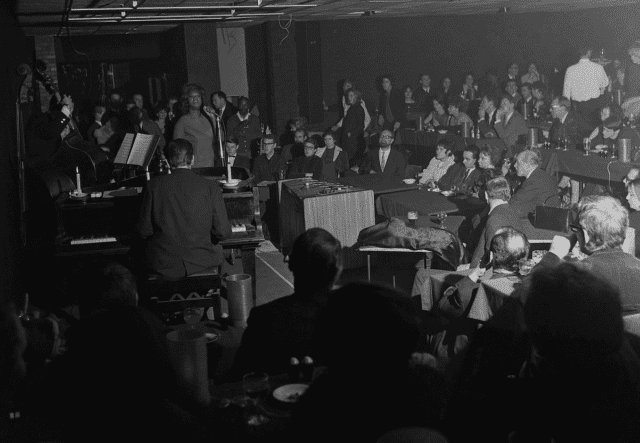
From the first note of Oliver Murray’s documentary, we get it. We feel that essential electric high that Ronnie Scott’s legendary jazz club always ran on.
The film opens with a performance by the Oscar Peterson trio. Their playing is burning, of course, but it’s the details which make it so good. Seeing the individual beads of sweat on Peterson’s forehead glinting in the stage light, hearing the percussive thud of his hand on the keys just before he strikes a note, observing the knowing glances between band-mates which mark the start of a new section, is what makes you feel like you’re there.
It is a film that sings and scats with astonishing jazz archive, and interlaced through the story of Scott’s life are glimpses of some of the most acclaimed appearances at the club from the likes of Cleo Laine, Buddy Rich, Nina Simone, Chet Baker and Ella Fitzgerald.
Together with business partner Pete King, Ronnie Scott rewrote the rules of jazz and performance. As a saxophonist and music-lover, opening a club meant that the onus was placed now on musicians and their new music rather than on mere commercial concerns and financial gain. This was a rarity and a game-changer for jobbing jazz musicians at the time; now there was a venue where the employer was onside for once. Ronnie was one of them, a fellow muso who reinforced their sense of community, and someone who loved the music like they did, especially when played live.
Scott was born into a Jewish family in London’s East End. His father Joseph Schatt, also a musician, left when Ronnie was just four years old. Scott was attracted to music from a very young age, trying various instruments before deciding on the saxophone – a choice, he believed, that was influenced by his absent father, also a saxophonist. As a teenager he made his name on the music scene, attending various jams and mixing with fellow young instrumentalists. By his mid 20s Scott was a pillar of the jazz community and a renowned sax player.
Playing in various swing bands, however, he grew to dislike how the scene functioned. Scott noticed the obsessive need on the part of promoters and venues to sell tickets – they valued the money over the music. The current, fresh jazz that Scott and his fellow musicians loved to play was shunned, considered too uncommercial.
These musicians didn’t want to play the stagnant swing tunes of 30 years before. Instead, they were inspired by what was going on in New York’s smoky clubs, such as the Three Dances or the Hickory House, as well as the exciting new sound of Charlie Parker and Dizzy Gillespie. A new scene was emerging whereby jazz players were more interested in creating music to listen to, no longer to dance to. It was out with Swing and in with Bebop.
For Scott and King, opening a jazz club in Soho was a labour of love; neither were in it for financial gain. As Scott himself said, “only an idiot would go into the jazz club business.” The decision was fuelled more by an urgency to keep the jazz scene current, and what’s more, they could do things their own way.
Pete was responsible, measured, and single-handedly managed the accounts, whilst Ronnie was a natural people person and compere out-front. They were each other’s perfect foil. Ronnie was often in financial difficulty due to gambling tendencies (or he would give away swathes of food or drink on the house), at which point the business-minded Pete would rein him in.
When, in the early days, the club became financially unfeasible Scott persuaded the UK and American Musicians’ Unions to allow their respective members to travel back and forth between countries. This was momentous for the club and, with huge American names now able to play at Ronnie Scott’s, it was continuously packed out. It became the epicentre for the best in modern jazz, with the likes of Oscar Peterson, Ella Fitzgerald, Count Basie and Miles Davis turning up regularly to play.
The club became a big success, but it soon became apparent that Scott was hugely unhappy. On stage, his sense of humour and passion for music was infectious, he was everyone’s best friend. But behind closed doors it was a different story. Scott’s manic depression surfaced, albeit seen mainly by the people closest to him. He had a lot of problems with self-esteem and underwent phases of shutting others out, and several suicide attempts studded this dark period. He rarely talked about his feelings, and every time he was low only music could save him. His wife Mary observes in the film, “that is how Ronnie dealt with every tragedy in his life… he played it out, through his music”.
Scott’s speedy and heart-breaking demise started with an agonising dental operation which destroyed his embouchure, meaning that he could no longer play his sax. Scott himself said that he was “useless” if he couldn’t play. His one glorious and meaningful means of communication had been taken away, which in turn eroded his passion for living. “When the time comes, and I can’t play to my satisfaction, I don’t belong here anymore,” he said. Ronnie Scott was found dead soon after in his Chelsea flat after overdosing on sedatives.
His death, of course, hugely affected many musicians, regulars of the club, friends and family. Twenty-five years on, the documentary illustrates just how integral Scott was to the music community, a man who single-handedly raised the bar of UK jazz both in performance and by creating a world-famous platform for forward-thinking, non-commercial music.
Director Murray does a terrific job in illustrating the sense of ambition and drive within the UK jazz scene, especially when Ronnie Scott’s club was as its peak. Scott himself was, of the course, the force behind this, and the film sensitively shows his many sides from quick-witted entertainer to reckless gambler, to passionate music-lover, to distant father.
This insightful and inspiring story is a must-see for anyone who has been, or is yet to go, to Ronnie Scott’s at 47 Frith Street, Soho. As George Benson said: “Keep this place alive… it impacts everybody who walks through that door.”
Country: UK
Running time: 104 minutes
Director: Oliver Murray
Writer: Oliver Murray
Cinematographer: Ben Thomas
Editor: Paul Trewarthur
Music: Alex Heffes
Producer: Kirsty Bell.
Co-Producer: Oliver Murray
Executive Producer: Phil McKenzie
Language: English
Sales Agent: Abacus Media Rights